How to Store Artichokes: Fridge Life, Freezing, and Spoilage Signs
Globe artichokes lose quality fast once they leave the plant. This guide covers how to store artichokes from the market or garden, and how long each form lasts. It also covers freezing the hearts and spotting spoilage.
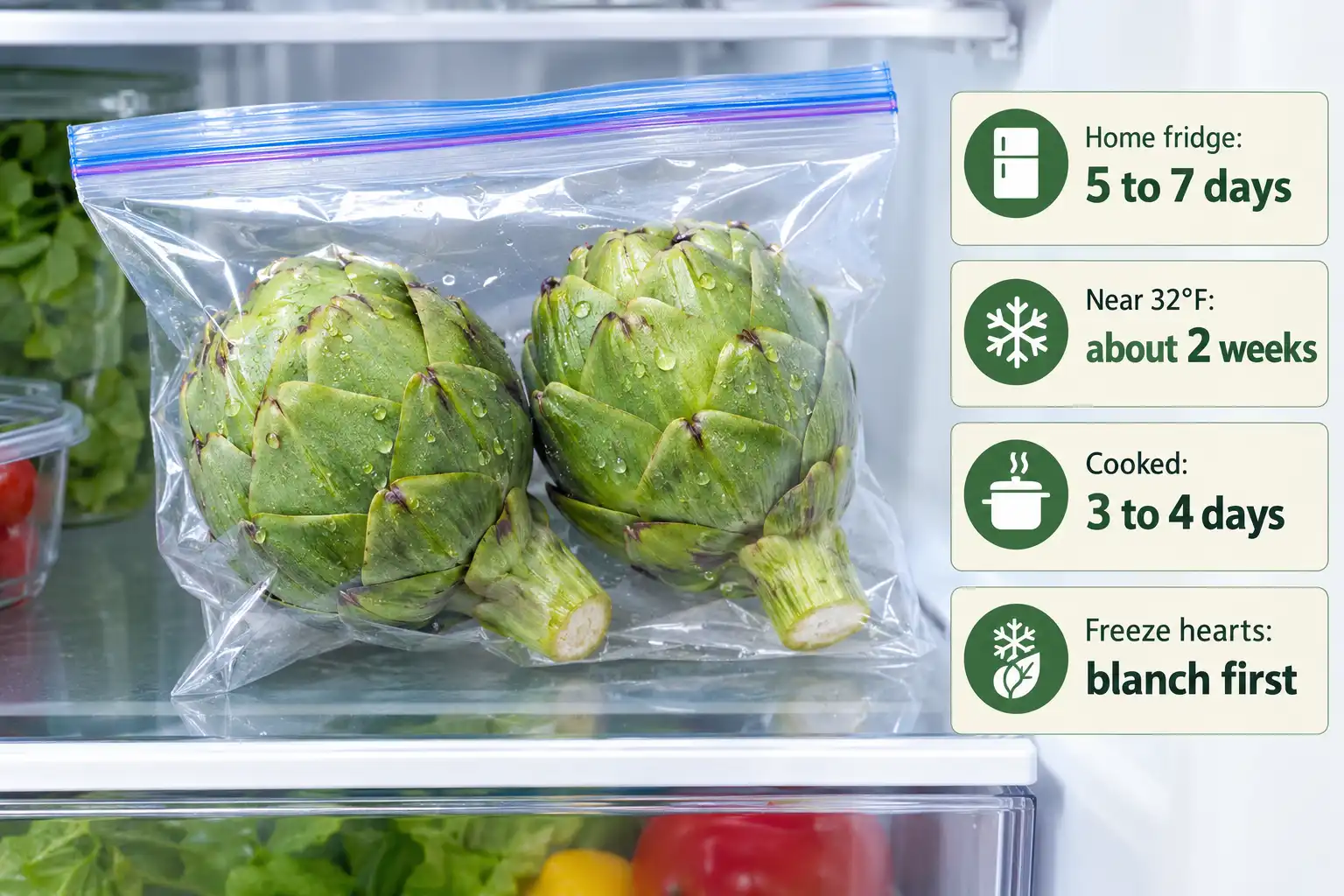
Store artichokes cold and humid. Trim a thin slice off each stem, sprinkle with water, and seal them in an airtight bag in the coldest part of the fridge. SDSU Extension gives them 5 to 7 days.
How Long Do Artichokes Last in the Fridge?
Fresh globe artichokes last about 5 to 7 days in a typical home fridge. If you can hold them close to 32°F, they can keep about 2 weeks.
The sources differ because they assume different temperatures. SDSU Extension says trimmed, moistened artichokes in an airtight bag keep 5 to 7 days. Texas A&M AgriLife Extension puts good-quality globe artichokes at about 2 weeks, but only near 32°F with humidity over 90%. The UC Davis Postharvest Technology Center gives commercial storage at 32°F under 21 days. Even there, look and flavor decline quickly.
So which figure fits your kitchen? The USDA Food Safety and Inspection Service sets 40°F or below as the safe fridge temperature. Unless your fridge runs close to 32°F, it is warmer than the conditions behind the longer figures. Plan on the shorter window, then.
How Long Do Artichokes Last in Each Form?
| Artichoke form | Storage conditions | How long | Source |
|---|---|---|---|
| Whole, fresh | Stem trimmed, sprinkled, airtight bag, home fridge | 5 to 7 days | SDSU Extension |
| Whole, fresh | Near 32°F, humidity over 90% | About 2 weeks | Texas A&M AgriLife Extension |
| Whole, fresh | Commercial cold room, 32°F, humidity over 95% | Under 21 days | UC Davis Postharvest Technology Center |
| Cooked | Covered container, fridge at 40°F or below | 3 to 4 days | USDA FSIS |
| Cooked | Freezer | 3 to 4 months for best quality | USDA FSIS |
Work Out Your Use-By Day
Count forward from the day the artichokes come home or come off the plant:
- Fresh, in a typical fridge: that day plus 5 to 7 days (SDSU Extension)
- Fresh, held near 32°F: that day plus about 14 days (Texas A&M AgriLife Extension)
- Cooked: the day you cook them plus 3 to 4 days (USDA FSIS)
For example, artichokes bought on a Saturday should be cooked between Thursday and the following Saturday. If you steam them on Sunday, finish the leftovers by Wednesday or Thursday.
Do Artichokes Need to Be Refrigerated?
Yes. Refrigerate artichokes the day you buy or pick them. UC Davis lists 32°F and humidity above 95% as ideal for globe artichokes. It also notes that gray mold and bacterial soft rot can become storage problems when temperatures run above that mark.
A countertop offers neither cold nor humidity, and those two things are what keep artichokes fresh. So leave them out only while you prep and cook.
One common tip doesn’t apply here, though. UC Davis rates artichokes as low in sensitivity to ethylene, the ripening gas that apples and bananas give off. That means you don’t need a separate drawer to keep them away from fruit.
How to Store Artichokes in the Fridge
Follow these steps the day the artichokes come home. Each one keeps them cold or keeps moisture in.
- Leave them whole. Don’t trim the leaves or cut into the bud until cooking day. Cut surfaces darken quickly once air reaches them.
- Trim the stem end. SDSU Extension advises cutting off the bottom of the stem before storage. This removes the dried end left from harvest.
- Sprinkle with water. SDSU suggests a light sprinkle. It adds humidity inside the bag, and UC Davis puts ideal humidity above 95%.
- Seal them in an airtight bag. The bag, also part of SDSU’s method, holds that moisture in so the leaves don’t dry out.
- Use the coldest spot. Set the bag where your fridge runs coldest. FSIS caps safe fridge temperature at 40°F, and artichokes do better as you get closer to 32°F.
- Don’t let them freeze. UC Davis notes freezing injury starts at 29.9°F. If the back wall of your fridge ices up, move the bag forward.
- Check every few days. Cook any artichoke that starts to open or feels lighter than the rest.
Storing Artichokes From Your Garden
Home-grown artichokes store best when you pick them at the right stage. In Santa Clara County, California, UC Master Gardeners advise cutting the central bud first. Pick it while the scales are tightly closed and the globe is about the size of an orange. The stem should still be supple 2 inches below the globe. Buds that have begun to open turn tough.
There, artichokes grow as a perennial crop that returns each year, with a spring crop and a fall crop.
Next, leave a short stub of stem. UC Davis notes commercial harvests leave 1 to 1.5 inches of stem below the base. That stub gives you a clean end to trim before storage.
Then chill the buds fast. UC Davis lists hydrocooling, forced-air cooling, and package icing as the usual commercial ways to cool artichokes after harvest. Your fridge does that job at home. So bag the buds the same day, and count your 5 to 7 days from harvest day.
Each flowering stem also carries several smaller buds below the top one, according to UC Master Gardeners. Store these side buds the same way. SDSU Extension suggests small artichokes for stews and casseroles.
How to Choose Good Artichokes
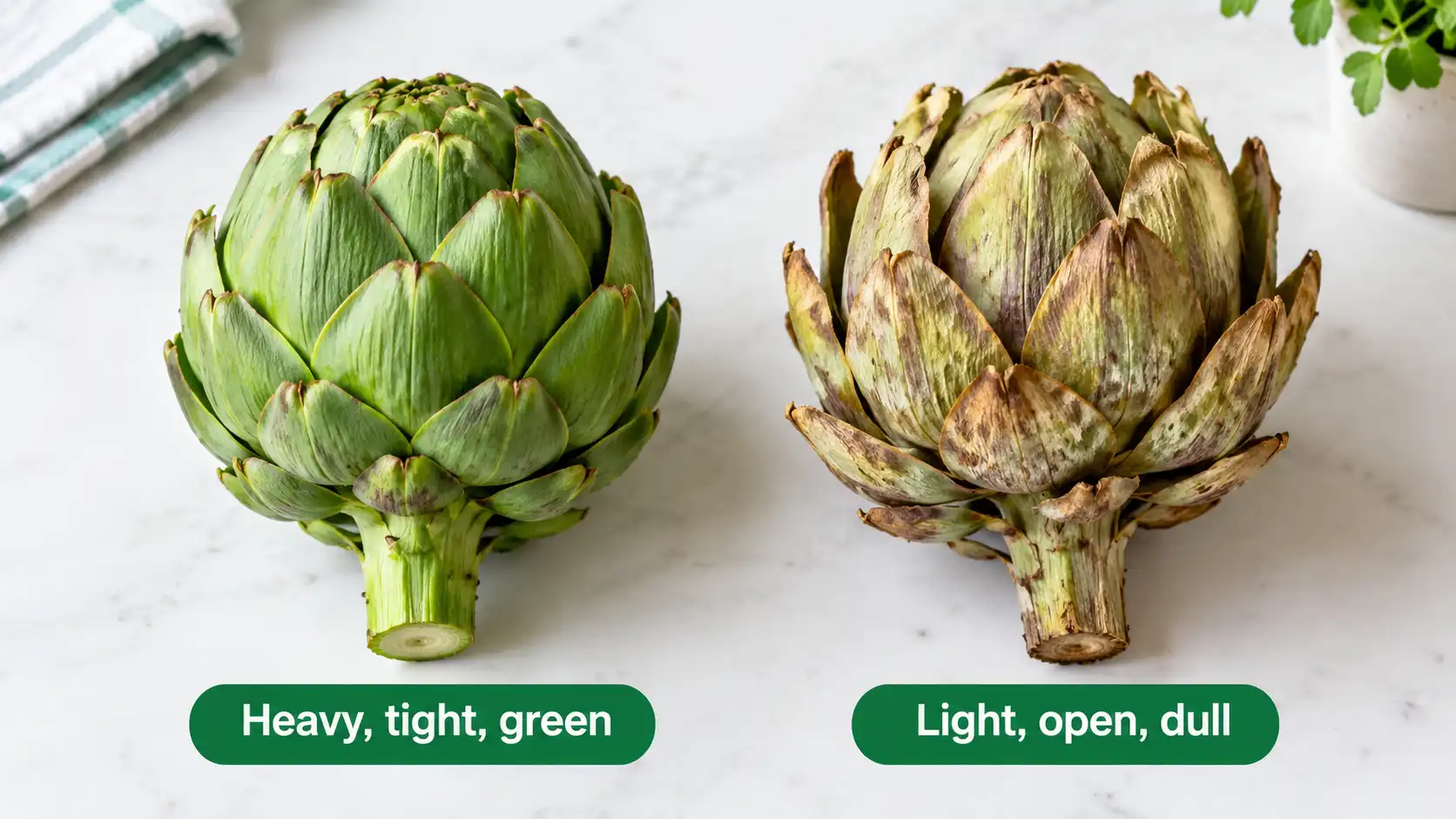
Choose artichokes that feel heavy for their size, with tight, compact leaves. Texas A&M AgriLife Extension also looks for dark green color with no blemishes. It says to skip any that are starting to open. SDSU Extension adds firmness and no black bruises.
| What to check | Good sign | Pass on it |
|---|---|---|
| Weight | Heavy for its size | Light for its size |
| Leaves | Tight and compact | Starting to spread open |
| Color | Even color for the variety | Black bruises or a dull brownish cast |
| Stem cut | Smooth and even | Ragged or damaged |
UC Davis describes overgrown buds the same way. They have an open, spreading shape and tough, stringy, brownish leaves. Inside, the center turns fuzzy and pink to purple.
Color needs one caution. SDSU’s sheet warns against a purple tint, but that applies to green types. Purple varieties such as Violetto Precoce, which UC Master Gardeners list for Santa Clara County, are purple by nature.
Winter artichokes may also show bronzed, blistered outer leaves. UC Davis traces this to light frost in the field. The produce trade even treats it as a sign of high quality. So a little bronze on a winter artichoke is no reason to pass it up.
How to Tell If an Artichoke Is Bad
Throw out an artichoke with fuzzy gray growth, soft slimy patches, a foul smell, or a black, jelly-like heart. Dry, spreading leaves mean it’s aging, so cook it soon rather than tossing it.
| What you see | Likely cause | What to do |
|---|---|---|
| Bronzed, blistered outer leaves | Light frost in the field | Cook as usual |
| Feels light, leaves spreading | Moisture loss and age | Cook it soon |
| Brown or black bruises on a few leaves | Handling damage | Pull off damaged leaves and cook soon |
| Fuzzy gray growth | Gray mold | Throw it out |
| Soft, slimy, foul-smelling patches | Bacterial soft rot | Throw it out |
| Water-soaked leaves, brown to black jelly-like heart | Severe freezing injury | Throw it out |

UC Davis names gray mold and bacterial soft rot as the main storage rots of artichokes. It also notes that other fungi can grow on cut stems or leaves during long cold storage. Severe freezing injury looks different: the leaves turn water-soaked, and over time the heart becomes brown to black and gelatinous. Bruising, it adds, is very common when artichokes are handled roughly.
Cooked artichokes follow the calendar instead. FSIS limits refrigerated leftovers to 3 to 4 days.
How Long Do Cooked Artichokes Last?
Cooked artichokes last 3 to 4 days in the fridge, or 3 to 4 months frozen for best quality. Those are the general leftover limits from USDA FSIS.
Get them cold quickly. FSIS says to refrigerate cooked food within 2 hours, or within 1 hour when the air is above 90°F. Then cover them or seal them in airtight containers. FSIS notes this keeps moisture in and stops leftovers from picking up odors from other food.
Frozen leftovers stay safe indefinitely, according to FSIS, but they lose moisture and flavor the longer they sit. So write the date on each container.
How to Freeze Artichoke Hearts
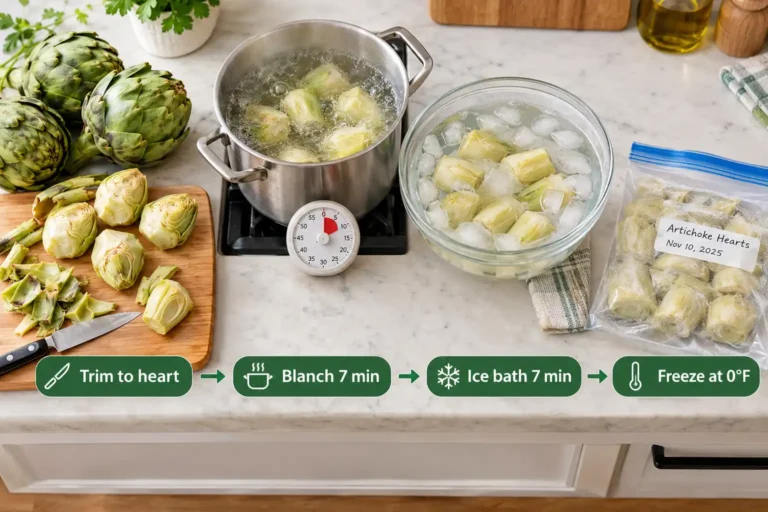
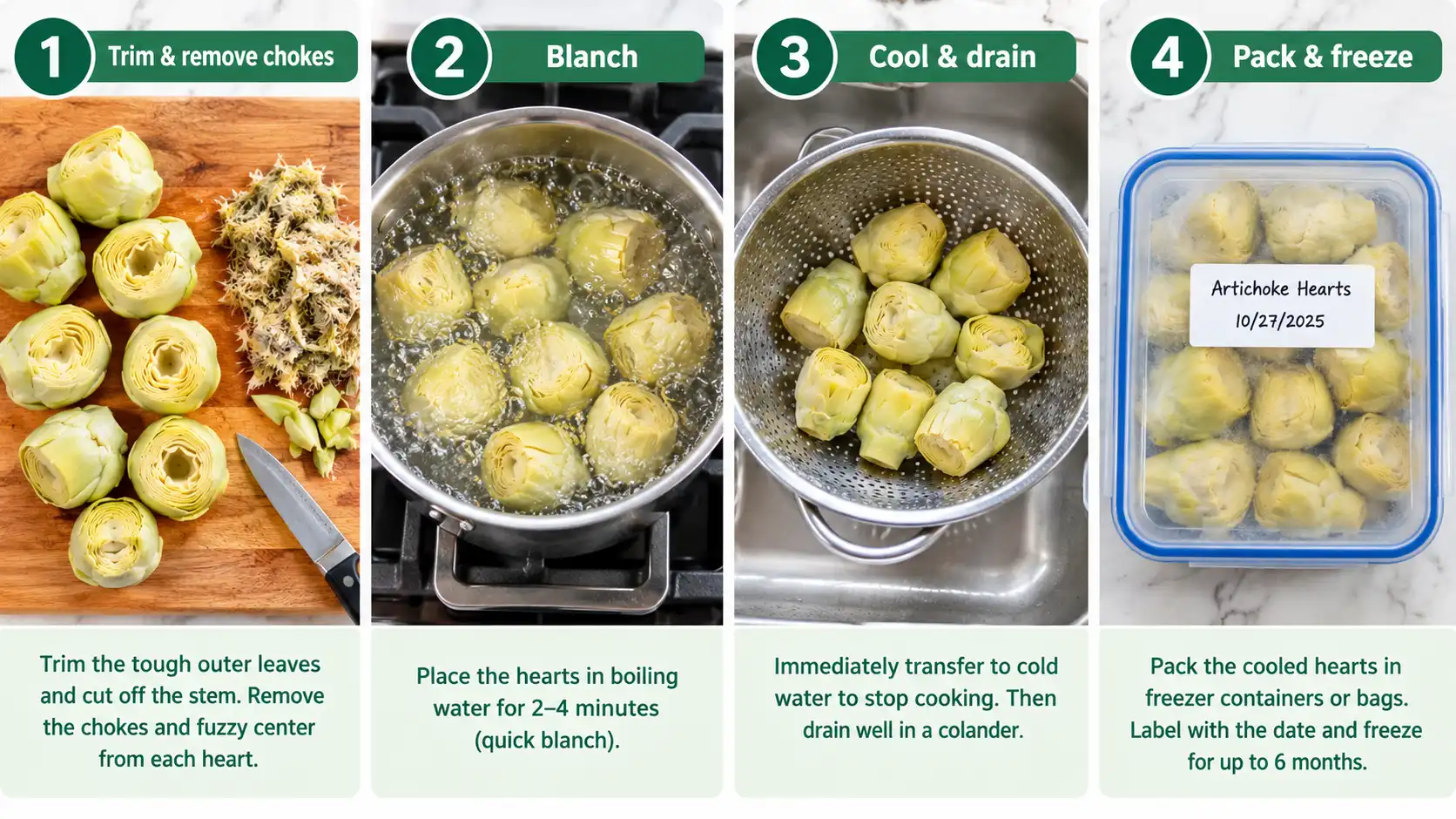
Freeze the hearts, not whole buds, and blanch them first. The National Center for Home Food Preservation method appears in full on an SDSU Extension artichoke preservation sheet. It covers hearts only, after a water blanch:
- Choose green artichokes with leaves that cling tightly.
- Remove all the leaves and the fuzzy choke. The base that’s left is the heart.
- Cut the stem off below the heart and trim any woody parts.
- Wash the hearts in cold water and drain.
- Blanch them in boiling water for 7 minutes.
- Cool, drain, and pack them into freezer containers with no headspace.
- Seal, label with the date, and freeze.
Blanching slows the enzymes that dull color and flavor in the freezer. The tested method includes it every time, and it does not cover freezing raw artichokes. So follow the sheet as written rather than skipping steps.
Can You Can Artichokes at Home?
Only with a tested recipe, and the tested artichoke pickle on that SDSU sheet uses Jerusalem artichokes, not globe artichokes. UC Marin Master Gardeners describe Jerusalem artichokes as tubers from a sunflower relative, so they are a different crop.
Globe artichokes are a low-acid vegetable. Don’t swap them into the Jerusalem artichoke pickle. And don’t keep marinated or oil-packed artichokes from an untested recipe on a pantry shelf. Low-acid foods canned without a tested process risk botulism, the same reason winter squash has strict canning rules. Before canning anything, check the National Center for Home Food Preservation for a current tested recipe.
Frequently Asked Questions
Can you leave artichokes on the counter?
Only while you prep and cook them. UC Davis lists 32°F and humidity above 95% as ideal for artichokes, and a countertop offers neither, so refrigerate them the day you buy or pick them.
Can you freeze raw artichokes without blanching?
The tested method doesn’t cover it. The National Center for Home Food Preservation freezes artichoke hearts only after a water blanch, which slows the enzymes that dull color and flavor during frozen storage.
Do Jerusalem artichokes store the same way?
No, they’re tubers and keep longer. UC Marin Master Gardeners say sunchokes store best left in the ground, and harvested tubers keep in a plastic bag in the fridge crisper for up to 3 weeks.
How long do opened jars of artichoke hearts last?
Go by the jar’s label. The maker’s “refrigerate after opening” directions and date set the limit, because packing liquids differ by brand, so keep the opened jar sealed and cold.
Are artichokes with brown outer leaves safe to eat?
Usually, yes. UC Davis says bronzed, blistered outer leaves on winter artichokes come from light frost in the field, but throw out any artichoke with mold, slime, or a black, jelly-like heart.
Can you refreeze cooked artichokes after thawing?
Yes, if they thawed in the fridge. USDA FSIS says leftovers thawed in the refrigerator can safely go back in the freezer, or you can eat them within 3 to 4 days.
The Practical Takeaway
Keep fresh artichokes whole, cold, and humid. Trim the stem, sprinkle with water, seal the bag, and cook them within 5 to 7 days. For anything you can’t use in a week, blanch and freeze the hearts with the tested method. Every crop has its own storage needs, and the harvest and preserving guides cover them crop by crop.