
Vegetable gardening: how to plan, plant, and grow your own food
Vegetable gardening comes down to sun, soil, and water. Get those three right and you can grow real food in a single raised bed. These guides take you from choosing a spot to picking your first ripe tomato.
Every number on this site comes from university extension services or USDA, and the source is named right next to it.
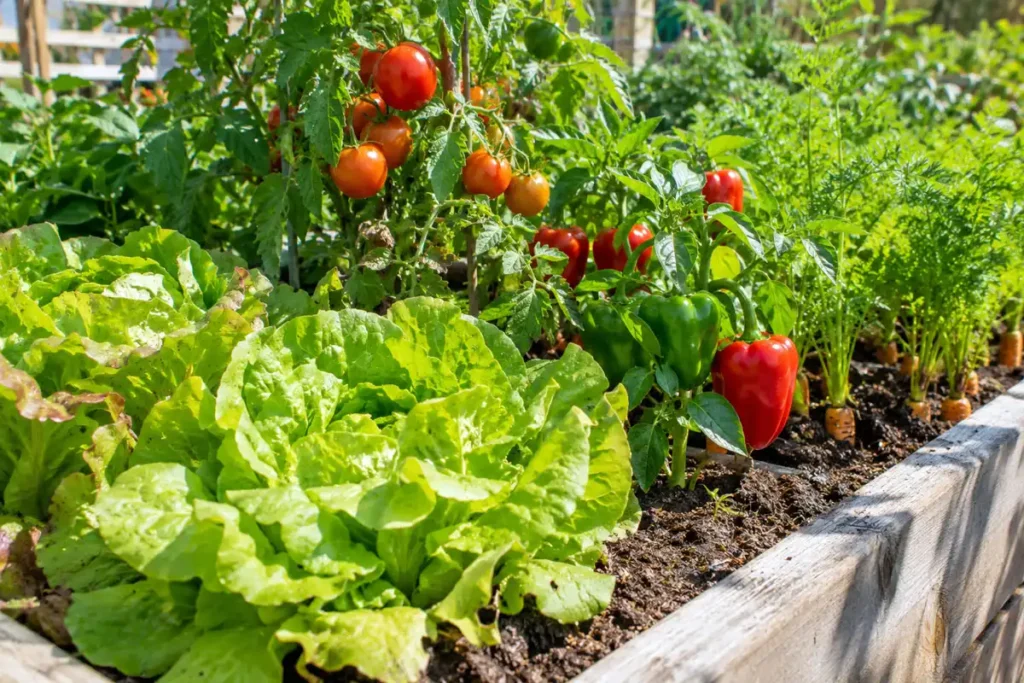
What is vegetable gardening?
Vegetable gardening is growing food plants at home, in the ground, in raised beds, or in containers. It covers the whole season: choosing a site, preparing the soil, planting, care, and harvest.
It doesn’t take much room. K-State Research and Extension notes that even a 100-square-foot garden, about 10 by 10 feet, can grow a good share of the vegetables a family of four eats.
Gardening for newbies: why first gardens struggle
First gardens usually run into the same few problems. They’re too big, too shady, or too far from a hose. Sort those out before you plant anything, and the rest gets much easier.
The checklist covers the basics most beginners skip.
Best things to grow in a garden when you’re new
Start with fast, forgiving crops. Every vegetable below appears on Iowa State Extension’s list of easy vegetables. Harvest times come from K-State’s planting guide.
| Vegetable | How to start it | Season | Days to first harvest |
|---|---|---|---|
| Radishes | Seed in the garden | Cool | 25 to 40 |
| Leaf lettuce | Seed or transplant | Cool | 45 to 65 |
| Kale | Seed or transplant | Cool | 55 to 65 |
| Potatoes | Seed potato pieces | Cool | 70 to 90 |
| Bush beans | Seed in the garden | Warm | 50 to 60 |
| Zucchini | Seed in the garden | Warm | 45 to 55 |
| Tomatoes | Transplant | Warm | 52 to 120 after transplanting |
| Peppers | Transplant | Warm | 50 to 110 after transplanting |
Tomatoes are the most popular crop, but UGA Extension says they can be fussy for beginners in hot, humid weather. They’re grown from transplants, so buy sturdy plants in your first year.
Sources: Iowa State University Extension; K-State Research and Extension, Vegetable Garden Planting Guide (MF315); UGA Extension.
How to plan a vegetable garden
A plan on paper saves money and mistakes. Illinois Extension suggests mapping where each crop will go before you plant a single seed.
Pick the sunniest spot
Watch it through a whole day. You want 6 to 8 hours of direct sun and a hose within reach.
Choose beds or rows
Keep beds no wider than 4 feet. Oklahoma State Extension notes most adults can reach only about 2 feet in from each side.
List what you’ll grow
Start with crops from the easy list, and check how much room each one needs on its seed packet.
Put tall crops on the north side
Tall plants go north, medium ones in the middle, and low ones south, so nothing shades its neighbor (UF/IFAS).
Plan the second crop
When spring lettuce finishes, a summer or fall crop can take its spot. Note what grew where, so you can rotate next year.
When to start growing vegetables
Plant by your average last spring frost date, not by the calendar. Cool-season crops go in before that date. Warm-season crops wait until after it, once the soil has warmed.
Colorado State University Extension times planting by how much cold a crop can take, and K-State’s planting guide rates each crop’s frost tolerance. Here’s how they line up.
Soil temperature matters as much as frost. UConn Extension says tomatoes, peppers, and eggplant need soil of at least 60°F. Oregon State’s germination data shows bean and pepper seed barely sprouts in colder soil.
Sources: Colorado State University Extension, Vegetable Planting Guide; K-State Research and Extension (MF315); UConn Extension.
Zone 6b planting schedule
Zone 6b means average winter lows of 5 below zero to 0°F on the USDA Plant Hardiness Zone Map. Zones describe winter cold, not frost dates, so two towns in 6b can plant on different days.
Much of central Missouri is zone 6b. The chart shows University of Missouri Extension’s planting windows for that region. Slide them earlier or later to match your own last frost date.
Swipe the chart sideways to see the whole season.
Starting seeds indoors? University of Minnesota Extension allows about 5 to 6 weeks for tomatoes and about 9 weeks for peppers. For a May 10 tomato planting, sow seeds around the first of April. Sow pepper seeds in early March.
Sources: University of Missouri Extension, Vegetable Planting Calendar (G6201); University of Minnesota Extension, Starting seeds indoors.
How to sow seeds
Most vegetables can be sown straight into the garden. A few habits cover nearly all of them.
- Get the depth right. If the packet doesn’t say, sow a seed about twice as deep as it is wide, per University of Minnesota Extension.
- Wait for warm enough soil. A soil thermometer tells you more than the air temperature does.
- Keep the seedbed evenly moist until seedlings show.
- Sow extra, then thin. K-State notes you usually need more seeds than the final number of plants.
How long do seeds take to germinate?
Anywhere from 2 days to several weeks, and soil temperature decides most of it. Tomato seed takes about 43 days to come up in 50°F soil, but about 6 days at 77°F.
| Crop | Lowest soil temp | At 50°F | At 68°F | At 77°F |
|---|---|---|---|---|
| Lettuce | 35°F | 7 | 3 | 2 |
| Radish | 40°F | 11 | 4 | 3 |
| Spinach | 35°F | 12 | 6 | 5 |
| Pea | 40°F | 13 | 7 | 6 |
| Onion | 35°F | 13 | 5 | 4 |
| Beet | 40°F | 17 | 6 | 5 |
| Carrot | 40°F | 17 | 7 | 6 |
| Sweet corn | 50°F | 22 | 7 | 4 |
| Tomato | 50°F | 43 | 8 | 6 |
| Bean | 60°F | won’t sprout | 11 | 8 |
| Cucumber | 60°F | won’t sprout | 6 | 4 |
| Pepper | 60°F | won’t sprout | 12 | 8 |
Days for seedlings to appear from seed sown 1/2 inch deep. Source: Oregon State University Extension, from research by J.F. Harrington at UC Davis.
Growing veg seedlings indoors
Starting your own seedlings gives you more varieties and an earlier start. University of Minnesota Extension suggests these times indoors before planting out.
Weeks indoors before planting out
- Skip the windowsill. It runs cold at night and hot by day, and seedlings stretch.
- Use lights 2 to 4 inches above the plants for 12 to 16 hours a day.
- Use a seed-starting mix, not garden soil. It’s sterile, light, and free of weed seeds.
Planting a vegetable garden: how to plant in the ground
Seedlings and bought transplants go in the same way. These steps protect roots and stems during the move.
Harden off first
Over about two weeks, give seedlings a little more time outside and a little more sun each day.
Pick your moment
Plant on a cloudy day or late in the afternoon, after the sun passes its peak.
Set the depth
Most transplants go in at the depth they grew in the pot. Bury tomatoes an inch or two deeper so the stem can root.
Hold the leaves, not the stem
A plant can replace a torn leaf, but a crushed stem may kill it.
Firm and water
Press soil gently around the roots and water right away.
Trim paper or peat pots
Tear off any rim above the soil so it doesn’t wick water away from the roots.
Sources: University of Minnesota Extension; University of Maine Cooperative Extension (tomato planting depth).
Best soil for vegetable gardens
The best soil for vegetable gardens is loose, drains well, and holds plenty of organic matter. Virginia Tech says vegetable beds do best with 5 to 10 percent organic matter. Most vegetables like a pH between 6.0 and 7.0.
- Test before you fix. A soil test shows pH and nutrients, and lead or other metals if you ask (Illinois Extension).
- Retest every few years. K-State suggests every 3 to 4 years. Nebraska Extension says every fifth year is enough unless you add a major amendment.
- Building a raised bed? Bagged garden soil means no digging, per UConn Extension.
- Add organic matter. Compost helps sandy soil hold water and helps clay drain.
Where vegetables like their soil pH
What fertilizer is best for vegetable gardens?
The best fertilizer is the one your soil test calls for. Virginia Tech Extension calls a soil test the best way to know what your garden needs.
A 10-10-10 bag holds 10 percent each of nitrogen, phosphate, and potash, by weight.
- Split the nitrogen. It washes out of soil, so New Mexico State suggests some before planting and the rest as a side dressing once plants are growing.
- More isn’t better. Too much nitrogen makes tall, leafy plants that produce little, per K-State.
- Don’t overdo compost either. Oregon State Extension warns gardeners can pile on too much, so test before adding more each year.
We don’t print one-size fertilizer amounts. Your soil test report gives amounts for your own garden. Source: Virginia Cooperative Extension, Fertilizing the Vegetable Garden.
Is Preen safe for vegetable gardens?
Some Preen products are labeled for vegetable gardens and some aren’t, so the answer depends on the bag.
Trifluralin. Labeled for certain listed vegetables, used exactly as the label directs.
Some vegetables, as directedIts label rules out vegetable gardens.
Not for vegetable gardensCorn gluten meal, made for food gardens. NDSU Extension says to keep it off areas you’ve just seeded.
Made for vegetable gardensAll of them stop seeds from sprouting, vegetable seeds included, and none kill weeds that are already up. Iowa State research found corn gluten stops new seedlings from forming roots. Mulch is the chemical-free way to block weeds.
Sources: Preen Garden Weed Preventer label (EPA Reg. No. 961-280); NDSU Extension; Iowa State University; Washington State University Extension.
Irrigation in the garden: how much water vegetables need
Most vegetable gardens need about 1 inch of water a week, rain included, per University of Minnesota Extension. Water deeply and less often. UGA Extension notes that frequent, light watering keeps roots shallow.
- Match your soil. Sandy soil does best with half an inch twice a week. Clay or loam can take it all at once.
- Water in the morning so leaves dry fast. Leaves that stay wet overnight invite disease (Michigan State Extension).
- Use drip lines or soaker hoses. They put water at the roots and keep leaves dry.
- Mulch 1 to 3 inches deep to hold moisture between waterings.
- Check a rain gauge before you water. It tells you what the sky already gave.
What 1 inch a week means
| One 4 by 8 foot bed (32 sq ft) | about 20 gal |
| 10 by 10 foot garden (100 sq ft) | about 62 gal |
| 20 by 30 foot garden (600 sq ft) | about 372 gal |
Companion planting: which plants really help each other
Some pairings help, but most companion charts promise more than the research shows. LSU AgCenter says studies generally don’t back companion planting claims. Here’s what does hold up.
| Pairing | The claim | What research found | Verdict |
|---|---|---|---|
| Sweet alyssum near lettuce | Draws insects that eat aphids | In UC research, alyssum meant more hoverfly larvae and fewer aphids in lettuce | Supported |
| Legumes as a cover crop or underplanting | Cuts fertilizer needs | Mississippi State Extension lists this among companion practices that work | Supported |
| Nasturtiums | Trap crop that pulls aphids and flea beetles away | Arizona Extension recommends them as a trap crop | Some support |
| Mixed plantings | Confuse pests | Varied heights, shapes, and colors can confuse some insects, per Mississippi State | Some support |
| Marigolds beside vegetables | Stop root-knot nematodes | Only work as a solid cover crop turned into the soil before planting, not as a companion (LSU AgCenter) | Not as a companion |
Use companions for what they do well: feeding helpful insects and pulling pests away from your crops. They don’t replace good spacing, rotation, and regular checks.
Sources: LSU AgCenter; University of Arizona Cooperative Extension; Mississippi State University Extension.
Garden insect control: start with the gentlest step
Most insects in a vegetable garden are harmless or helpful. Integrated pest management, or IPM, means naming the problem first and then using the mildest fix that works, as UConn Extension describes it.
Name the insect
Look at the insect and the damage. Your county extension office can help identify it.
Check every week
Look under leaves, and count helpful insects too. A few pests keep their predators around.
Pick, block, and trap
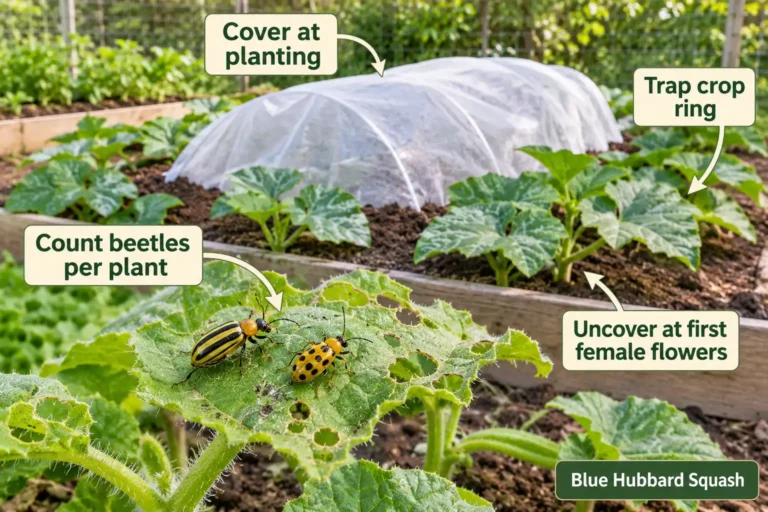
Hand-pick beetles and use row covers. Take covers off squash and cucumbers when they flower so bees can reach them.
Bring in helpers
Flowers like sweet alyssum feed hoverflies, and their larvae eat aphids.
Spray last, and gently
Insecticidal soap works on soft-bodied insects like aphids. Follow the label, and don’t spray open flowers where bees are working.
We don’t publish pesticide rates. The product label sets them, and the label is the law. Sources: UConn Extension; University of Arizona Cooperative Extension.
Latest guides

Garden Pests
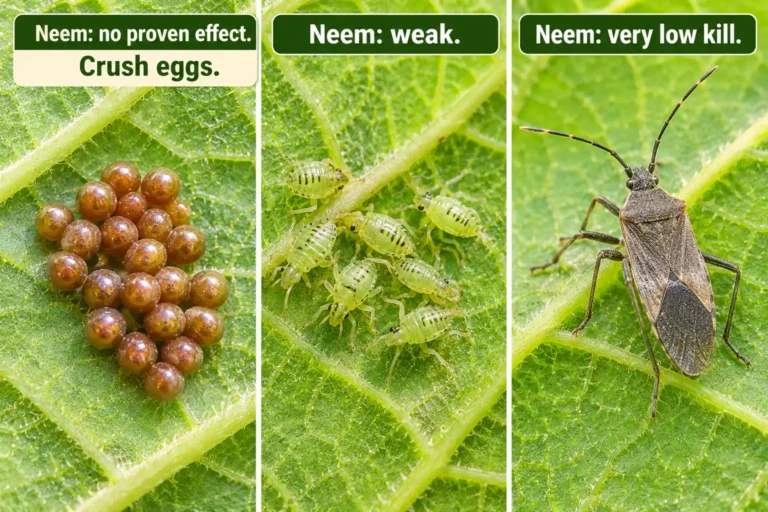
Does Neem Oil Kill Squash Bugs? What the Research Shows
Squash bugs suck sap from zucchini, pumpkins, and winter squash, and neem oil is a common organic spray for them….
November 8, 2026
Garden Pests
How to Get Rid of Cucumber Beetles Before They Spread Bacterial Wilt
Knowing how to get rid of cucumber beetles matters most in the first weeks after planting. That’s when they chew…
November 8, 2026
Garden Pests
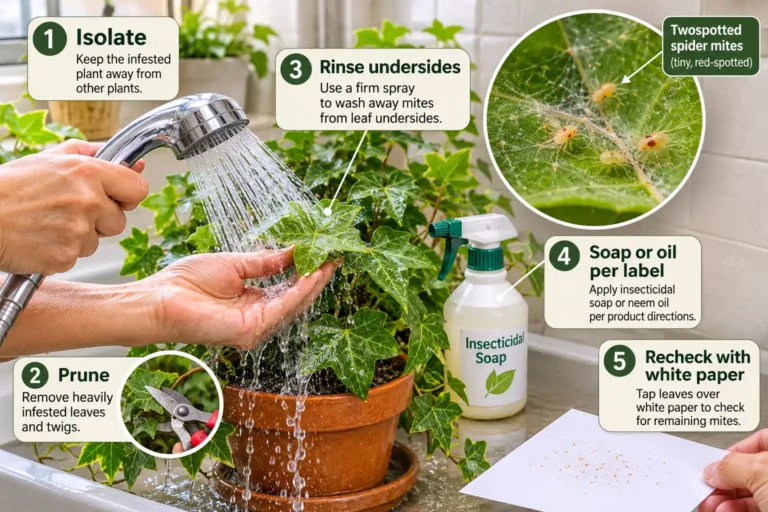
How to Get Rid of Spider Mites on Houseplants: A 5-Step Plan
Pale speckles and fine webbing on a houseplant are classic signs of spider mites. These tiny pests multiply fastest in…
November 6, 2026
Natural Pest Control
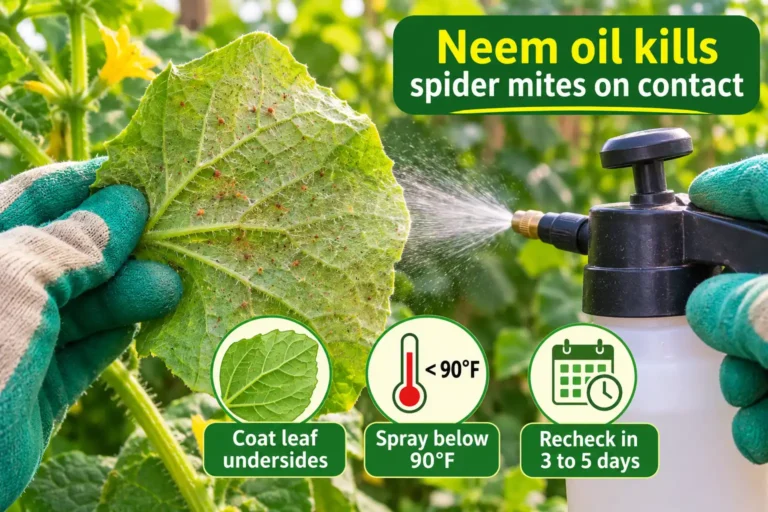
Does Neem Oil Kill Spider Mites? Yes, but Only on Contact
Neem oil is one of the few low-toxicity sprays extension entomologists list for spider mites on vegetables. So does neem…
November 6, 2026
Natural Pest Control
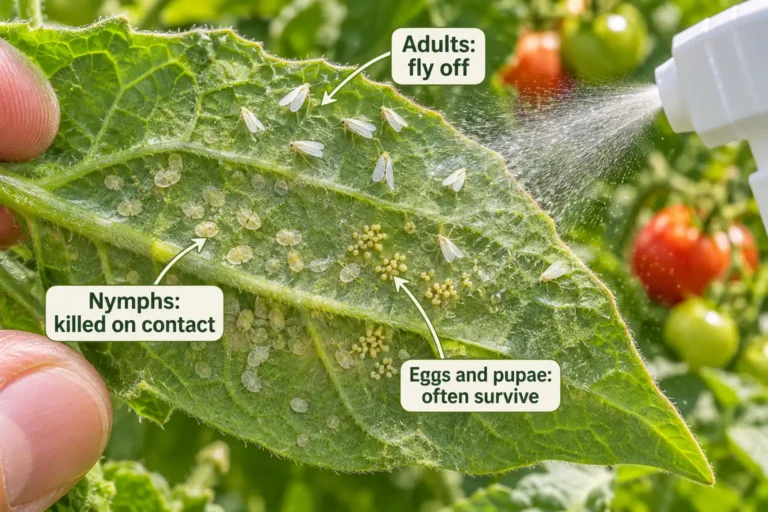
Does Neem Oil Kill Whiteflies? Yes, but Only the Stages It Touches
Tiny white insects lift off your tomato, squash, or kale leaves when you brush past. Neem oil looks like an…
November 6, 2026
Natural Pest Control
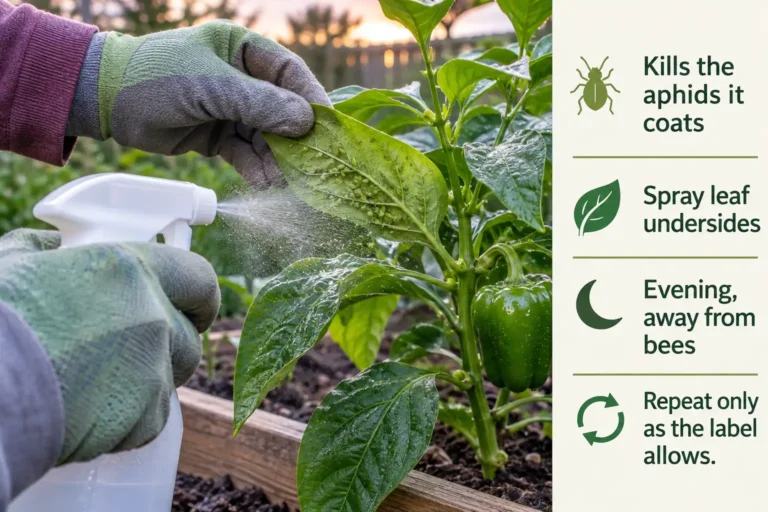
Does Neem Oil Kill Aphids? Yes, on Contact. Here’s How to Use It
Aphids crowd the undersides of pepper, kale, and squash leaves fast. Neem oil is often the first spray people reach…
November 6, 2026
Vegetable gardening questions
What vegetables are easiest to grow?
Radishes, leaf lettuce, bush beans, and zucchini are reliable first crops. Iowa State Extension also lists tomatoes, peppers, and potatoes among the easiest. Grow the ones you actually like to eat.
When should I start gardening vegetables?
Count from your average last spring frost date. Hardy crops like peas and spinach go in 2 to 4 weeks before it. Tomatoes, beans, and squash wait until after, once the soil warms.
How long do seeds take to germinate?
In soil around 68°F, most vegetable seeds come up in 3 to 14 days, based on Oregon State data. Cold soil slows them a lot. Tomato seed takes about 43 days at 50°F.
What is the best soil for a vegetable garden?
Loose, well-drained soil rich in organic matter, with a pH near 6.0 to 7.0. Virginia Tech suggests 5 to 10 percent organic matter for vegetable beds. A soil test shows what yours needs.
What fertilizer is best for vegetable gardens?
The one your soil test recommends. The three numbers on a bag are the percent of nitrogen, phosphate, and potash. Nitrogen washes out of soil, so it often needs a top-up midseason.
Is Preen safe for vegetable gardens?
Only some Preen products, used exactly as the label directs. Preen Garden Weed Preventer lists certain vegetables, while Extended Control isn’t for vegetable gardens. Every version stops seeds from sprouting, so check before sowing.
How often should I water my vegetable garden?
Aim for about 1 inch of water a week, rain included. Clay and loam soils can take it all at once. Sandy soil does better with half an inch twice a week, per University of Minnesota Extension.
How big should a beginner’s vegetable garden be?
Start with one or two raised beds or a few containers. K-State notes that even 100 square feet, about 10 by 10 feet, can grow a good share of a family’s vegetables.
Does companion planting work?
Partly. Sweet alyssum near lettuce brought in more aphid-eating hoverflies in UC research, and nasturtiums work as a trap crop. Marigolds planted beside crops don’t stop root-knot nematodes, per LSU AgCenter.
Can I grow vegetables in containers?
Yes. UF/IFAS Extension lists containers as a good option for small spaces. Give pots the same 6 to 8 hours of sun as a garden bed, and check the soil moisture often.
How we work
These guides aren’t based on one person’s backyard results. Every figure comes from a university extension service, USDA, or a product label, and the source sits right next to it.
When sources disagree, like the soil test timing above, we show both. We don’t diagnose sick plants from photos or publish pesticide rates. Your county extension office does that better.
Sources we rely on
- University of Minnesota ExtensionSeed starting, transplanting, and watering
- Oregon State University ExtensionSeed germination by soil temperature
- University of Missouri ExtensionVegetable planting calendar
- K-State Research and ExtensionPlanting guide, harvest times, frost tolerance
- Virginia Cooperative Extension (Virginia Tech)Fertilizer, soil pH, organic matter
- Illinois ExtensionPlanning a vegetable garden
- Iowa State University ExtensionEasy vegetables for beginners
- UF/IFAS Gardening SolutionsGarden layout and small spaces
- USDA Plant Hardiness Zone MapHardiness zones
- UConn ExtensionPest management in home gardens
- Michigan State University ExtensionSmart watering
- LSU AgCenterMarigolds and nematodes
Get organic gardening ideas
Vegetable Gardening
Join our community for practical tips, helpful guides, and fresh ideas delivered straight to your inbox. Subscribe today and never miss an update!
Corrections and contact
Found a figure that looks wrong?
Tell us the page, the figure, and the source you’re comparing against.
Corrections usually go up the same week.
Everything else
Questions about the site, permissions, or a page that won’t load.
contact@vegetablegardening.net
We aim to reply within three business days.
Sick plant or mystery bug?
Your county extension office and local Master Gardener volunteers can identify plant problems for your area.