How to Get Rid of Cucumber Beetles Before They Spread Bacterial Wilt
Knowing how to get rid of cucumber beetles matters most in the first weeks after planting. That’s when they chew cucurbit seedlings and spread bacterial wilt, a disease no spray cures once a vine has it.
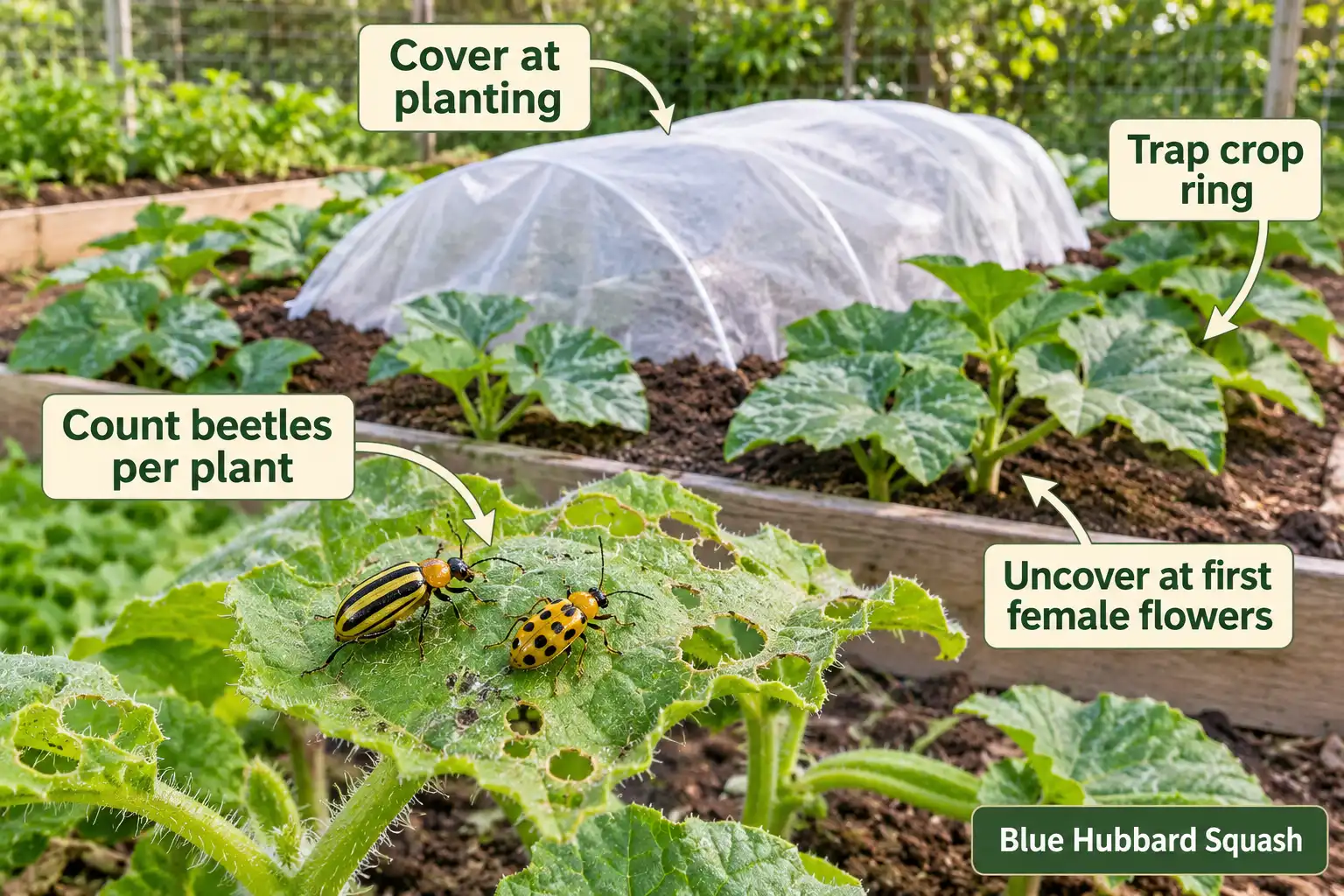
The surest way to get rid of cucumber beetles is to keep them off seedlings: use row cover until female flowers open, plus a Blue Hubbard trap crop. Then hand-pick beetles and spray only past your crop’s threshold.
Striped vs Spotted Cucumber Beetles: How to Tell Them Apart
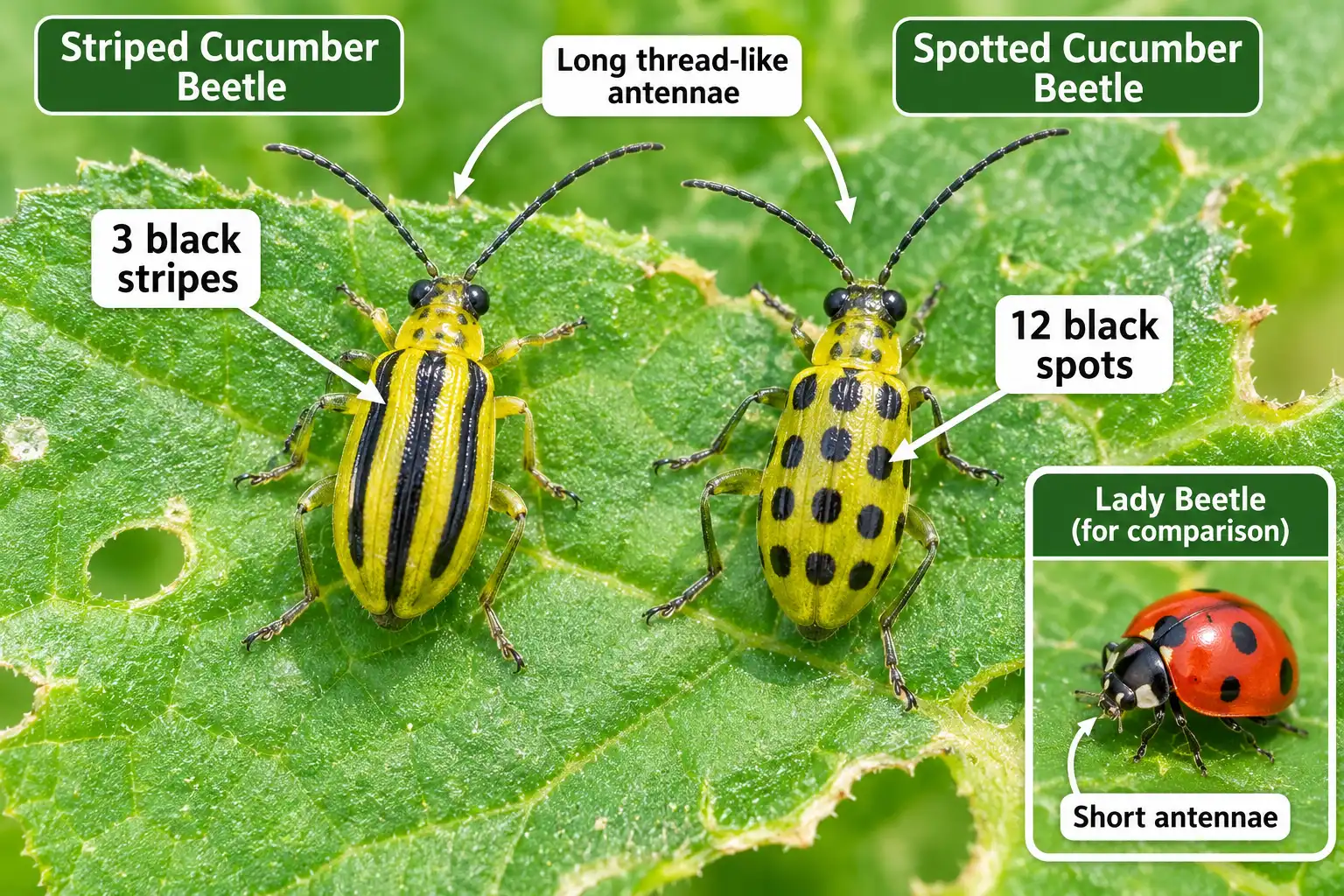
Both are small, yellowish beetles with black heads, and the markings tell them apart. University of Minnesota Extension describes the striped cucumber beetle as about 1/5 inch long, with three black stripes on yellow wing covers. The spotted cucumber beetle has 12 black spots instead. According to UConn Extension, it’s also slightly larger.
The two also differ in what they eat. The details below come from UConn Extension and UC IPM.
| Striped cucumber beetle | Spotted cucumber beetle | |
|---|---|---|
| Markings | 3 black stripes on yellow | 12 black spots on yellow-green |
| Adults feed on | Cucurbits only | Cucurbits and many other crops |
| Larvae feed on | Cucurbit roots only | Roots of corn, beans, and grasses |
| Bacterial wilt | Main carrier | Carries it less often |
In California, UC IPM lists the western spotted cucumber beetle as the most common species. The western striped cucumber beetle shows up there too.
Two lookalikes cause most mix-ups. Western corn rootworm has blurry-edged stripes and a yellow underside, per UConn. Lady beetles, UC IPM notes, have short, stubby antennae, while cucumber beetles have long, thread-like ones. If you aren’t sure what’s on your plants, your county extension office or local Master Gardener volunteers can confirm it.
Learn more: Does Neem Oil Kill Whiteflies or Not
Cucumber Beetle Damage: What to Look For
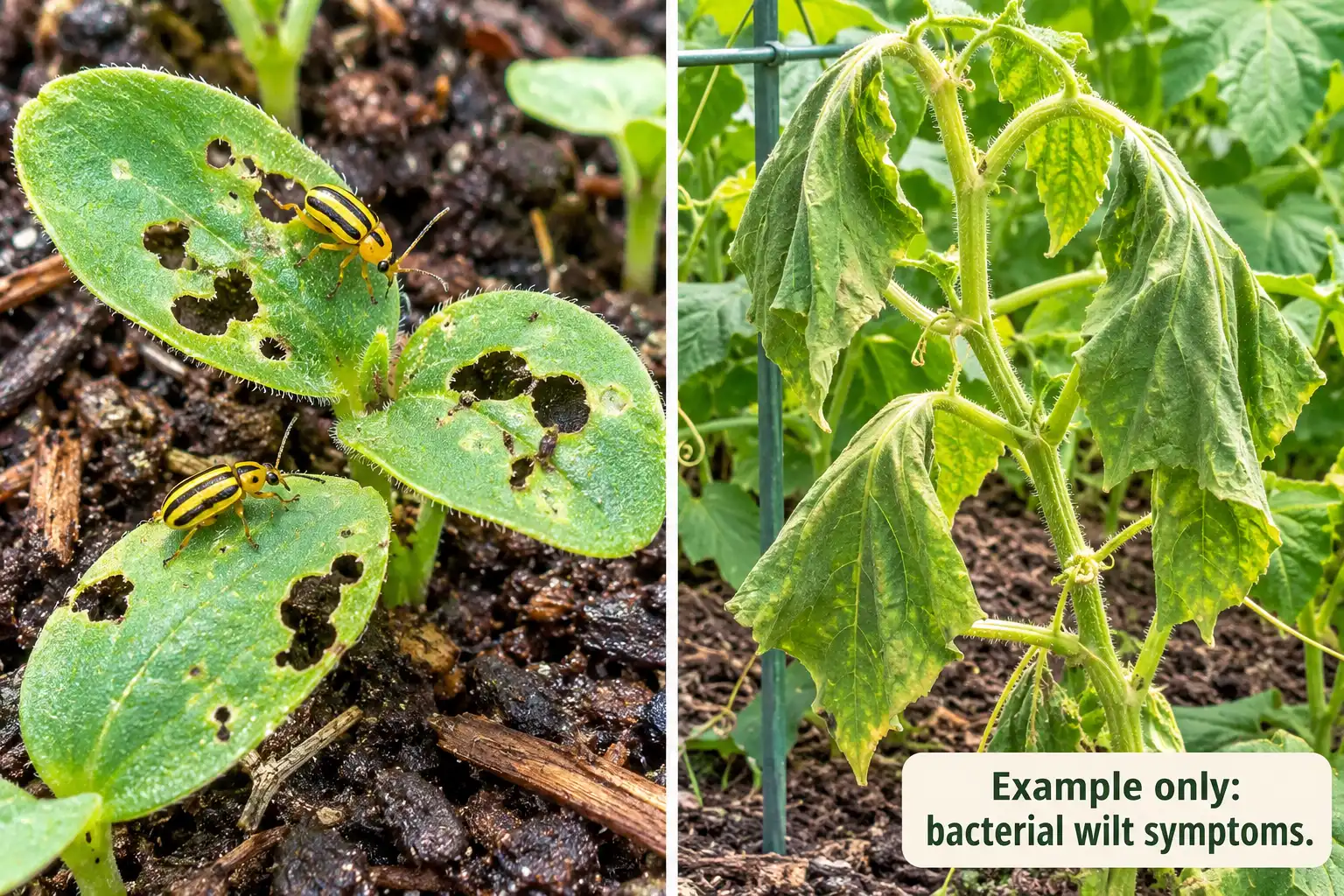
Chewed Seedlings
Adults chew cotyledons, leaves, and stems as soon as cucurbit seedlings emerge. University of Minnesota Extension says this feeding does the most harm up to the third true leaf. Heavy feeding at that stage can kill young plants. After it, pumpkins and winter squash can lose a lot of leaf area without much harm.
Bacterial Wilt
Bacterial wilt is the bigger threat. The bacteria survive winter inside the beetles and enter plants through feeding wounds. In fact, UConn’s Northeast fact sheet estimates that more than 10% of beetles may carry them.
UConn’s bacterial wilt fact sheet describes the first sign as a dull green leaf that wilts fast around chewed spots. Then the wilt moves along the vine. A young plant can collapse in about 2 weeks.
Once a plant is infected, Purdue Extension says nothing saves it. UConn adds that copper sprays do nothing, because the beetles carry the bacteria straight into the plant.
UConn also describes a stem check. Cut a wilted stem, touch the cut ends together, and pull them apart slowly. Fine, sticky threads point toward wilt in cucumbers, though the check is unreliable in muskmelons. Squash vine borers and dry soil can also wilt vines, so let your county extension office or a plant diagnostic lab confirm the cause. If the symptoms don’t fit, compare them with other common vegetable garden pests.
Flowers, Fruit, and Roots
Once plants bloom, beetles crowd into flowers to feed on pollen. University of Minnesota Extension says that feeding doesn’t cut yield, and late chewing on fruit is cosmetic. For market growers, though, UMass Extension notes the scars can make fruit unsellable. Meanwhile, larvae feed on roots below ground.
Striped beetles can spread cucumber mosaic virus too. Still, UMass says aphids spread it more efficiently, so check for aphids on garden crops as well.
Which Crops Are Most at Risk, and How Many Beetles Is Too Many?
Cucumbers and muskmelons are most at risk, because bacterial wilt hits them hardest. UConn rates cantaloupe, muskmelon, and cucumber as severely affected. It rates summer squash and pumpkin as less affected, and watermelon as resistant. Minnesota’s guidance stresses protection up to the third true leaf. UMass and UConn extend that to the fifth leaf.
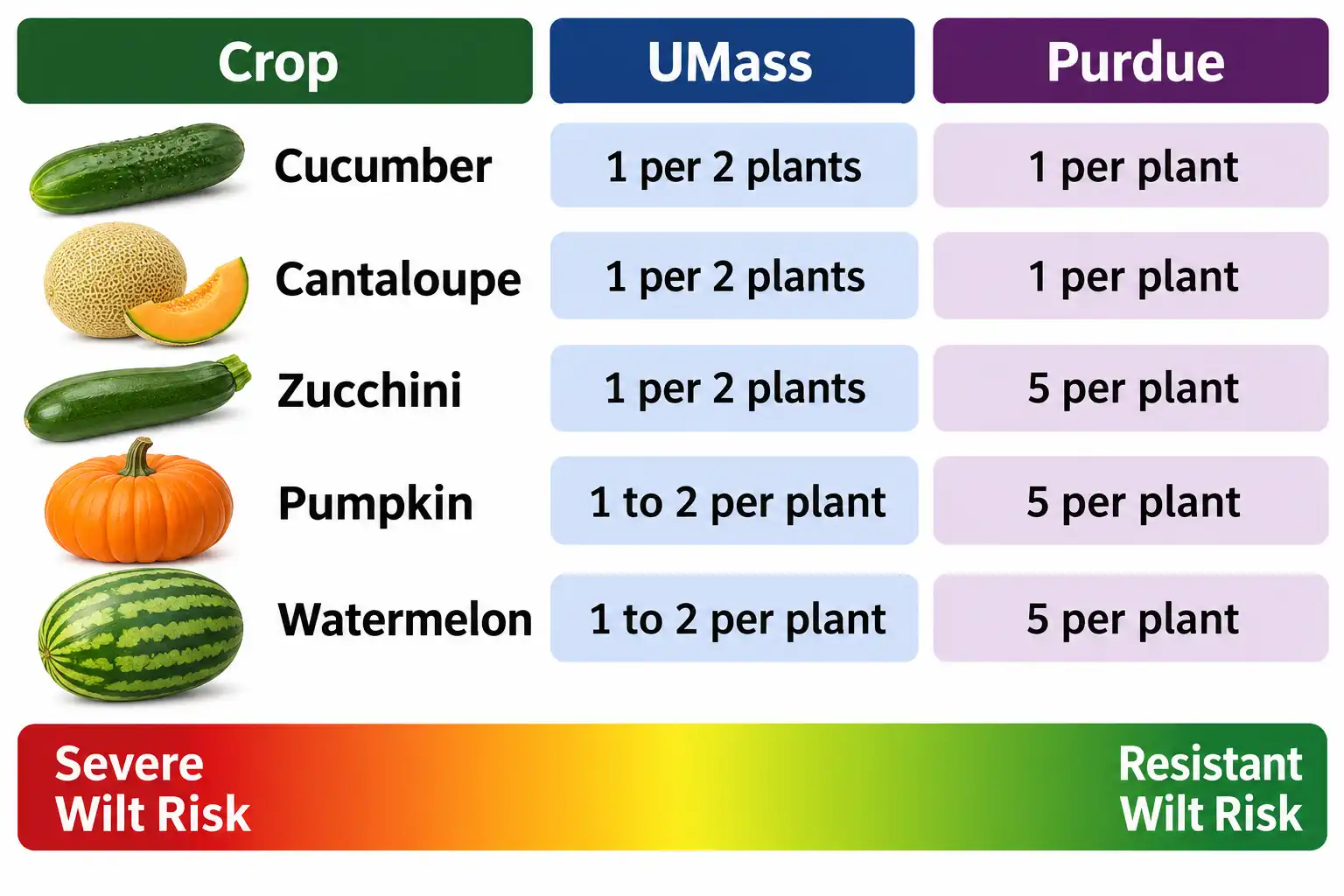
Two respected programs disagree on squash thresholds, so the table shows both.
| Crop | Wilt risk (UConn) | UMass threshold | Purdue threshold |
|---|---|---|---|
| Cucumber | Severe | 1 beetle per 2 plants | 1 beetle per plant |
| Cantaloupe, muskmelon | Severe | 1 beetle per 2 plants | 1 beetle per plant |
| Summer squash, zucchini | Lower | 1 beetle per 2 plants | 5 beetles per plant |
| Pumpkin | Lower | 1 to 2 beetles per plant | 1 per plant under 3 weeks old, then 5 |
| Watermelon | Resistant | 1 to 2 beetles per plant | 5 beetles per plant |
UMass sets the low number for summer squash and zucchini to prevent wilt. By contrast, Purdue’s Vegetable Crops Hotline groups summer squash with watermelon, based on Indiana research. So if wilt has killed squash in your garden before, the UMass number is the safer pick.
Run the Numbers for Your Planting
University of Minnesota Extension adds a simpler home-garden rule. At the cotyledon stage, act when 25% of your plants each carry 2 or more beetles. From the second or third true leaf on, act when a plant has lost 25% of its leaf area.
Say you have 6 cucumber seedlings. Use your own count in place of 6.
- UMass: 6 plants ÷ 2 = act at 3 beetles in total.
- Purdue: 6 plants × 1 = act at 6 beetles in total.
- Minnesota rule: 6 plants × 25% = 1.5, so act once 2 plants each hold 2 or more beetles.
Count every plant, including the outer ones. UConn notes that arriving beetles bunch up along the edges of a planting first.
When Cucumber Beetles Arrive, Region by Region
Striped cucumber beetles spend winter as adults in field edges, leaf litter, and old crop debris. UConn’s Northeast fact sheet says they leave those sites once temperatures pass 55°F. Then they move onto cucurbits as plants come up.
| Region | When beetles reach cucurbits | Source |
|---|---|---|
| Southern Minnesota | Usually the first week of June | Univ. of Minnesota Extension |
| Massachusetts | Warm days, usually mid-June | UMass Extension |
| Connecticut | Peak around the third week of June | UConn Extension |
| California | As plants emerge, with several generations a year | UC IPM |
A second generation follows in many areas. In Massachusetts, UMass says new adults emerge in early to mid-August. University of Minnesota Extension says late-summer striped beetles cause little damage. Even so, cucumbers and melons stay at risk of wilt all season.
How to Get Rid of Cucumber Beetles Naturally
Nonchemical steps carry most of the load with this pest. In fact, Purdue Extension says no organic insecticide effectively manages striped cucumber beetles. So the plan is to block and lure beetles before they feed. Most gardens need at least the first two steps.
1. Cover Seedlings on Planting Day

Floating row cover is the most dependable barrier. Purdue says to put it on right after transplanting, or before direct-sown seedlings emerge. Then bury or weigh down every edge, since beetles crawl through gaps. UMass suggests wire hoops so the fabric doesn’t rub tender leaves, and pins or weights for row covers keep the edges sealed.
Next, watch for the first female flowers, which have a tiny fruit at the base. At that point, Purdue says to remove the cover or open the ends so bees can pollinate. Most cucurbits need insect pollination to set fruit, per University of Minnesota Extension.
Also, plant in a bed that didn’t grow cucurbits last year. UMass notes that some beetles overwinter inside old plantings, and those can emerge under your cover.
2. Ring the Bed With a Blue Hubbard Trap Crop
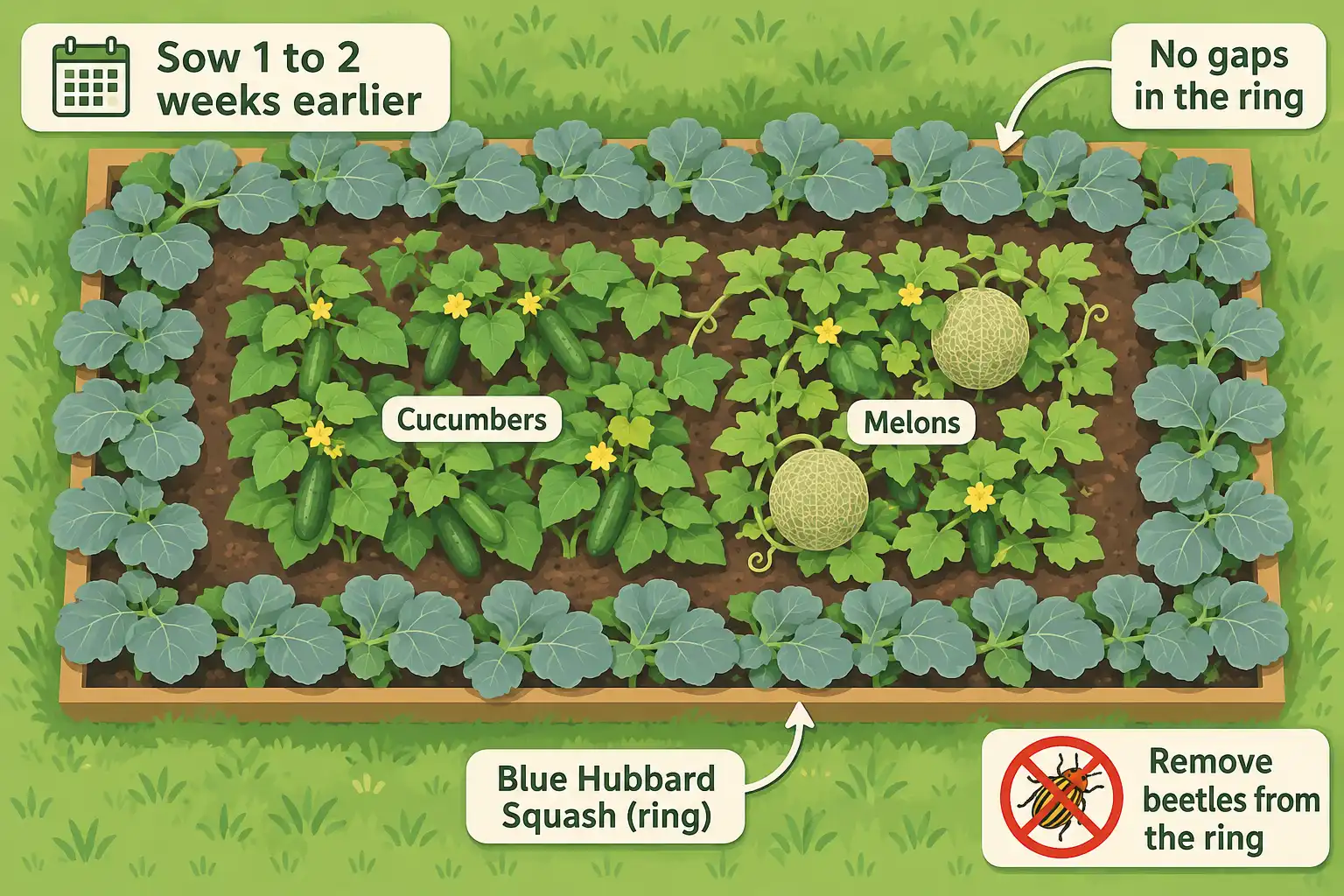
A trap crop works because beetles prefer some cucurbits over others. UMass names Cucurbita maxima types, such as Blue Hubbard and buttercup squash, as the strongest lures. In UConn trials around summer squash in Connecticut, over 94% of beetles gathered on a Blue Hubbard border. Beetles on the unsprayed squash inside fell by up to 95%, with extra controls in the border.
University of Minnesota Extension suggests sowing the trap crop 1 to 2 weeks before the main crop, since beetles arrive in one early flush. Run it for your own sowing date:
Trap crop sowing date = your main sowing date minus 7 to 14 days
For example, cucumbers sown June 1 put Blue Hubbard in the ground May 18 to 25. Blue Hubbard is frost-tender too, so both dates must fall after your average last frost.
That research used full rings around farm fields. For home gardens, Minnesota’s version is simpler: a few Blue Hubbard plants near the main crop. Either way, remove or kill the beetles that gather there, or UConn warns they spread into the main crop. Purdue adds that beetles move on once the trap crop declines. Finally, skip Turk’s Turban squash, which UConn warns can hold the wilt bacteria.
3. Use Transplants or Sow Later
Transplants give you a head start. UMass notes they can reach a later growth stage before beetles arrive, so they handle more feeding. For direct sowing in Connecticut, UConn suggests waiting until the last week of June, after the main beetle flush, and sowing extra seed. The trade-off is a shorter season.
4. Knock Beetles Into Soapy Water
On a few plants, hand removal works. University of Minnesota Extension suggests swatting beetles into a bucket of soapy water. Check in the evening, because UMass says beetles are most active from dusk to dawn. Look inside open flowers too, where beetles gather.
5. Mulch Around Established Plants
Once plants are growing, University of Minnesota Extension suggests thick straw around the base to make egg-laying harder. UConn’s Northeast fact sheet also reports that black plastic mulch cut striped beetle larval survival by up to 50% in cucurbit plantings.
6. Plant Crops Beetles Like Less
UConn lists Blue Hubbard, zucchini, cucumbers, yellow summer squash, and acorn squash among the beetles’ favorites. So cover an acorn squash planting early. Pumpkins, muskmelons, butternut squash, and watermelons rank slightly lower. Still, muskmelons need protection because wilt hits them hard. For cucumbers, UConn notes wilt-resistant varieties exist, while no resistance has been found in melons.
7. Clear Weeds and Old Vines
University of Minnesota Extension advises pulling weeds in and around the garden and removing plants that show wilt. After harvest, clear debris and leaf litter. That leaves adult beetles fewer places to spend the winter.
8. Let Natural Enemies Help
A tachinid fly parasitizes both striped and spotted beetles in New England, per UConn. UC IPM also lists general predators that attack them. However, Purdue notes that a threshold as low as 1 beetle per plant leaves little time to wait for predators.
Beneficial nematodes are a split call. UConn reports partial control of striped beetle larvae. UMass, on the other hand, says little research exists, and new adults keep flying in from outside anyway. Beneficial insects are a core part of pest control without sprays, but here they work best alongside covers and trap crops.
Cucumber Beetle Spray Options Compared
Sprays are a backup for cucumber beetles, and several popular ones fall short. University of Maryland Extension summarized 153 field trials of organic insecticides. Cucumber beetles ranked among the hardest pests to control.
| Spray type | What it is | What extension sources report |
|---|---|---|
| Kaolin clay | Mineral film on leaves | Deters feeding but doesn’t kill; best before heavy feeding (UMass, Minnesota) |
| Pyrethrin | Botanical contact insecticide | Quick knockdown of adults, no lasting effect (UMass) |
| Neem (azadirachtin) | Botanical growth inhibitor | Labeled for striped beetles in some products; weak on adults (UMass, Maryland) |
| Spinosad | Insecticide made from soil bacteria | Not labeled for or effective against striped beetles (UMass) |
| Pyrethroids, carbaryl | Synthetic broad-spectrum insecticides | Pyrethroids give excellent control (Purdue); highly toxic to bees (UMass) |
Spinosad is the surprise. It was the most effective product overall in Maryland’s trials. Yet UMass says it doesn’t control striped cucumber beetles.
Spray Timing, Labels, and Bees
Timing matters as much as the product. In Purdue’s Indiana research, spraying cantaloupe only after beetles passed 1 per plant took 2 to 3 sprays. A fixed spray schedule took 7 to 10, and the extra pyrethroid sprays lowered cantaloupe yield.
The label on the product you buy sets the rate, how often to reapply, and how long to wait before harvest. It also carries bee directions, and you must follow them. UMass notes broad-spectrum insecticides are highly toxic to bees and belong before bloom only. Because cucurbits need bees, keep any spray off open flowers. Also keep children and pets off treated plants for as long as the label says.
Does Neem Oil Kill Cucumber Beetles?
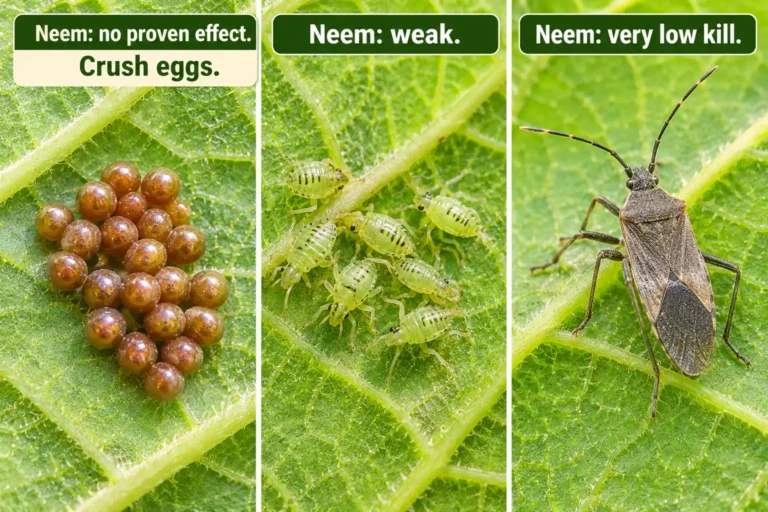
Not reliably, and least of all adult striped cucumber beetles. UMass notes that some azadirachtin products list striped cucumber beetle on the label. Still, a pest on the label isn’t proof of strong control.
How Neem Works on Cucumber Beetles
Azadirachtin, the main active compound in neem seed extract, works mostly by slowing insect growth. In Maryland’s trials, it did well on larvae of Mexican bean beetle and Colorado potato beetle. Against infestations made up mostly of adults, it did much less.
That’s the mismatch. The adults chewing your seedlings have finished growing. Their larvae, meanwhile, feed on roots underground. UMass points out that eggs and larvae sit in the soil, out of reach, so sprays mainly hit adults. A neem spray on the leaves therefore lands on the stage it affects least.
If You Still Want to Try Neem
Read the active ingredient first. Some neem products list azadirachtin, while others list clarified hydrophobic extract of neem oil, a different material. Next, confirm the label names cucumber beetles and your crop. Then use neem alongside row cover and a trap crop, never in place of them. Results also vary widely by pest, so how neem performs against aphids says little about beetles.
Striped vs Spotted Cucumber Beetle Control: What Changes
The same methods work on both, but timing and urgency differ.
Striped cucumber beetles need protection from planting day. They feed only on cucurbits, arrive as plants emerge, and carry most bacterial wilt. That’s why University of Minnesota Extension says to focus your effort on them.
Spotted cucumber beetles in the North show up later. They don’t survive Minnesota winters and fly in from the South in late June or early July. By then, many seedlings are past the riskiest stage. University of Minnesota Extension says their numbers are usually too low to treat. They also carry wilt less often, per UConn.
The West differs. UC IPM lists the western spotted cucumber beetle as California’s most common species, with several generations a year. So later plantings there may need covers too. UC IPM suggests leaving cloth on until plants are old enough to tolerate damage.
Why Cucumber Beetle Control Fails
- Covers went on a few days late, after beetles had found the seedlings.
- Covers stayed on through bloom, so bees never reached the female flowers.
- The bed grew cucurbits last year, and beetles emerged under the fabric.
- Beetles on the trap crop were left alone and spread into the main crop.
- Cucurbits moved only across the yard. UConn says only moves of more than half a mile cut beetle numbers. In a backyard, rotation mainly helps covers work, per Minnesota Extension.
- Neem or spinosad was the only defense.
- Spraying targeted late-summer beetles while the seedling stage went unprotected.
FAQs on Get Rid of Cucumber Beetles
What kills cucumber beetles fast?
Knocking beetles into a bucket of soapy water kills them on the spot, and University of Minnesota Extension suggests it for small plantings. Pyrethrin sprays also knock adults down fast, but UMass notes they leave no lasting protection.
Can I leave row covers on cucumbers all summer?
Only on cucumber varieties that set fruit without pollination, often sold as parthenocarpic. Purdue notes those don’t need bees, while most other cucumbers, squash, and melons need covers removed or opened once female flowers appear.
Why do cucumber beetles come back every year?
Adults spend the winter nearby, in leaf litter, weedy edges, and old crop debris, according to Minnesota, Massachusetts, and California extension sources. They return to cucurbits as plants come up, and some carry the wilt bacteria.
Should I pull a cucumber plant with bacterial wilt?
Yes, once your extension office or a diagnostic lab confirms the cause. University of Minnesota Extension advises removing infected plants before more beetles feed on them and carry the bacteria to healthy vines.
Do cucumber beetles eat plants other than cucurbits?
Spotted cucumber beetles do. UC IPM notes the adults feed on many vegetables and soft fruit, while striped cucumber beetles stick to cucurbits, per UConn, and their larvae feed only on cucurbit roots.
What time of day are cucumber beetles most active?
From dusk to dawn, according to UMass Extension. That makes evening the best time to check your cucumber and squash plants and, where the label allows, the time contact sprays reach the most beetles.
Where to Start
Start before the beetles do. Pick a bed that didn’t grow cucurbits last year, sow a Blue Hubbard trap crop 1 to 2 weeks ahead, and cover the main crop on planting day. Count beetles every few days until plants pass the third to fifth true leaf. After bloom, late striped beetles rarely need treatment, except on cucumbers and melons.