Can Arugula Be Frozen? Yes, for Cooking: Blanch, Pack, and Store
Arugula wilts within days of picking, and a cool-season bed often grows more than one kitchen can eat. So can arugula be frozen, or should it stay in the fridge? The answer depends on how you plan to eat it.
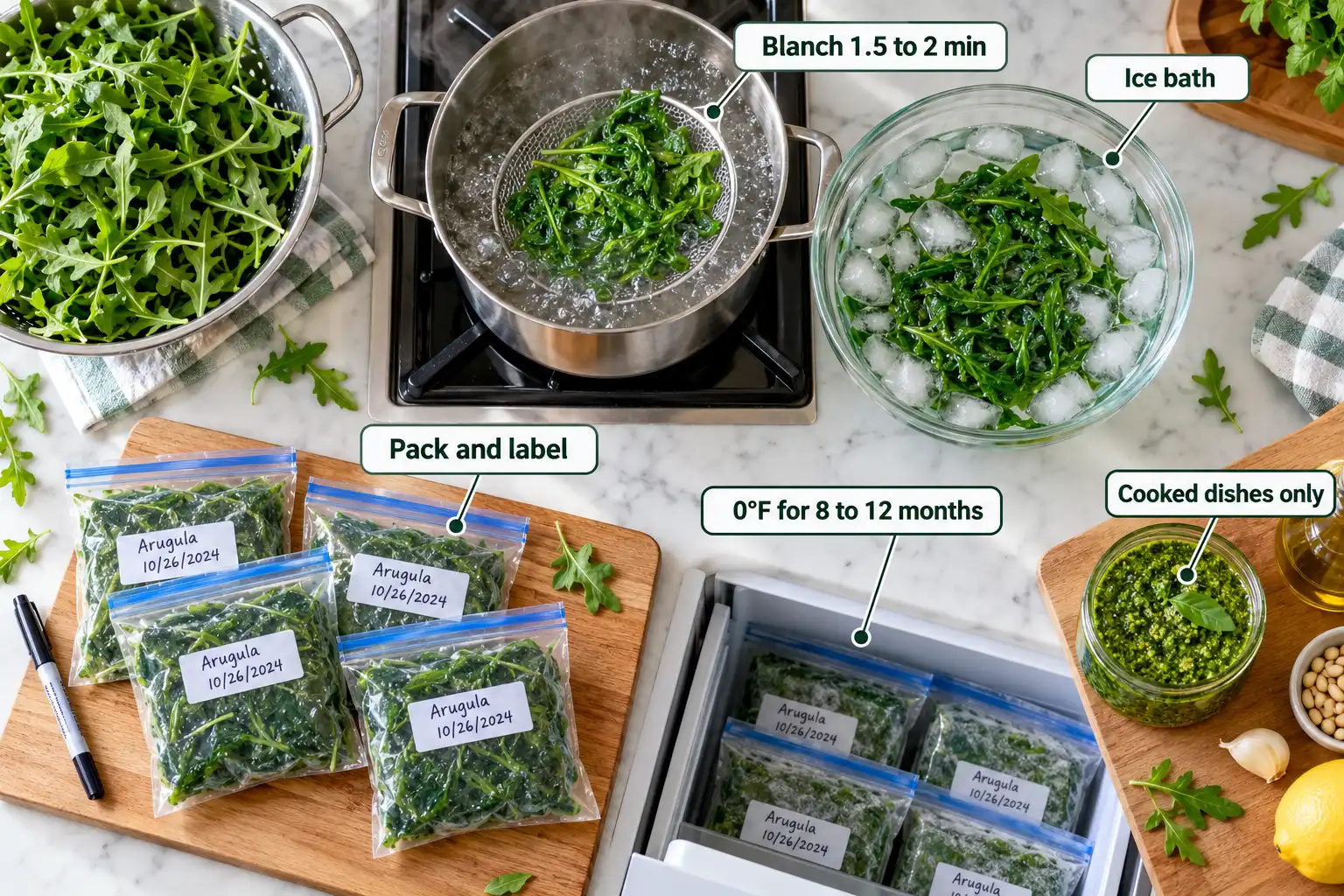
Yes, arugula can be frozen, but only for cooking, because thawed leaves turn limp. The National Center for Home Food Preservation’s greens method blanches leaves 2 minutes, and blanched greens hold best quality 8 to 12 months at 0°F.
Can Arugula Be Frozen and Still Taste Fresh?
Frozen arugula works well in cooked dishes, but it loses its crunch for good. Freezing bursts the thin cell walls in tender leaves, so thawed arugula comes out soft and wet.
The National Center for Home Food Preservation (NCHFP) explains the cause. Leafy green cells are full of water, and that water expands as it turns to ice. That’s why the center recommends frozen greens only as a cooked vegetable.
Its list of foods that don’t freeze well says the same thing. Lettuce, cress, and endive meant for raw salads thaw limp and water-logged. They also pick up off colors and flavors quickly. Arugula isn’t on that list by name. Still, cress belongs to the same mustard family, so expect the same result.
So plan frozen arugula for soups, sauces, pasta, eggs, and pesto. For salads, eat it fresh.
Three Ways to Freeze Arugula
Each method suits a different dish, so choose by how you’ll use the leaves.
| Method | How it works | Best uses | Freezer life |
|---|---|---|---|
| Blanched leaves | Boil 1 1/2 to 2 minutes, chill in ice water, drain, pack | Soups, sauces, pasta, casseroles | 8 to 12 months at 0°F (NCHFP); 12 to 18 months (Colorado State) |
| Raw leaves | Wash, dry, freeze flat on a tray, then bag | Smoothies, quick sautés | No tested figure, so use these first |
| Pesto or leaves in oil | Blend with oil, freeze in small jars or cube trays | Pasta, pizza, soups, spreads | No tested figure; 3 to 4 days in the fridge |
Blanch anything you plan to keep long term. NCHFP says blanching stops the enzyme actions that cause loss of flavor, color, and texture, even in frozen storage. Its storage times assume properly blanched produce. No tested source gives a freezer life for raw arugula.
Raw freezing still has a place, though. Texture doesn’t matter in a smoothie, so a quick tray freeze works for leaves you’ll blend soon.
How to Freeze Arugula Step by Step
NCHFP’s greens freezing method and Colorado State University Extension’s Preserve Smart greens guide cover spinach, kale, chard, and similar greens. Neither names arugula, so these steps follow their method for tender greens. Read both pages in full before you start.
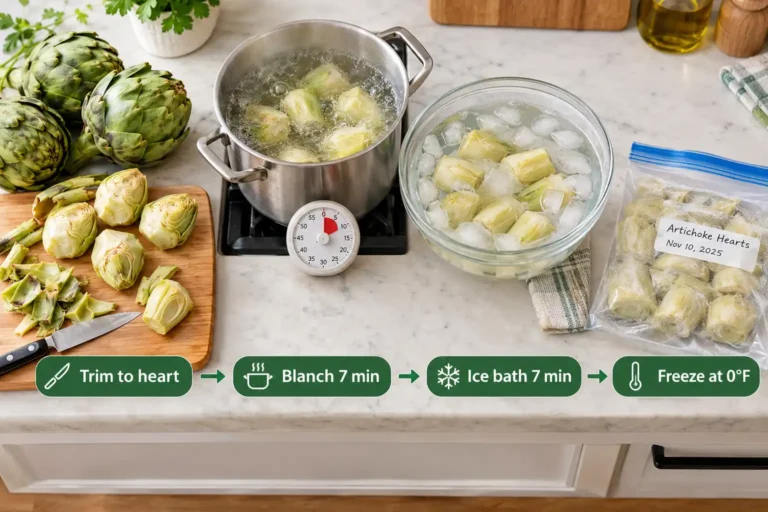
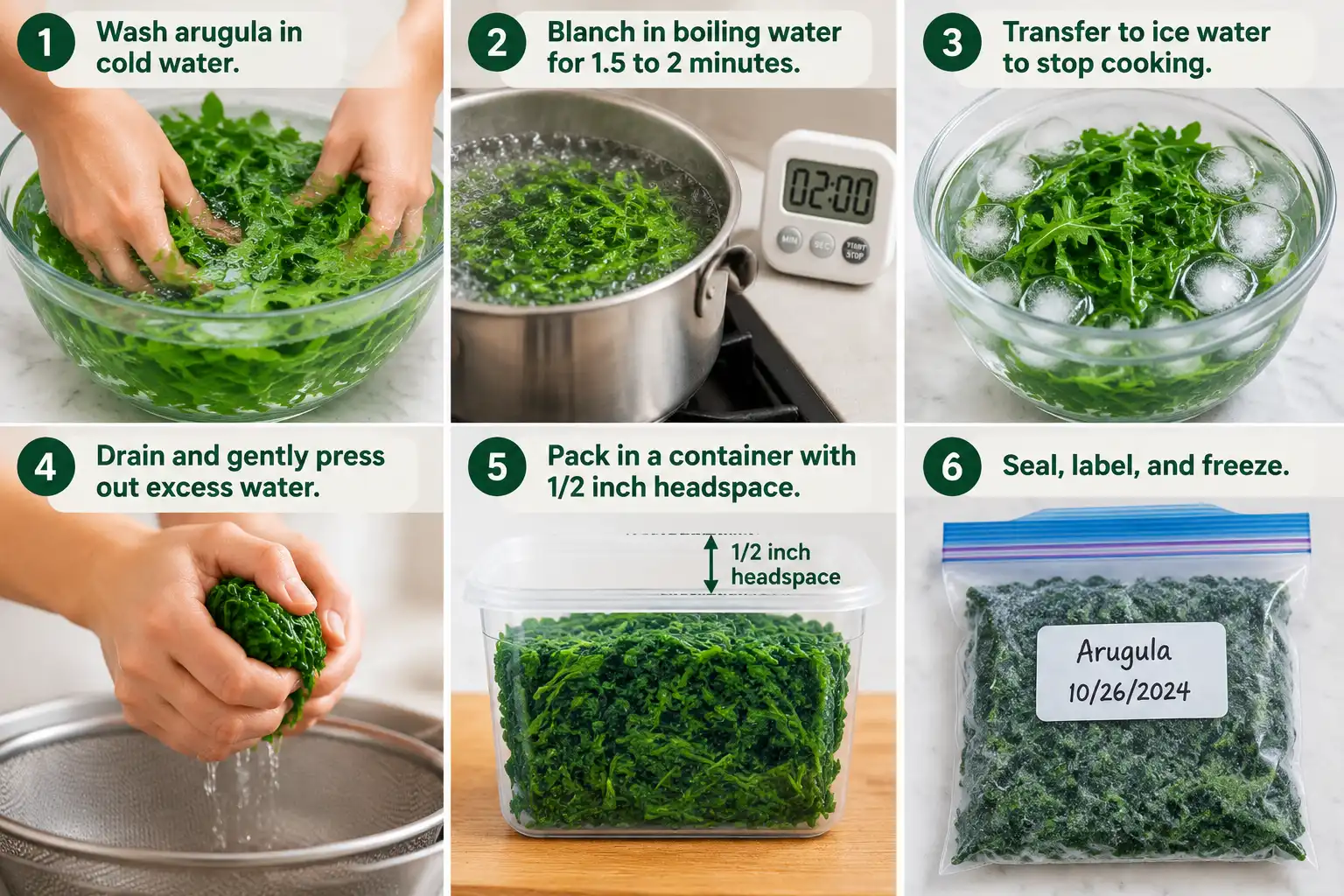
- Pick young, tender leaves. Both sources call for young leaves. Skip any that show yellowing, decay, or mold.
- Wash well. Swish the leaves in cold water, lift them out, and repeat until no grit settles. Then trim off tough stems.
- Boil plenty of water. Colorado State calls for 1 gallon of water per pound of greens. Lower the leaves in, cover the pot, and start timing right away.
- Blanch 1 1/2 to 2 minutes. The next section explains the range and the high-altitude adjustment.
- Chill in ice water. Cool the leaves for as long as you blanched them. Next, drain well and press out extra water.
- Pack. Leave 1/2 inch of headspace in rigid containers, per NCHFP. In bags, press out as much air as you can. For loose portions, freeze leaves in a single layer on a tray first, then bag them.
- Label and freeze. Write the date on each package. Then freeze at 0°F or below, with new packages spread in a single layer so they freeze fast.
How Long to Blanch Arugula
Blanch arugula for 1 1/2 to 2 minutes below 5,000 feet. No tested source gives a time for arugula itself, so this range comes from the two closest matches.
NCHFP sets 2 minutes for all greens except collards, which get 3. Colorado State splits greens by texture instead. Below 5,000 feet, it gives tender spinach 1 1/2 minutes and kale, chard, and mature spinach 2 minutes. Baby arugula leaves are thin like young spinach, so the shorter time suits them. Older, tougher arugula fits the 2 minute mark.
Altitude changes the time, too. At 5,000 feet and above, Colorado State adds a minute. That means 2 1/2 minutes for tender spinach and 3 for kale and chard. Water boils at a lower temperature up high, so leaves take longer to heat through.
How Much Arugula Fills a Freezer Container
Colorado State says 2 to 3 pounds of fresh greens fill one frozen quart. That figure covers spinach, kale, and chard. It doesn’t list arugula, so treat this math as an estimate.
- Frozen quarts = pounds of fresh arugula ÷ 2 to 3
- Blanching water = 1 gallon per pound of greens
- Ice = about 1 pound per pound of greens
For example, say you cut 2 pounds of arugula from your bed (use your own weight here). That fills about 2/3 to 1 quart, or roughly 2 2/3 to 4 cups. You’d need 2 gallons of boiling water, or two 1-gallon batches, plus about 2 pounds of ice. So weigh the harvest on a kitchen scale first, and the pot and ice will be ready.
Freezing Arugula Pesto or Arugula in Oil
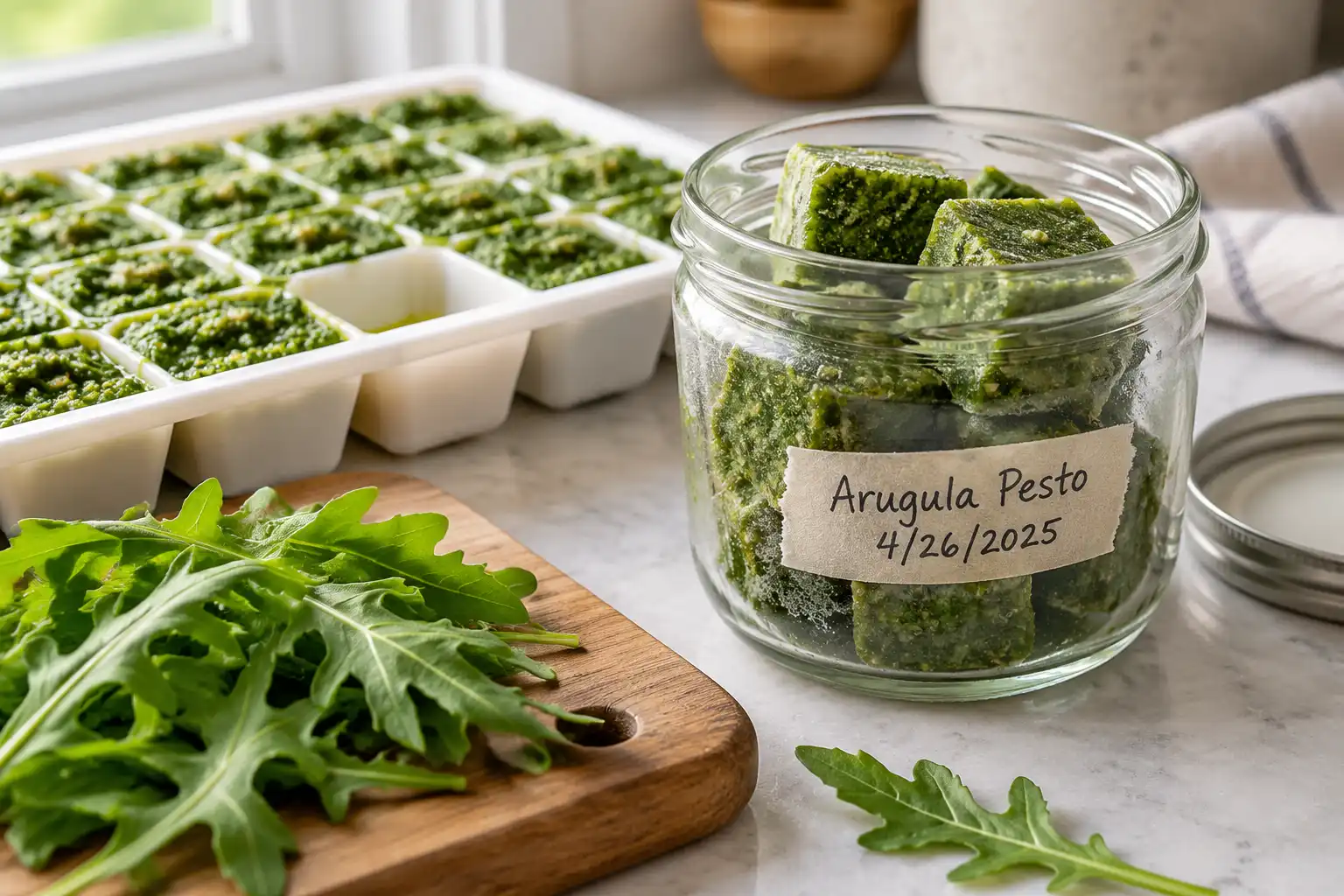
Pesto is the handiest way to freeze a big arugula harvest. But oil adds a safety rule. Oregon State University Extension explains that low-acid herbs and vegetables covered in oil create an oxygen-free space. There, Clostridium botulinum, the bacteria behind botulism, can grow.
That’s why both tested sources limit fridge time for homemade pesto. NCHFP’s pesto guidance says no more than 3 days. Oregon State’s herbs-in-oil publication, revised in January 2025, allows up to 4 days. For anything longer, both say freeze it. The same rules apply to arugula pesto and to chopped arugula covered in oil.
Follow these points from the two sources:
- Pack pesto in glass freezer jars or plastic freezer boxes with 1/2 inch of headspace (NCHFP).
- Or freeze it in ice cube trays, then move the cubes to an airtight container (Oregon State).
- Label each container with the date you made it (Oregon State).
- Go light on garlic. NCHFP notes garlic tends to turn strong and bitter in the freezer, so add more when you serve.
- Never leave arugula in oil at room temperature.
- Don’t can pesto. Oregon State notes that no research supports safe canning times for it.
Thaw frozen pesto in the fridge, and use it within that 3 to 4 day window.
How Long Does Frozen Arugula Last?
Blanched arugula keeps its best quality for 8 to 12 months at 0°F, the range NCHFP gives for frozen produce. Colorado State’s greens guide allows longer, at 12 to 18 months. Since the sources differ, aim for NCHFP’s shorter window. After that, NCHFP says frozen food stays safe but drops in quality.
Count forward from the day you pack. For example, freeze a fall harvest on November 1. The 8 to 12 month window then ends between July 1 and November 1 of the next year.
Raw-frozen leaves and frozen pesto have no tested storage time, so eat those first. NCHFP also advises rotating packages so the oldest get used first. Also check your freezer with an appliance thermometer, because every one of these times assumes 0°F or colder.
How Long Does Arugula Last in the Fridge?
Plan on about 2 days in a home fridge. That’s the figure UF/IFAS Extension in Alachua County, Florida gives for loose leaves or bunches kept in a plastic bag.
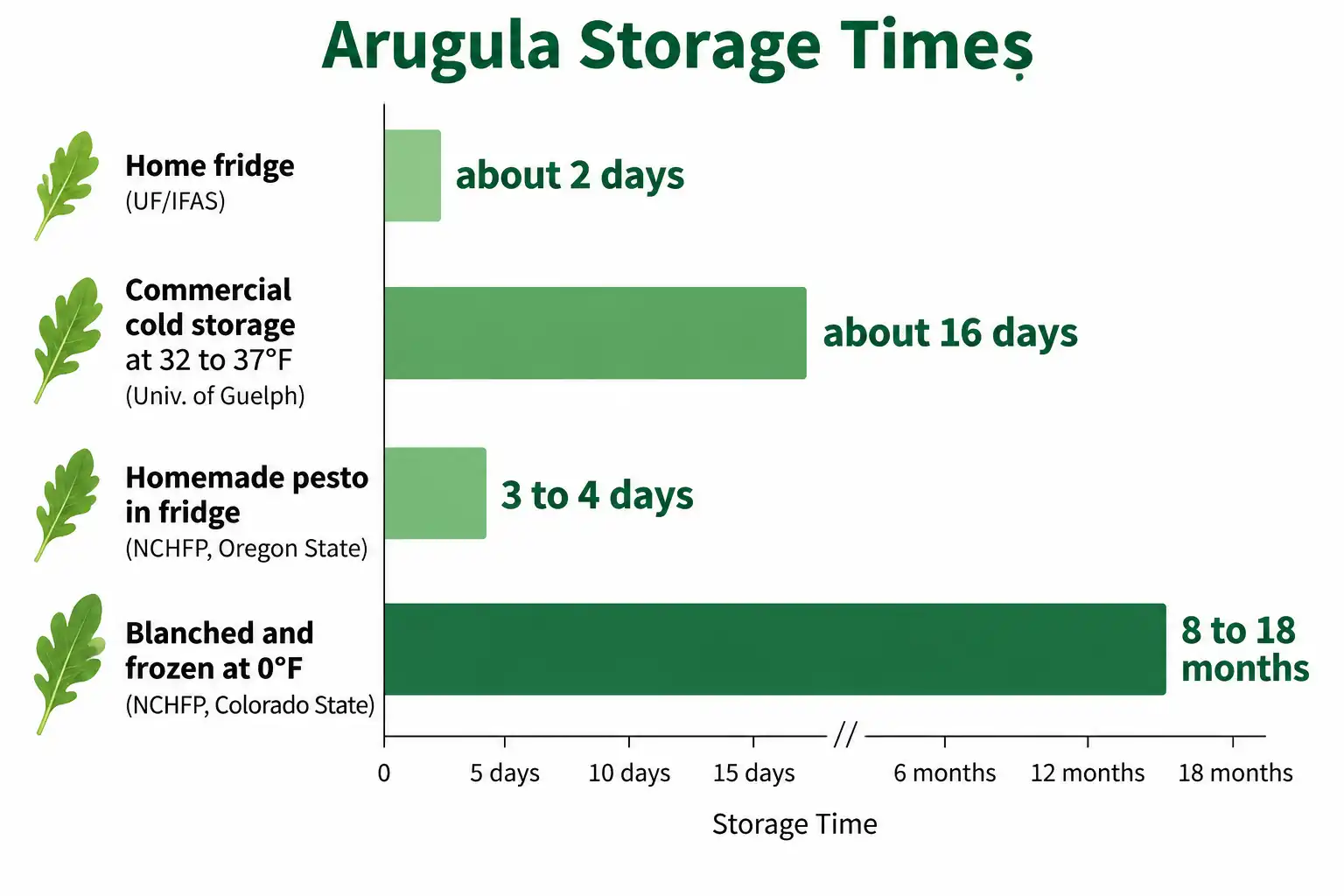
Commercial cold rooms do far better. A 2024 University of Guelph study puts ideal arugula storage at 32 to 36°F with humidity of 95% or higher. It cites earlier postharvest work for those figures. Under those conditions, baby leaf arugula keeps about 16 days at 32 to 37°F. Above 41°F, though, the leaves age faster. In the study itself, arugula held at 50°F discolored, wilted, and decayed faster than arugula held at 39°F.
Home fridges run close to that warm edge. The FDA says to store perishable produce at or below 40°F. That’s just 1 degree under the point where arugula ages faster.
So the 2 day and 16 day figures measure very different conditions. Don’t average them. Instead, treat the UF/IFAS figure as your plan for a typical home fridge. A colder crisper can buy a few extra days.
How to Keep Arugula Fresh Longer
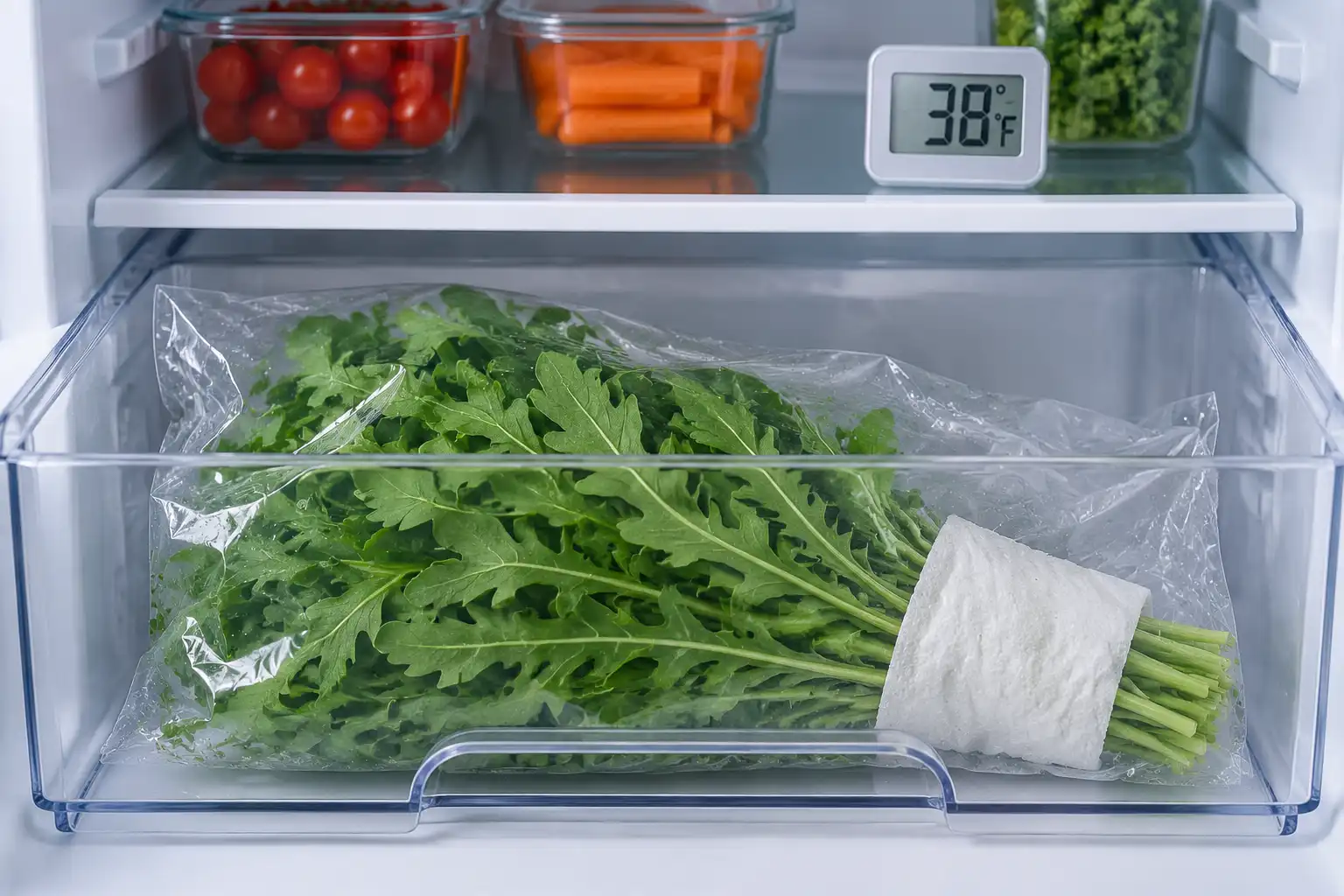
Keep arugula cold, damp at the stems, and dry on the leaves. These habits come from UF/IFAS Extension and the FDA.
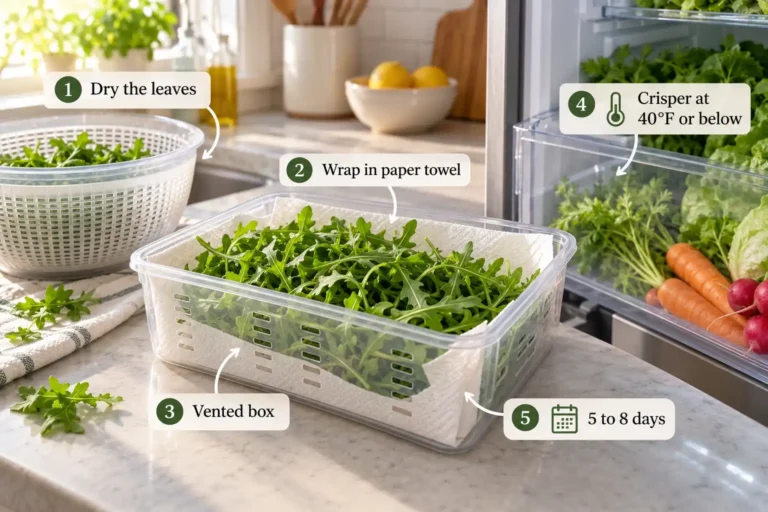
Wrap the stems. UF/IFAS suggests wrapping bunched stems in damp paper towels. Then store leaves or bunches in a plastic bag. You can also stand bunches in a glass of water in the fridge for up to 2 days.
Wash right before serving. UF/IFAS puts washing in the prep step, not the storage step. Swish the leaves in cold water and lift them out so the grit stays behind.
Dry anything you’ve washed. The FDA advises drying produce with a clean cloth or paper towel. So spin or blot the leaves before they go in a bag.
Run the fridge at 40°F or colder. An appliance thermometer shows the real number. For arugula, colder is better, as long as the leaves don’t freeze.
Leave leaves on the plant until you need them. UF/IFAS describes picking outer leaves once they reach 2 to 3 inches. Take less than a third of each plant. With this cut-and-come-again harvesting, the plant keeps producing new leaves while temperatures stay cool.
Signs Arugula Has Gone Bad
Yellowing, wilting, and decay mark the end of arugula’s shelf life, according to the University of Guelph study. Off-flavors can also develop in storage.
Limp leaves that are still green are fine to cook. But slimy, dark, or sour-smelling leaves belong in the compost. The FDA also advises cutting away damaged or bruised parts before you prepare produce. So pick out bad leaves as you go.
What to Do With Arugula Before It Spoils
Cook it. Heat wilts arugula down hard, so a heaping bowl shrinks into a single dish.
UF/IFAS Extension suggests stirring arugula into soups and pasta sauce, blending it into pesto, and adding it to pizza or sandwiches. You can also wilt it as a bed for grilled fish, meat, or poultry. Its peppery, mustard-like flavor holds up in all of these.
Frozen arugula fits the same kinds of dishes. NCHFP suggests frozen greens for casseroles, lasagna, soups, sauces, and dips. Thaw the leaves before cooking, since NCHFP notes leafy greens heat more evenly that way.
Bolting plants still give you something, too. UF/IFAS notes that leaves from flowering arugula turn bitter and tough but stay edible, so they’re better cooked than raw. The flowers are edible as well and make a peppery garnish for salads.
Sow Smaller Batches So Less Goes to Waste
The easiest surplus to handle is the one you never grow. In Alachua County, Florida, UF/IFAS Extension says arugula leaves are ready 30 to 40 days after sowing. It lists September through March for planting there. For a steady supply, the same source suggests sowing or transplanting every 2 to 3 weeks from fall through spring.
Run the math on your own calendar:
- Harvest window = sowing date + 30 to 40 days
- Next sowing = last sowing date + 2 to 3 weeks
For example, arugula sown October 1 in north-central Florida starts yielding between October 31 and November 10. Sow the next batch between October 15 and October 22, and the harvests overlap instead of piling up.
Outside Florida, your frost dates set the calendar, so check arugula sowing windows by frost date before you plan. Also, a few pots of arugula near the kitchen or a tray under lights indoors keeps each harvest small enough to eat fresh.
Frequently Asked Questions
Can I freeze arugula without blanching?
Yes, but expect faster quality loss. NCHFP says blanching stops the enzymes that fade flavor, color, and texture in frozen storage, so use up raw-frozen arugula first, ahead of any blanched packages.
Can you freeze arugula for smoothies?
Yes, and smoothies are the best use for raw-frozen leaves. Texture doesn’t matter once the blender runs, so wash and dry them, freeze them flat on a tray, and bag them for quick handfuls.
Does blanching arugula destroy its nutrients?
A short blanch protects more than it costs. NCHFP says blanching helps slow vitamin loss in frozen storage by stopping enzyme actions that otherwise keep breaking down flavor, color, texture, and nutrients.
Does freezing kill bacteria on arugula?
No, freezing doesn’t sterilize food; NCHFP says the cold only slows microbes and quality changes. Wash arugula well before you blanch it, and handle frozen leaves with the same care as fresh ones.
Can you dry arugula instead of freezing it?
You can, though NCHFP calls drying the least common way to preserve greens. Its greens guidance blanches leaves before drying and suggests the dried product for soups, casseroles, and baked goods, so follow the full tested method.
Can you freeze store-bought arugula?
Yes, bagged or boxed arugula freezes the same way as garden leaves. Freeze it while it’s still fresh, because NCHFP notes freezing can’t improve flavor or texture; it can only hold what’s already there.
The Practical Takeaway
Freeze arugula only for cooking. Below 5,000 feet, blanch young leaves 1 1/2 to 2 minutes, the range NCHFP and Colorado State support. Then chill, pack, and hold them at 0°F. Keep homemade pesto in the fridge no more than 3 to 4 days, then freeze the rest. Fresh leaves last about 2 days in a home fridge, per UF/IFAS, so pick small and sow in staggered batches.