What Is Arugula? Rocket, Seedlings, Nutrition, and Benefits
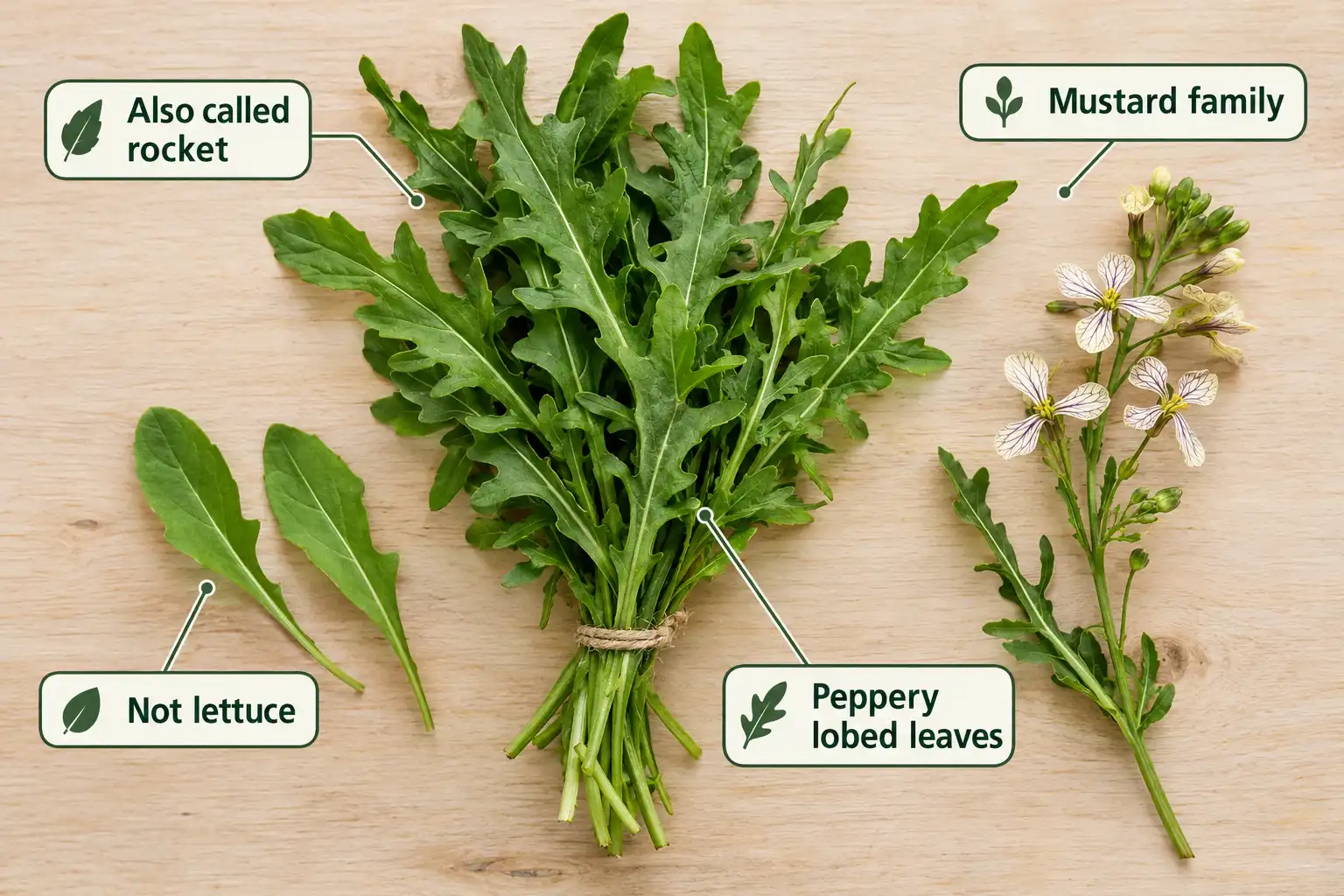
Arugula turns up in salad mixes, on pizza, and in seed catalogs under several names. So what is arugula? It’s a fast, peppery leafy green from the mustard family. Here’s how to recognize it at every stage, what it offers nutritionally, and how it behaves in a garden.
Arugula, also called rocket, is a cool-season leafy green in the mustard family, not a lettuce. Its lobed, peppery leaves grow fast from seed. USDA data puts one cup at about 5 calories, with useful vitamin K.
Where Arugula Comes From and How It Tastes
Arugula is a leafy green people grow for its sharp, peppery leaves. UW-Madison Extension describes it as a cool-season annual in the mustard family (Brassicaceae), grown much like lettuce or spinach. It comes from the Mediterranean, east to Turkey and northern India. Romans grew it, and Italian cooks still use it widely. Even so, it only caught on in the United States in the 1990s.
Botanists don’t agree on its formal name. UW-Madison Extension lists it as Eruca sativa. By contrast, NC State Extension uses Eruca vesicaria. Both names describe the same plant, so seed packets may carry either one.
The flavor is the giveaway. UF/IFAS Extension compares the bite to horseradish. Young leaves taste nutty and peppery, while older leaves turn stronger and more bitter, according to UW-Madison. Also, the leaves aren’t the only part you can eat. NC State notes that the flowers, young seed pods, and seeds are edible too.
Because it grows fast and handles frost, arugula fits easily among other cool-season leafy greens in spring and fall beds.
What Does Arugula Look Like?
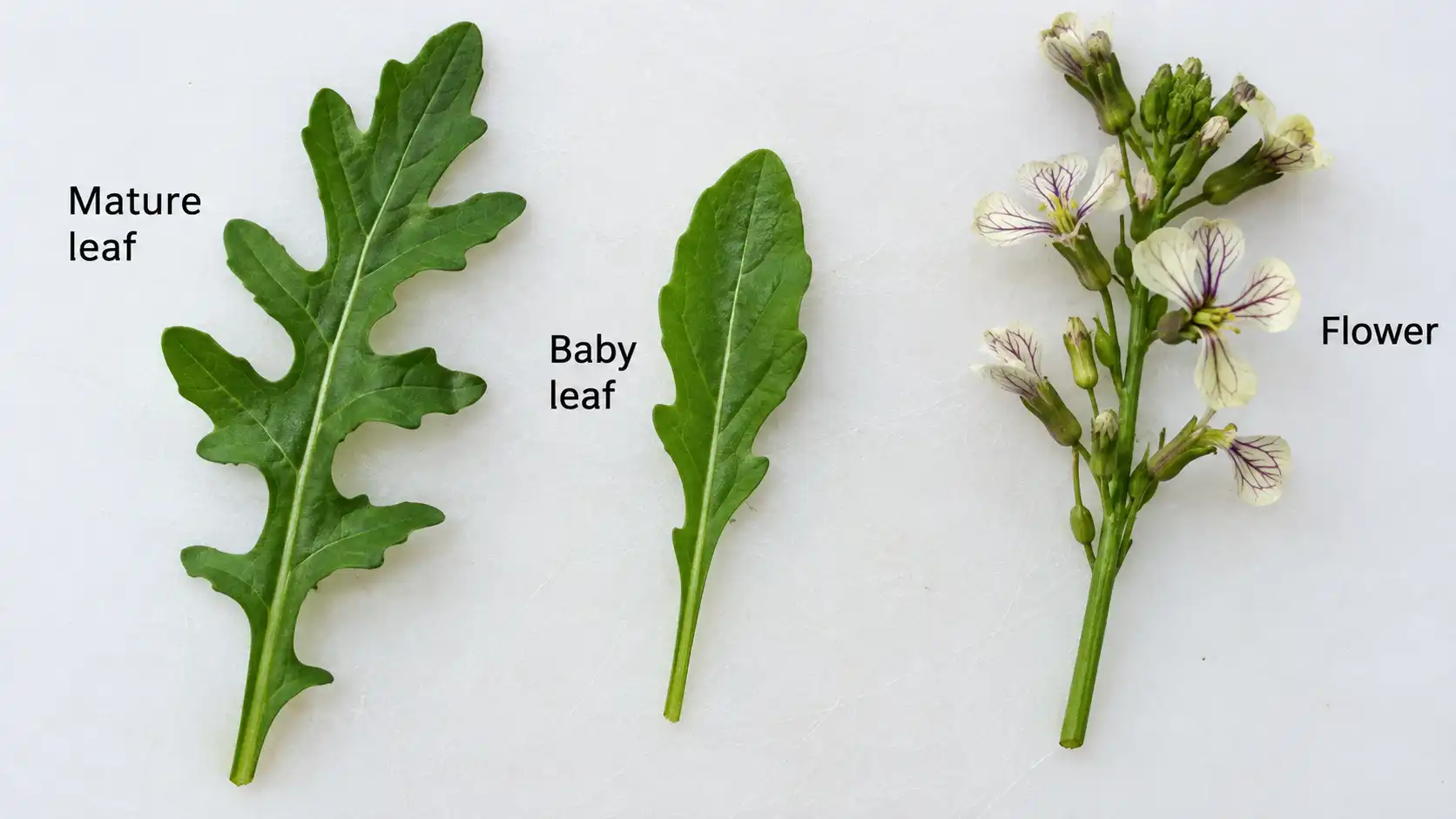
Arugula grows as a low rosette of dull green leaves, each 3 to 8 inches long, per UW-Madison Extension. Mature leaves have deep lobes. NC State counts 4 to 10 small side lobes and one larger lobe at the tip. Overall, the plant looks a lot like dark green oak leaf lettuce.
Young leaves look quite different. They start smooth-edged and narrow, with no lobes at all. That’s why bagged baby arugula looks like small green paddles, not the notched leaves of a garden plant. So if you’re comparing a picture of arugula with a plant in your bed, check the leaf age first.
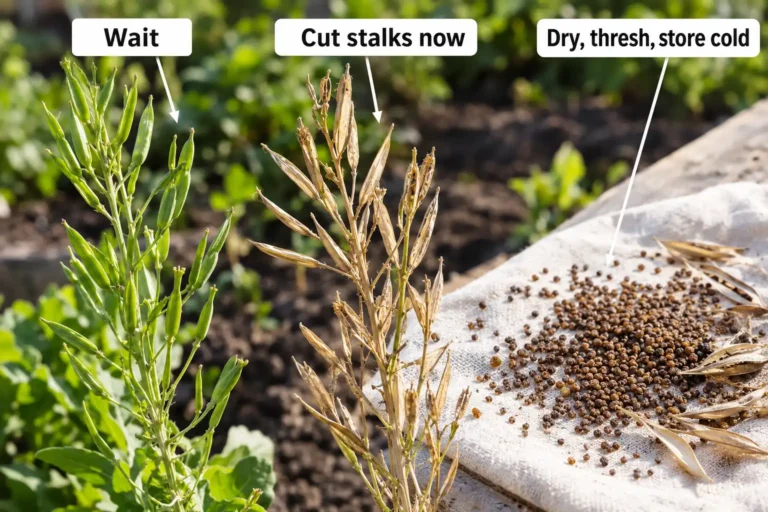
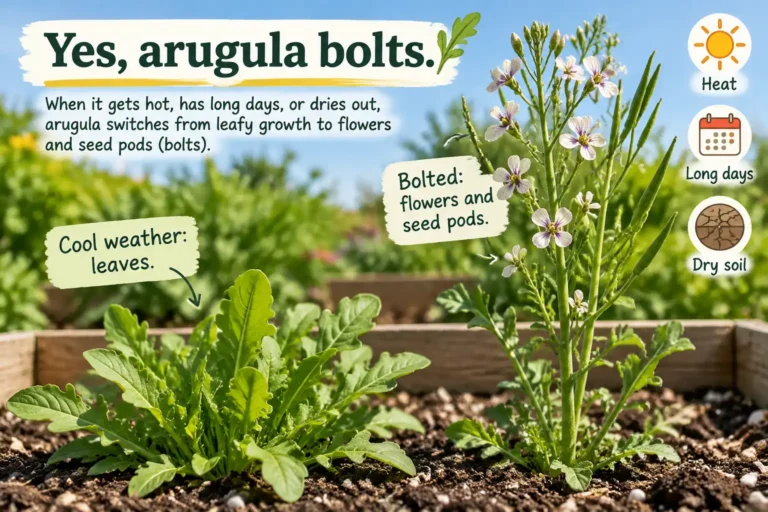
Later in the season, the plant changes shape. UW-Madison notes that long days, heat, or dry soil trigger a branched flower stalk 2 to 3 feet tall. Each flower has four cream petals with purple to reddish brown veins, about 1/2 to 3/4 inch across. Then slim pods follow, up to 1 1/2 inches long, each holding 6 to 8 brown seeds.
Is Arugula Lettuce?
No, arugula is not lettuce, even though some stores label it “arugula lettuce.” NC State Extension places lettuce in the daisy family (Asteraceae). Arugula, on the other hand, sits in the mustard family with cabbage, radishes, and kale.
The mix-up makes sense, though. Both are fast, cool-season salad greens. Both also bolt when the weather turns hot. In fact, NC State describes arugula as resembling tall lettuce.
Taste settles the question quickly. Lettuce is mild, while arugula has a mustard-like bite. That bite comes from sulfur compounds that cabbage family plants make and lettuce doesn’t.
Is Arugula Rocket?
Yes, arugula and rocket are the same plant. NC State Extension lists rocket, salad rocket, garden rocket, roquette, and rucola among its common names. UF/IFAS adds “true rocket” and traces the English word back to the French roquette. In practice, Americans usually say arugula, while British cooks say rocket.
Garden Arugula vs. Wild Arugula
“Wild arugula” or “wild rocket” is a separate plant, Diplotaxis tenuifolia. NC State’s wild arugula profile describes it as a heat-tolerant perennial with narrow, deeply divided leaves and yellow flowers. It’s hardy in zones 5a to 9b, per NC State. Garden arugula, by contrast, is an annual with broader leaves and cream flowers. Both work the same way in the kitchen.
NC State Extension’s plant profiles supply most entries in this comparison.
| Trait | Garden arugula | Wild arugula | Lettuce |
|---|---|---|---|
| Botanical name | Eruca vesicaria (also E. sativa) | Diplotaxis tenuifolia | Lactuca sativa |
| Plant family | Mustard (Brassicaceae) | Mustard (Brassicaceae) | Daisy (Asteraceae) |
| Life cycle | Annual | Perennial, zones 5a to 9b | Annual |
| Mature leaves | Broad, with 4 to 10 side lobes | Narrow, deeply divided | Round to ragged, often wavy |
| Flowers | Cream with purple veins | Yellow | Small, yellow, on tall stalks |
| Flavor | Peppery, nutty | Strong, peppery | Mild |
| Heat response | Bolts in hot weather | Heat tolerant | Heat (70 to 80°F) and dry soil trigger bolting |
| Height | 8 inches to 3 feet | 6 inches to 2 feet | 6 to 12 inches |

Is Arugula a Cruciferous Vegetable?
Yes. The National Cancer Institute lists arugula among cruciferous vegetables, along with broccoli, kale, cabbage, radishes, and watercress. “Cruciferous” comes from Cruciferae, an older name for the mustard family. UF/IFAS still uses that name for arugula. The term points to the flowers, and NC State describes arugula’s four petals as cross-shaped.
That family tie explains the flavor. According to the NCI, cruciferous vegetables contain glucosinolates, sulfur-containing compounds behind their pungent smell and bitter taste.
It matters in the garden as well. Arugula shares pests with its relatives. UW-Madison Extension names flea beetles as the main one, and NC State adds aphids. So if you spot clusters of tiny soft insects, compare them with these signs of aphids on vegetables. Also, plan arugula with your other cabbage family crops when you rotate beds.
What Do Arugula Seedlings Look Like?
Arugula seedlings open with two rounded seed leaves, or cotyledons, each notched at the tip. UW-Madison Extension describes the first true leaves as smooth-edged and elongated. Lobes appear only on later leaves, so a young patch looks nothing like the finished plant.
Speed is another clue. UW-Madison says arugula seed comes up within a few days, even in cool soil. That quick start stands out, because cold soil slows sprouting in many other crops. To tell crop from weed, sow in a marked row or a labeled patch.
Watch the first leaves closely. Small round holes match the shot-hole pattern UW-Madison links to flea beetle feeding. Other problems can look similar, though, so your county extension office or local Master Gardener volunteers can confirm the cause. Row covers keep flea beetles off, UW-Madison notes. However, the beetles spend winter in the soil, so they may emerge under covers you lay down too early.

Is Arugula a Weed?
No. Arugula is a crop, but it can act weedy. UW-Madison Extension says it reseeds readily when plants mature in the garden. NC State Extension agrees that it self-seeds. Still, NC State adds that it seldom becomes a weed or escapes into natural areas.
Wild arugula behaves a bit differently. NC State reports that it has escaped from cultivation and turns up now and then in disturbed ground in North America. And because it’s perennial, a patch returns each year.
The “rocket” name adds confusion too. Yellow rocket and dame’s rocket are weedy mustard family plants, but neither one is arugula.
Volunteers are easy to manage. Cut flower stalks before the pods dry and split open. Or, as UW-Madison suggests, let a few plants drop seed on purpose for a fall crop.
Arugula Nutrition Facts
USDA FoodData Central lists raw arugula at about 92% water and 25 calories per 100 grams. USDA weighs half a cup at 10 grams, so a loose cup comes to about 20 grams. The table carries USDA’s 100-gram figures down to that one-cup serving.
| Nutrient | Per 1 cup (20 g) | Per 100 g |
|---|---|---|
| Calories | 5 | 25 |
| Protein | 0.5 g | 2.6 g |
| Carbohydrates | 0.7 g | 3.7 g |
| Fiber | 0.3 g | 1.6 g |
| Vitamin K | 21.7 mcg | 108.6 mcg |
| Folate | 19 mcg | 97 mcg |
| Vitamin A (RAE) | 24 mcg | 119 mcg |
| Vitamin C | 3 mg | 15 mg |
| Calcium | 32 mg | 160 mg |
| Potassium | 74 mg | 369 mg |
| Magnesium | 9 mg | 47 mg |
| Iron | 0.3 mg | 1.46 mg |
| Lutein + zeaxanthin | 711 mcg | 3,555 mcg |
Per cup, vitamin K is the standout. Most other nutrients arrive in small amounts, simply because a cup of arugula weighs so little. So the gains show up when you eat it by the salad bowl, not a few leaves on a sandwich.

Benefits of Arugula
Vitamin K for very few calories is the clearest of arugula’s benefits. The NIH Office of Dietary Supplements sets adequate intake at 120 mcg a day for men and 90 mcg for women.
Now carry that to a real portion. A 2-cup side salad weighs about 40 grams. At USDA’s 108.6 mcg per 100 grams, that salad holds about 43 mcg of vitamin K. That covers roughly half the daily target for women and over a third for men, for about 10 calories.
Arugula also adds folate, calcium, and the carotenoids lutein and zeaxanthin. The NCI groups cruciferous vegetables with the dark-green vegetables in federal diet guidance. Still, each serving supplies modest amounts, so arugula works best as one green among several.
What the Cancer Research Shows
Many articles credit arugula with fighting cancer. The evidence is thinner than those claims suggest. NCI explains that compounds formed from glucosinolates slowed cancer in lab animals and cell studies. In people, though, studies show mixed results. NCI does note that eating more vegetables in general may protect against some cancers. So arugula earns its place as a vegetable, not as a cure.
A Note for People Taking Warfarin
Vitamin K affects how the blood thinner warfarin works. For that reason, NIH advises people on warfarin to keep vitamin K from food and supplements about the same each day. So if you take it and plan to eat a lot more arugula, talk with your doctor or pharmacist first.
Arugula as a Garden Crop
Arugula is a quick cool-season crop, and your climate sets its timing:
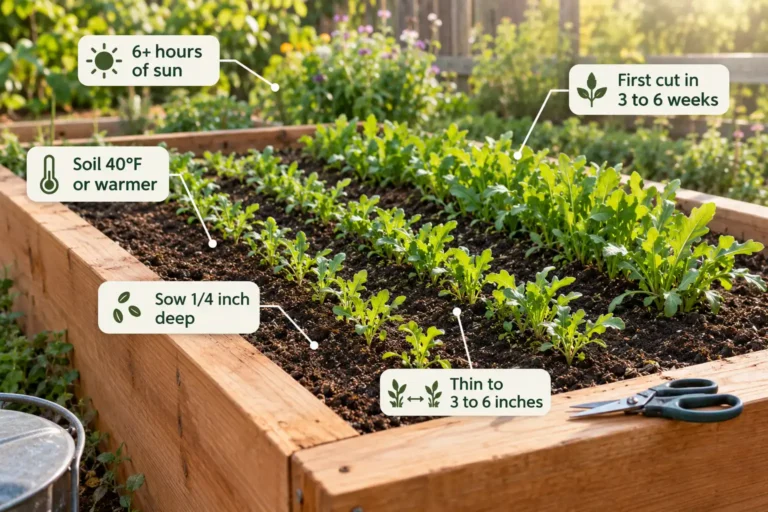
- Upper Midwest: UW-Madison Extension says arugula tolerates frost, so Wisconsin gardeners can sow it several weeks before the average last spring frost. Repeat sowings every 2 to 3 weeks from early spring to fall.
- Florida: UF/IFAS grows it in fall, winter, and spring, the same seasons as radishes, because hot spells make it bolt quickly.
- North Carolina: NC State Extension favors cooler spring and fall weather, with some shade in hot climates to slow bolting.
For dates tied to one climate, this month-by-month calendar for zone 6b shows where cool-season greens fit around frost dates.
How Long Until Harvest?
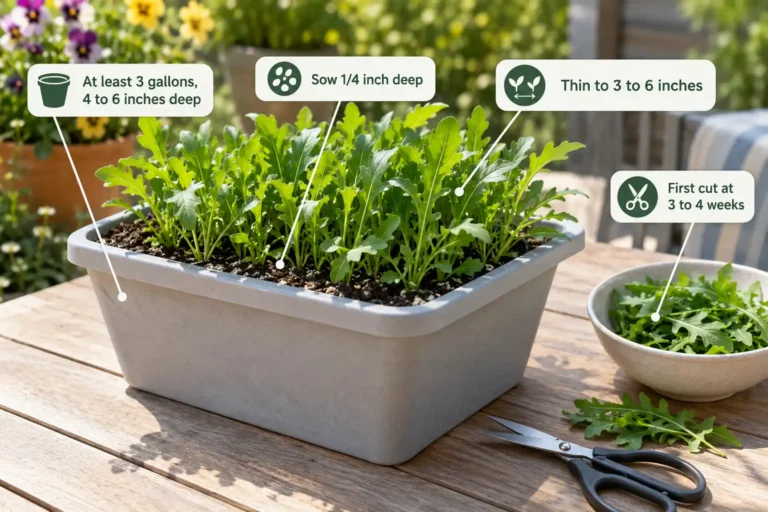
Baby leaves can be ready in as little as 3 to 4 weeks, per UW-Madison Extension in Wisconsin. Full-size plants take 40 to 50 days in North Carolina, according to NC State. Meanwhile, UF/IFAS gives 2 to 3 months from seed in Florida’s cool season. The gap comes partly from what each figure measures: a first cut of young leaves versus a full-size plant.
To plan your own first cut, add 3 to 4 weeks to your sowing date. For example, if you sow on April 1, UW-Madison’s figure puts baby leaves around April 22 to 29. After that, pick often. UW-Madison notes that regular harvesting helps keep the plant from going to seed.
Spacing in a Bed or Pot
UW-Madison Extension suggests thinning to 3 to 6 inches for single plants, while NC State uses 6 inches. For cut-and-come-again leaves, UW-Madison says you can leave plantings denser. To fill a row, divide its length in inches by the spacing. An 8-foot row along a 4 by 8 foot bed is 96 inches long. So it holds 16 plants at 6 inches, or 32 plants at 3 inches.
In pots, NC State calls for at least 3 gallons of soil and a depth of 4 to 6 inches. That makes arugula an easy fit for container vegetable gardening on a patio or balcony.
Frequently Asked Questions
Is baby arugula a different plant?
No, baby arugula is the same plant, picked while its leaves are small, smooth-edged, and mild. UW-Madison Extension notes that older leaves develop a stronger, more bitter flavor as plants age.
Is arugula an herb or a vegetable?
It’s a leafy vegetable, though people often buy and use it like an herb. NC State Extension calls it a cool-season vegetable, while UF/IFAS notes that seed catalogs often list it under herbs as roquette.
Can you eat arugula flowers?
Yes, arugula flowers are edible, and UW-Madison Extension says they taste milder than the leaves. Scatter them over salads or soups as a garnish, and try the young seed pods while they’re still tender.
Why does my arugula taste so bitter?
Age, heat, and drought all sharpen arugula’s flavor, according to UW-Madison Extension. Pick leaves young and harvest often, which also slows the plant’s shift toward flowering, when leaves turn bitter.
Does arugula come back every year?
Garden arugula is an annual, so each plant dies after setting seed, though dropped seed may sprout later. Wild arugula is a perennial, and NC State Extension lists it as hardy in zones 5a to 9b.
Can you grow arugula indoors in winter?
Yes, and UW-Madison Extension notes it can grow in containers, even on a bright windowsill in winter. Sow a fresh pot every 2 to 3 weeks, the interval UW-Madison suggests outdoors, for steady leaves.
Key Points for Your Garden
Arugula is rocket: a fast, peppery green from the mustard family, not a lettuce. Sow it in cool weather, pick the leaves young, and cut flower stalks before the pods split unless you want volunteers. At the table, count on it mainly for vitamin K, and keep your intake steady if you take warfarin.