How to Grow Arugula: Sowing, Spacing, and Harvest Times
Arugula is a cold-tolerant salad green in the mustard family. It is ready to cut within weeks of sowing. Below is how to grow arugula from seed, with sourced figures for soil temperature, spacing, sun, water, and harvest.
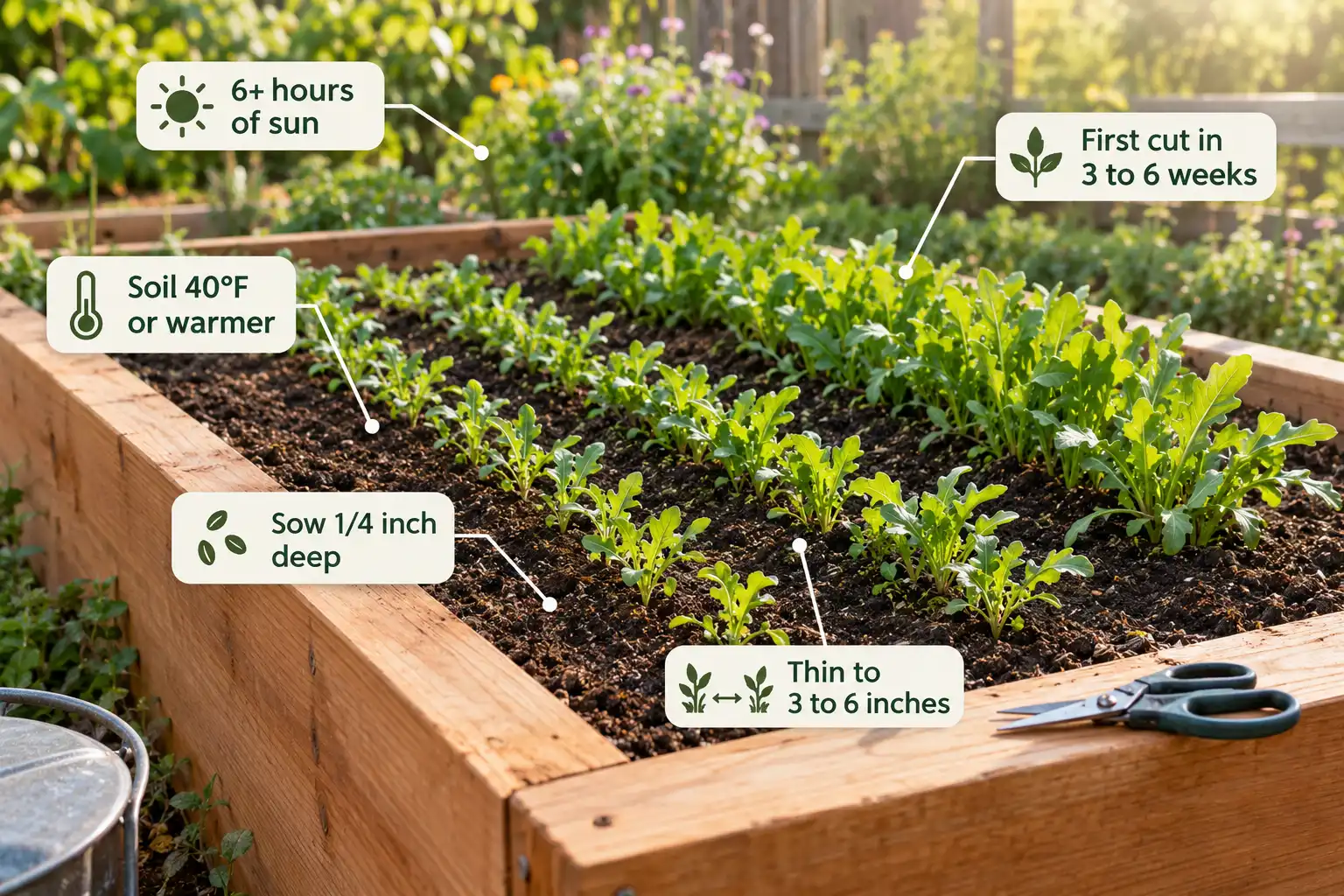
To grow arugula, sow seed 1/4 inch deep in spring or fall soil of at least 40°F. Give it 6+ hours of sun and steady moisture. Thin to 3 to 6 inches, and cut leaves in 3 to 6 weeks.
How to Grow Arugula: What It Needs at a Glance
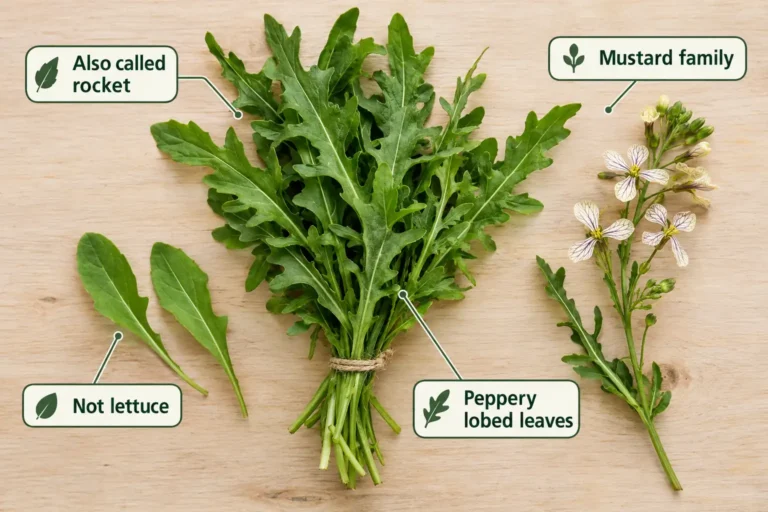
Salad arugula (Eruca vesicaria, also sold as Eruca sativa) is a cool-season annual. Like other cool-season leafy greens, it grows best in spring and fall and tends to flower in summer heat.
| Need | Figure for salad arugula | Source and region |
|---|---|---|
| Soil temperature to sprout | At least 40°F; fastest at 75°F | USDA SARE manual (Northeast) |
| Seed depth | 1/4 inch | SARE (Northeast), UF/IFAS (Florida) |
| Spacing after thinning | 3 to 6 inches | UF/IFAS, UW-Madison (Wisconsin), NC State |
| Sun | 6 or more hours; tolerates 2 to 6 | NC State Extension (North Carolina) |
| Water | About 1 inch a week, rain included | Univ. of Minnesota Extension |
| Time to first harvest | 20 days in summer; 30 to 40 in spring and fall | Illinois Extension (Midwest) |
| Plant height | 8 inches to 3 feet, counting the flower stalk | NC State Extension |
Each extension service writes for its own climate. So where two sources disagree, the sections below give both figures and explain why.
When to Plant Arugula
Plant arugula in early spring, as soon as the soil can be worked. Then sow again from late summer into fall. University of Wisconsin-Madison Extension notes that arugula tolerates frost. That means it can go in several weeks before your average last spring frost.
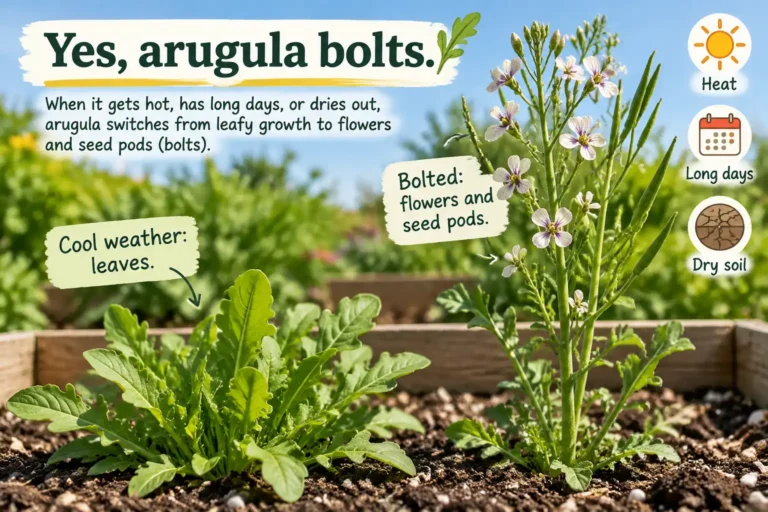
Late spring is the window to skip. The USDA SARE Northeast Crop Production and Harvest Manual explains that long days and high temperatures make arugula bolt. For that reason, it advises against spring sowings that would mature in summer.
For fall, the SARE manual suggests sowing again once nights cool off. In the northern United States, that’s August through September. Keep sowing until 3 to 4 weeks before your first fall frost. For example, if your average first fall frost is October 10, your last sowing falls between September 12 and September 19.
Florida flips the calendar. UF/IFAS Extension’s Florida Fresh guide, checked in October 2026, lists September to March for north and central Florida. In south Florida, the window runs October to March.
If you garden in zone 6b, a month-by-month zone 6b calendar shows where spring and fall greens fit around your frost dates. Still, soil temperature is the more reliable signal, as the next section shows.
How Soil Temperature Affects Arugula Germination
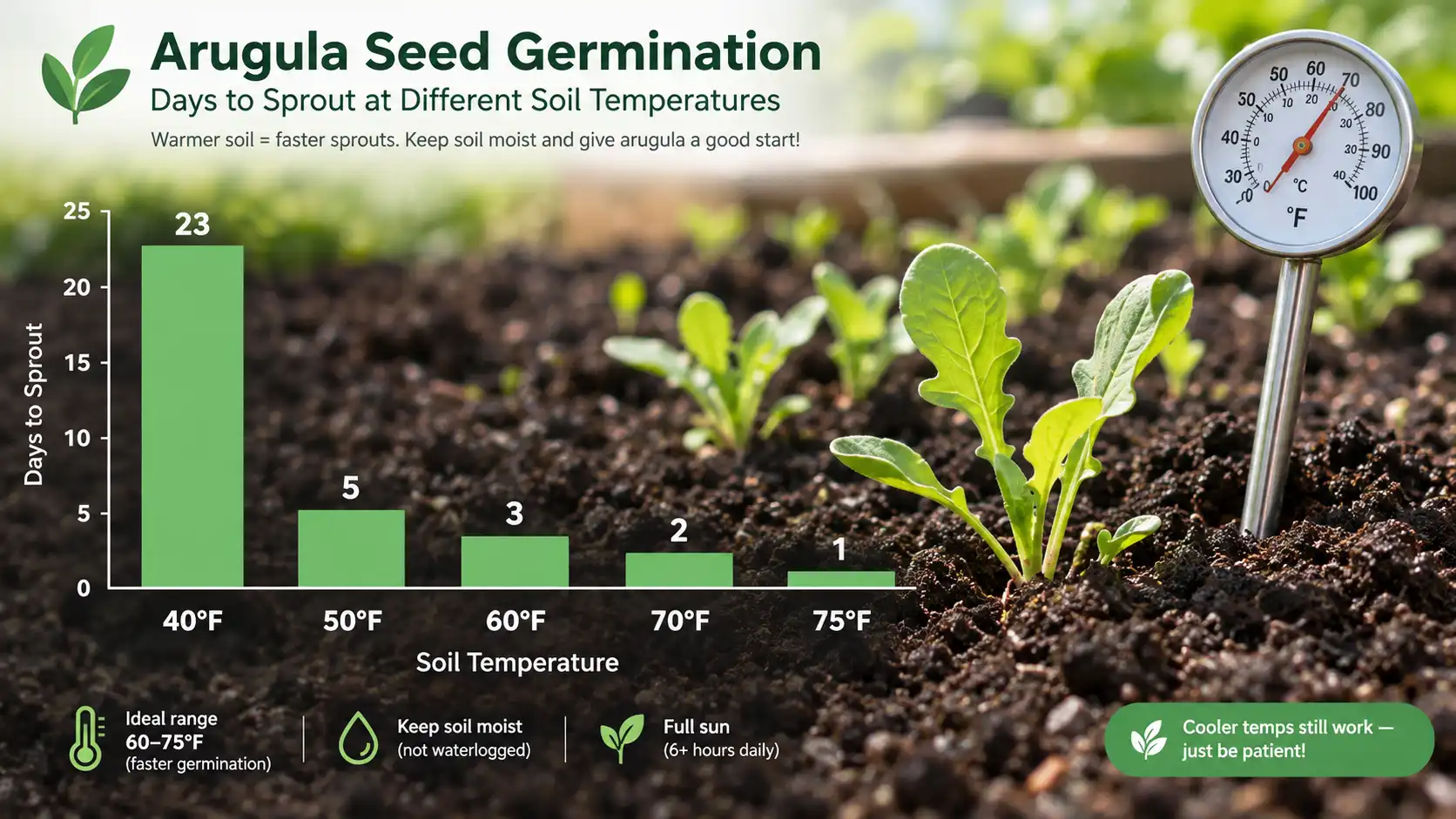
Arugula seed sprouts in about 5 days in 50°F soil but needs about 23 days at 40°F. Those figures come from the SARE manual’s germination table for the Northeast. The same manual notes that arugula won’t sprout below 40°F.
| Soil temperature | Days for arugula to sprout |
|---|---|
| 40°F | 23 |
| 50°F | 5 |
| 60°F | 3 |
| 70°F | 2 |
| 75°F | 1 |
That gap between 40°F and 50°F matters most in early spring. Seed sown into cold soil sits for three weeks before anything shows. So check the soil at seed depth with a soil thermometer before you sow.
Other vegetables slow down in cold soil too. For that reason, checking germination times by soil temperature helps when you plan the rest of a spring bed.
How to Plant Arugula Seeds
Seeding arugula directly into the bed is the usual method, because it sprouts fast in cool ground. UW-Madison notes that transplants work too.
- Choose a sunny, well-drained spot. Arugula wants 6 or more hours of sun, per NC State. Also, Illinois Extension warns that heavy clay or soggy ground can lead to root rot.
- Rotate away from cabbage-family beds. The SARE manual advises keeping arugula off ground that grew broccoli, cabbage, or other brassicas for 1 to 3 years. They share pests and diseases.
- Test the soil first. SARE advises amending based on a soil test. Its Northeast table lists a pH of 6.2 to 6.5 for arugula. On a new site near older buildings or busy roads, ask the lab to check for lead too.
- Sow 1/4 inch deep. Both SARE and UF/IFAS give that depth. Space rows about 10 inches apart, as UF/IFAS does in Florida, or scatter seed in a band for baby leaves.
- Keep the seedbed moist. Shallow seed dries out fast, so water often until sprouts appear.
- Thin once true leaves appear. Snip extras at soil level with scissors, so the roots you keep stay intact.
- Sow again on a schedule. UW-Madison suggests every 2 to 3 weeks, while NC State suggests every 1 to 2 weeks. Shorter gaps give a steadier supply of young leaves.
In a new raised bed, a loose, well-drained soil mix sidesteps the heavy clay that leads to root rot.
How Far Apart to Plant Arugula
Thin arugula to 3 to 6 inches apart: closer for baby leaves, wider for full-size plants. The sources print different numbers, and the reason is harvest size.
- UF/IFAS spaces plants 3 to 4 inches apart in rows 10 inches apart, for Florida gardens.
- UW-Madison suggests 3 to 6 inches for single plants, or a denser stand for cut-and-come-again picking.
- NC State thins to 6 inches.
Tight spacing suits baby leaves that you cut young and often. In contrast, wider spacing gives each rosette room to reach full size.
Bed math for a 4 by 8 foot raised bed. Run rows the long way. At 10 inches apart, five rows fit across the 48-inch width, with 4 inches to spare on each edge. Each 96-inch row then holds 16 plants at 6 inches apart (96 ÷ 6), or 32 plants at 3 inches apart (96 ÷ 3). That’s 80 full-size plants or 160 baby-leaf plants in one bed.
Few households can eat that much arugula before it bolts. So one or two rows, sown again every few weeks, usually serves a kitchen better than one big sowing.

How Many Arugula Seeds per Hole?
Plant one fresh seed per hole, or two or more if the seed is older. That matches University of Minnesota Extension’s seed-starting guidance for cells and pots. Once true leaves appear, it advises cutting all but the strongest seedling at soil level.
In the garden, though, holes are rarely the easiest method. Arugula seed is small, and the extension sources above sow it along a shallow row or in a band. Then they thin to spacing. A thin pinch of seed along a 1/4 inch furrow is faster than placing seeds one by one, and thinning fixes any crowding.
How Much Sun Does Arugula Need?
Arugula needs 6 or more hours of direct sun for its best growth, but it tolerates partial shade. NC State Extension rates it for both full sun (6 or more hours) and partial shade (2 to 6 hours).
Shade has a use, too. UW-Madison notes that light shade can slow bolting during the hottest part of the season. So give spring and fall sowings your sunniest spot. Then, for a late spring sowing, pick a bed that gets afternoon shade from taller crops or a building.
How to Care for Arugula
Watering
Keep the soil evenly moist, because dry soil is one of the bolting triggers UW-Madison names. University of Minnesota Extension puts a vegetable garden’s need at about 1 inch of water a week, rain included. That’s 62 gallons per 100 square feet. So one 4 by 8 foot bed of arugula (32 square feet) needs about 20 gallons a week without rain.
On sandy soil, UMN suggests half an inch twice a week instead. For that same bed, that’s about 10 gallons each time. Water when the soil is dry 2 inches below the surface, also per UMN.
Wet leaves invite leaf diseases, UMN adds. For that reason, drip irrigation along each row keeps the water at the roots.
Feeding and Mulch
UW-Madison describes arugula as a crop that needs little care. Feed it based on a soil test, not a calendar. A light mulch between rows also helps, since UMN notes that mulched soil may need watering less often.
Arugula Pests and Problems
Several leaf problems look alike. So your county extension office, local Master Gardener volunteers, or a plant diagnostic lab can confirm what you’re seeing. The descriptions below help you know what to ask about.
Flea beetles. UW-Madison describes these tiny beetles chewing small round holes in arugula leaves. In large numbers, they can wipe out young plants. Illinois Extension notes the pressure runs highest in spring and summer, then fades as fall cools. Leaves with holes are still edible, per UW-Madison.
Floating row covers and insect netting keep the beetles off. But UW-Madison cautions that flea beetles overwinter in the soil. A cover laid too early over infested ground can trap them inside. That’s one more reason to rotate away from last year’s cabbage-family beds.
Other problems. NC State lists aphids, bacterial leaf spot, and powdery mildew as occasional issues. Illinois Extension ties root rot to heavy clay and poorly drained soil. If you use any insecticide on a food crop, the product label sets how to mix it, how often to apply it, and how long to wait before picking.
Bolting. Bolting isn’t a pest, but it ends the harvest. UW-Madison names long days, high temperatures, and dry soil as triggers. Once the flower stalk rises, NC State notes that leaf growth stops and the flavor changes.
How Long Does Arugula Take to Grow?
Arugula takes about 3 to 6 weeks from seed to first harvest, depending on the season and the leaf size you want. Illinois Extension reports that summer arugula is ready within 20 days of sowing. Spring and fall crops, by contrast, take 30 to 40 days. Meanwhile, UF/IFAS lists 35 to 60 days for Florida’s fall-to-spring season.
Warm weather speeds growth, but it also speeds bolting. That’s why summer arugula is fast but short-lived.
| Stage | Timing for salad arugula | Source and region |
|---|---|---|
| Sprouts appear | About 5 days in 50°F soil | SARE (Northeast) |
| First whole-plant cut | 3 to 4 weeks | UW-Madison (Wisconsin) |
| Spring or fall harvest | 30 to 40 days | Illinois Extension (Midwest) |
| Full size | 40 to 50 days | NC State (North Carolina) |
| Bolting | As days lengthen and heat rises | UW-Madison, SARE |
Your harvest window = sowing date + days to harvest. For example, take an April 1 sowing in a Midwest spring. Illinois Extension’s 30 to 40 days puts your first cut between May 1 and May 11.
How Big Does Arugula Get?
Salad arugula forms a low rosette of leaves 3 to 8 inches long, according to UW-Madison. When it bolts, it sends up a branched flower stalk 2 to 3 feet tall. NC State gives the full range as 8 inches to 3 feet tall and 8 to 18 inches wide. Wild arugula stays a little smaller, at 6 inches to 2 feet tall.
You rarely need to wait for full size, though. The SARE manual treats plants 3 to 4 inches tall as salad size and 6 to 10 inches tall as cooking-green size. UF/IFAS suggests cutting whole plants at 8 to 10 inches.
How to Harvest Arugula
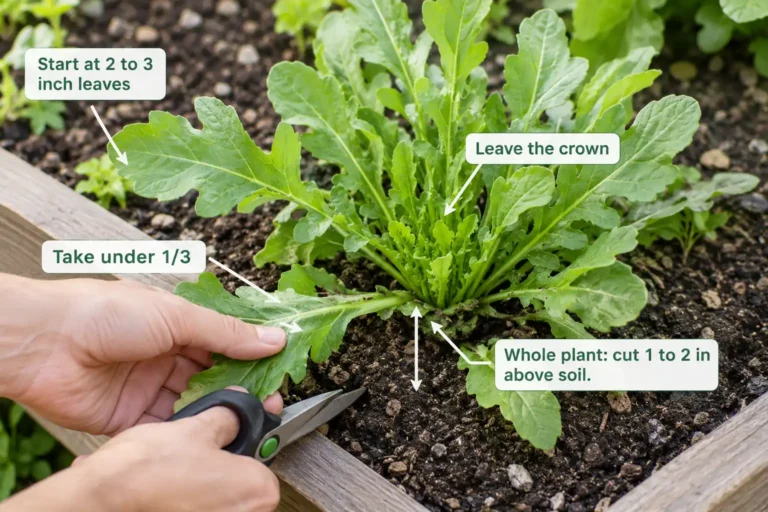
Start harvesting when leaves are about 2 inches long, which UW-Madison gives as the earliest picking size. You can pick single leaves or cut the whole plant. Either way, the plant regrows.
How to Pick Arugula Leaf by Leaf
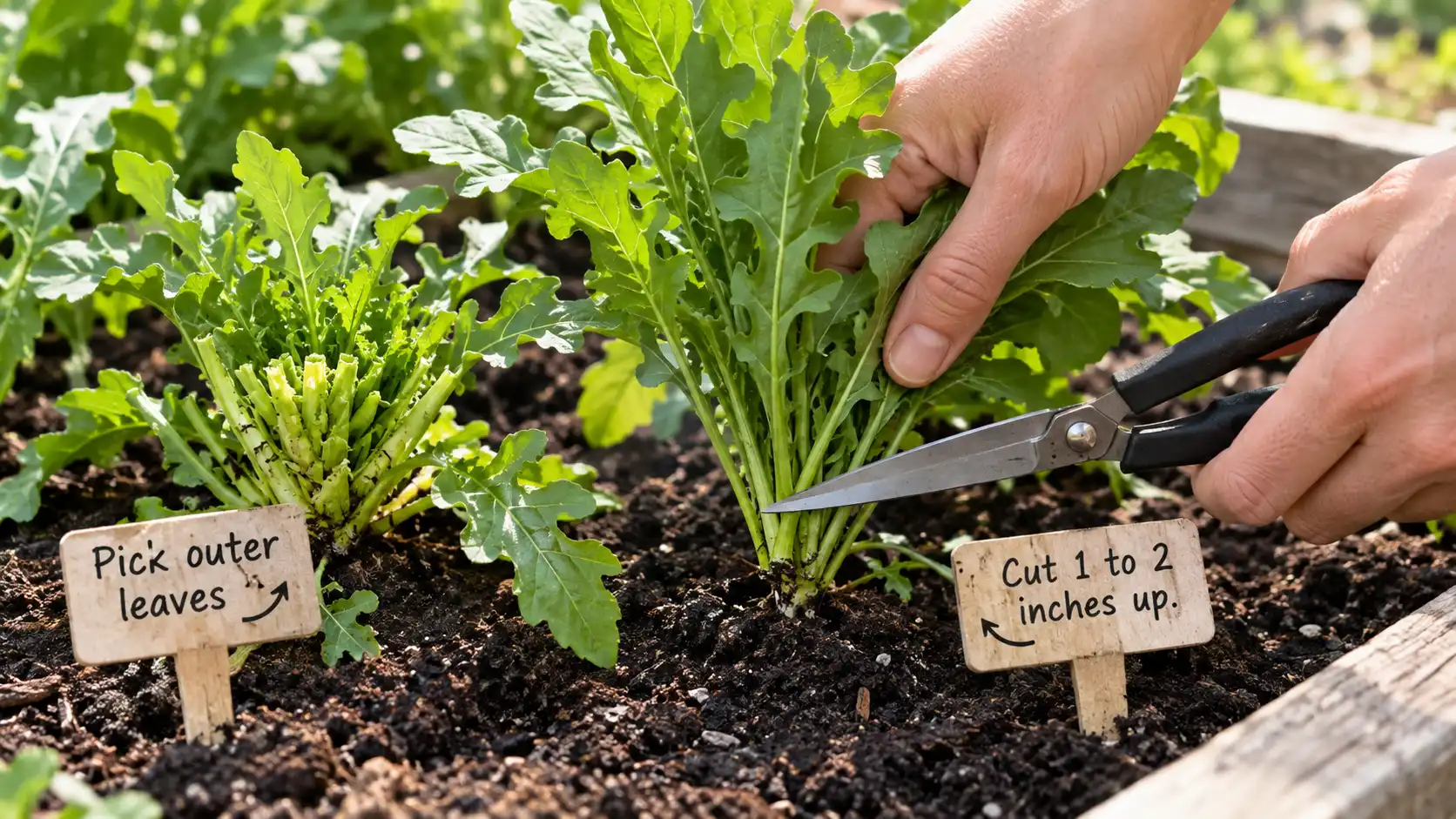
Snip the outer leaves at their base and leave the center to keep growing. Pick often. UW-Madison notes that regular picking of small leaves helps hold off flowering. Young leaves also taste milder than old ones.
Cutting the Whole Plant
Cut the plant 1 to 2 inches above the soil, then harvest the regrowth. Both UW-Madison and the SARE manual describe this method. Illinois Extension adds that fall-grown arugula can take several cuts and keep going into the next spring, until it bolts.
Storing the Harvest
Pick in the morning, as SARE advises, to avoid field heat. Then refrigerate the leaves right away. NC State notes that arugula doesn’t keep long in the refrigerator, so harvest only what you’ll use soon.
Growing Arugula in Pots
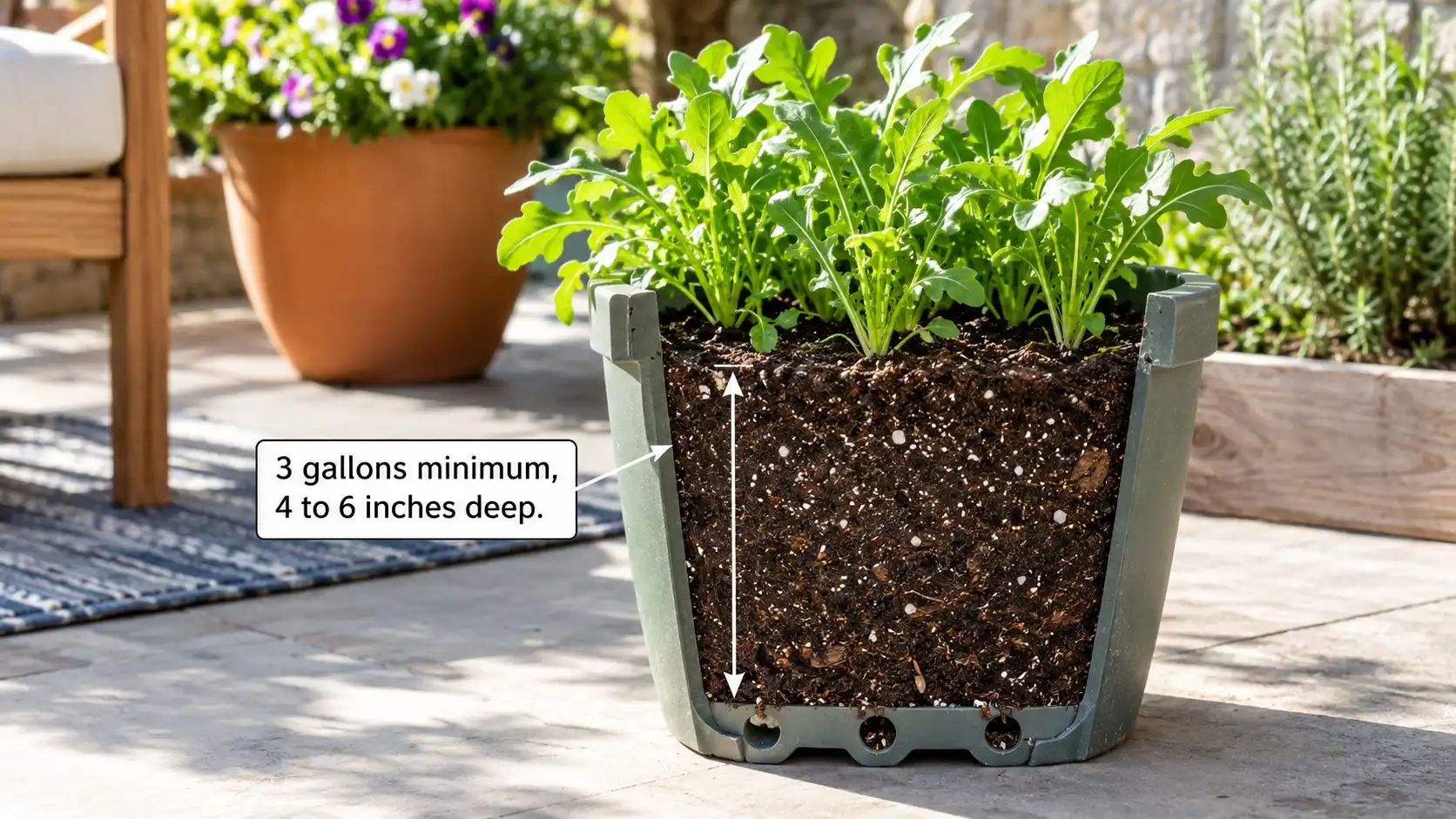
Arugula grows well in a pot that holds at least 3 gallons of mix. NC State sets that minimum, along with a soil depth of at least 4 to 6 inches. UW-Madison adds that it grows in containers, even indoors on a bright windowsill in winter.
Use a pot with drainage holes, and fill it with potting mix rather than garden soil. Sow 1/4 inch deep and thin to 3 to 6 inches, as in a bed. In a pot 12 inches across, 4-inch spacing leaves room for about 6 or 7 plants.
Pots dry out faster than beds. So check the mix often, and water when it’s dry 2 inches down, the same test UMN uses for gardens. In late spring, move the pot into afternoon shade to slow bolting.
Does Arugula Come Back Every Year?
Salad arugula does not come back. It’s an annual, and Illinois Extension notes that flowering marks the end of its life cycle. Still, UW-Madison points out that arugula reseeds readily when plants are left to flower. As a result, volunteer seedlings often appear nearby.
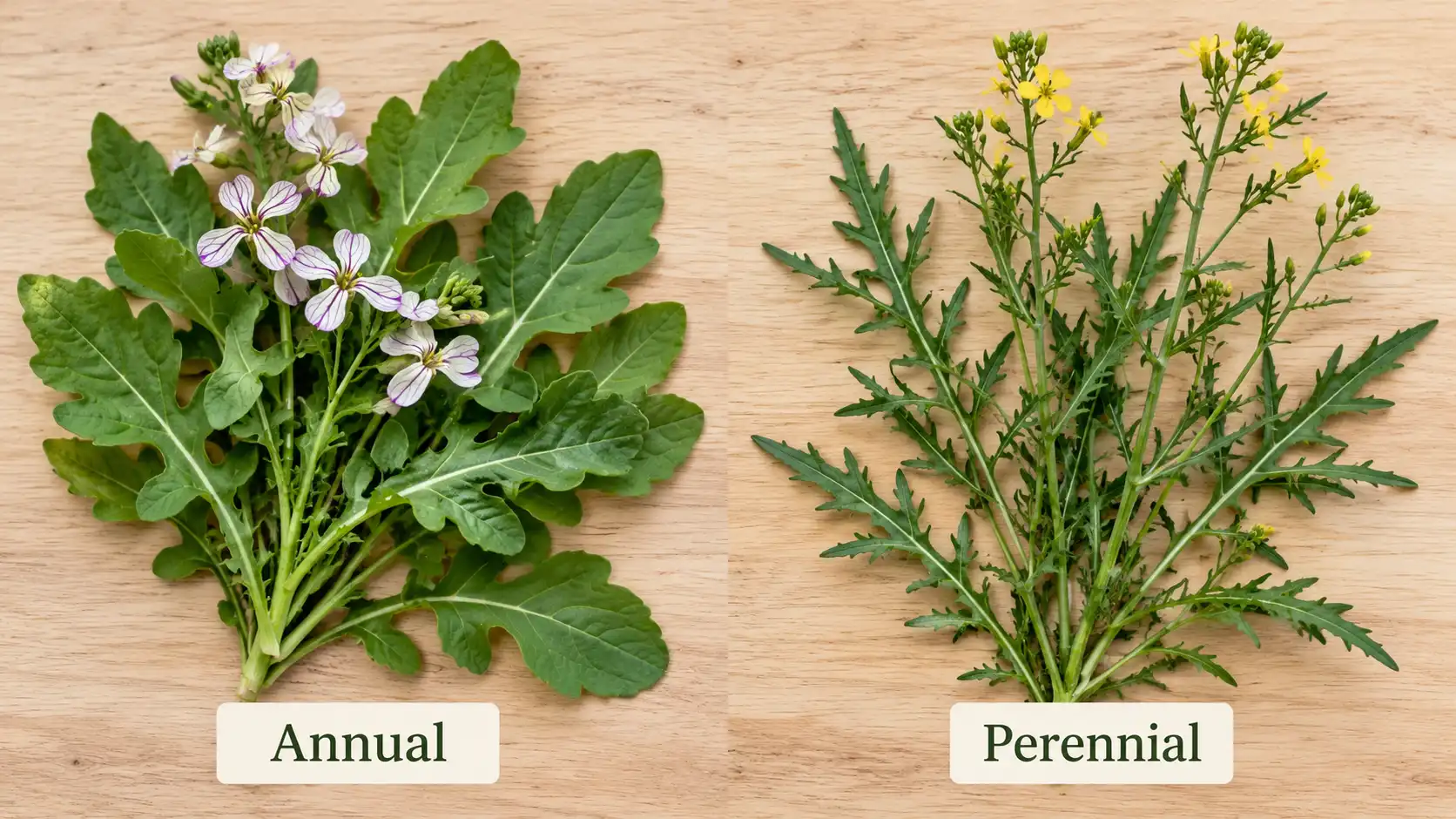
Wild arugula is different. NC State lists wild arugula (Diplotaxis tenuifolia) as a heat-tolerant perennial for hardiness zones 5a to 9b. It suggests sowing it after the last frost, and it can also be grown as an annual.
| Trait | Salad arugula | Wild arugula |
|---|---|---|
| Botanical name | Eruca vesicaria (also Eruca sativa) | Diplotaxis tenuifolia |
| Life cycle | Annual | Perennial in zones 5a to 9b |
| Height | 8 inches to 3 feet | 6 inches to 2 feet |
| Leaves | Broad and lobed | Narrow and deeply divided |
| Flowers | Cream to white, with purple veins | Yellow |
| Summer heat | Bolts | Heat tolerant |
The plant traits above come from NC State, with flower detail from UW-Madison.
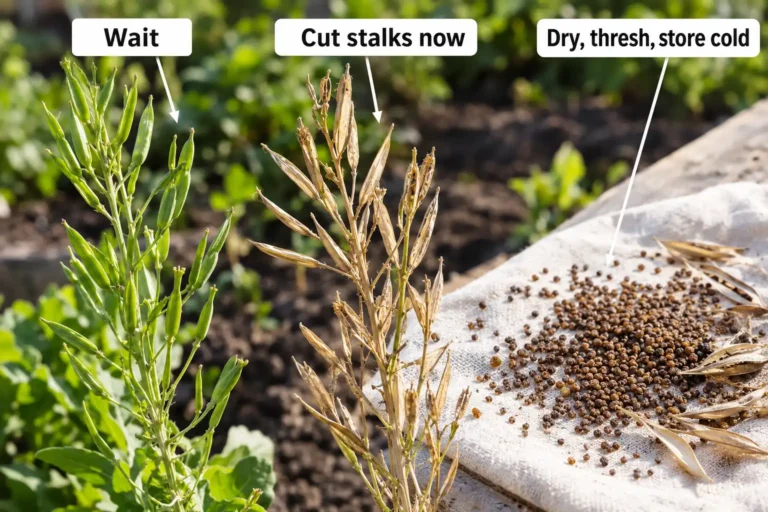
To save seed from salad arugula, UW-Madison suggests cutting the stems as the plants begin to dry. Then hang them upside down in a paper bag until the pods split and release their seeds.
FAQs About Growing Arugula
Can you grow arugula in summer?
Yes, but summer arugula bolts fast in heat and long days. Illinois Extension notes it’s ready within 20 days of sowing, so sow small batches often and give it afternoon shade.
Why is my arugula so bitter?
Bitterness usually comes from older leaves, heat, dry soil, or a plant that has started to flower. UW-Madison notes drought and summer heat strengthen the flavor, so pick leaves young and keep the soil evenly moist.
Can arugula survive frost?
Yes, arugula handles light frost well, and Illinois Extension reports most types survive 22°F. In the Midwest, plants under a cold frame or low tunnel may even last the whole winter.
Will arugula grow back after cutting?
Yes, if you leave 1 to 2 inches of stem above the soil. UW-Madison and the SARE manual both describe cutting at that height and harvesting the regrowth until the plant bolts.
Can you eat arugula flowers?
Yes, the flowers are edible and milder than the leaves, per UW-Madison. Young, tender seed pods are edible too, though once a plant flowers, its leaf harvest is nearly over.
Why does my arugula have tiny holes in the leaves?
Small round holes match the damage UW-Madison describes from flea beetles on arugula. Other pests can leave similar holes, so your county extension office or a plant diagnostic lab can confirm the cause.
Before You Sow
Start with a soil thermometer. At 50°F, arugula sprouts in about 5 days instead of three weeks. Sow short rows every few weeks in spring, skip the late-spring window, and sow again as late summer cools. Pick leaves young. And if you want plants that return each year, grow wild arugula.