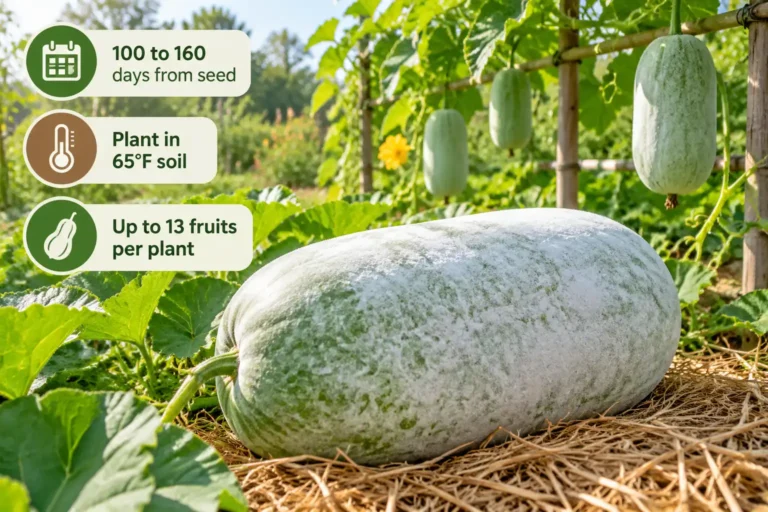
What Is Ash Gourd? How to Identify Winter Melon and Its Look-Alikes
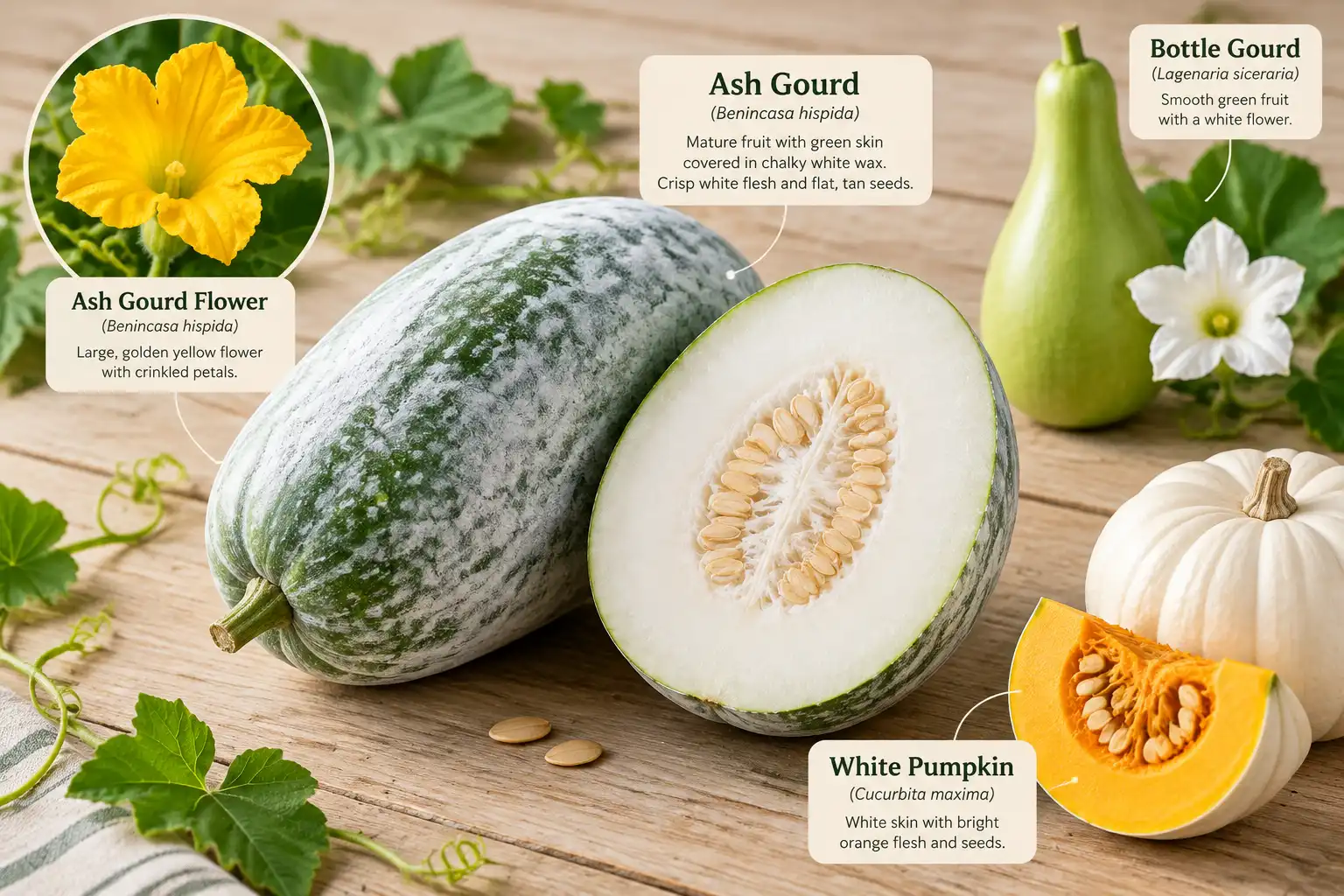
Ash gourd sells under several names in the US. Shoppers also mix it up with bottle gourd and white pumpkin. So what is ash gourd, and how do you tell it apart from those look-alikes?
Ash gourd is Benincasa hispida, a warm-season gourd vine grown for large, waxy fruit cooked as a vegetable. It is the same plant as winter melon and wax gourd, but not bottle gourd (lauki) or white pumpkin.
Where Ash Gourd Comes From and How Cooks Use It
Ash gourd belongs to the cucumber and squash family. The USDA National Agricultural Library files it as Benincasa hispida, with ash gourd and wax gourd as synonyms.
The plant is a pumpkin-like annual vine, according to UF/IFAS Extension. In the US, Asian vegetable farms in South Florida have grown it commercially for years.
In the kitchen, it acts like a mild vegetable, not a sweet melon. Michigan State University Extension notes that cooks use it in soups and stir-fries from India through China. UF/IFAS adds that people mostly boil it or cook it into dishes, though some slice it raw like cucumber.
Growers also pick it at two stages. Most ash gourd comes off the vine mature, after the wax forms, so it keeps for months. A smaller variety called fuzzy melon, however, gets picked young while it is still hairy.
What Does Ash Gourd Look Like?

A mature ash gourd looks like a watermelon dusted with chalk. UF/IFAS describes thin, tough green skin under a layer of white, chalky wax. That ashy coating is where the names ash gourd and wax gourd come from.
Skin, Flesh, and Seeds
Fine hairs cover young fruit. As it matures, it trades most of those hairs for wax. Even so, UF/IFAS notes that some varieties keep pale gray hairs on full-grown fruit.
Michigan State’s variety trial also turned up one type, Southern Dark Skin, that grew hairs but never formed wax. So a fruit without wax can still be an ash gourd.
Inside, the flesh is white, crisp, juicy, and mild. The seeds are flat, oval, and light brown, per UF/IFAS.
Handle mature fruit with care, though. Michigan State University Extension reports that the wax rubs off onto hands and clothes, and the stiff hairs irritate skin. Gloves solve both problems.
How Big Ash Gourd Gets
Size depends on the variety, and the sources give different typical weights. UF/IFAS says most fruit weighs 15 to 20 pounds. Some reach 30 to 40 pounds and up to 4 feet long. By contrast, UC ANR’s Small Farms Network says Chinese winter melon usually tops 30 pounds.
Michigan State’s 2016 trial shows how wide the spread runs. Average fruit weights went from 4.5 pounds for Large Oblong to 62.1 pounds for Long Giant. Shapes vary just as much, from round to long and oblong.
The Vine and Flowers
The vine has thick, furrowed, hairy stems that climb with tendrils. Its leaves are roughly triangular, irregularly lobed, and up to 10 inches long. According to UF/IFAS, the flowers are golden yellow and 2.5 to 3.5 inches wide. That flower color is also the fastest way to tell ash gourd from bottle gourd in a garden.
Is Ash Gourd the Same as Winter Melon?
Yes. Winter melon and ash gourd are two common names for the same plant, Benincasa hispida. UF/IFAS lists winter melon among its names, and Michigan State calls it winter melon or Chinese wax gourd.
The name has nothing to do with sweetness. Instead, it comes from storage. Michigan State University Extension explains that the fruit keeps at room temperature for several months, hence “winter melon.”
Fuzzy melon is a close relative worth knowing, too. UC ANR’s Small Farms Network describes hairy melon, or moqua (Benincasa hispida var. chieh-qua), as a smaller form of Chinese winter melon. Growers pick it young, before any wax forms, and cooks peel off the hairy skin.
Is Ash Gourd the Same as Bottle Gourd or Lauki?
No. Lauki is the Hindi name for bottle gourd, Lagenaria siceraria, which belongs to a different genus. US Asian markets often sell the long types as opo, which UC ANR identifies as a bottle gourd. Italian cucuzzi is another long bottle gourd, per UF/IFAS.

The flowers settle it fastest. UF/IFAS’s bottle gourd fact sheet describes white flowers up to 4 inches across, while ash gourd flowers are golden yellow.
The fruit differs too. UC ANR describes opo as very smooth and hairless, and growers usually pick it at 10 to 12 inches long. Young ash gourd, on the other hand, is hairy, and most of it goes to market mature and waxed. Left on the vine, bottle gourd dries into a hard shell that people turn into containers.
One safety point matters here. UF/IFAS warns that some bottle gourd varieties are bitter and may contain poisonous substances. So don’t eat a bottle gourd that tastes bitter.
Is Ash Gourd the Same as White Pumpkin?
It depends on who uses the name. UF/IFAS lists white pumpkin as one of ash gourd’s names. At US farm stands, though, a white pumpkin is usually a true pumpkin.
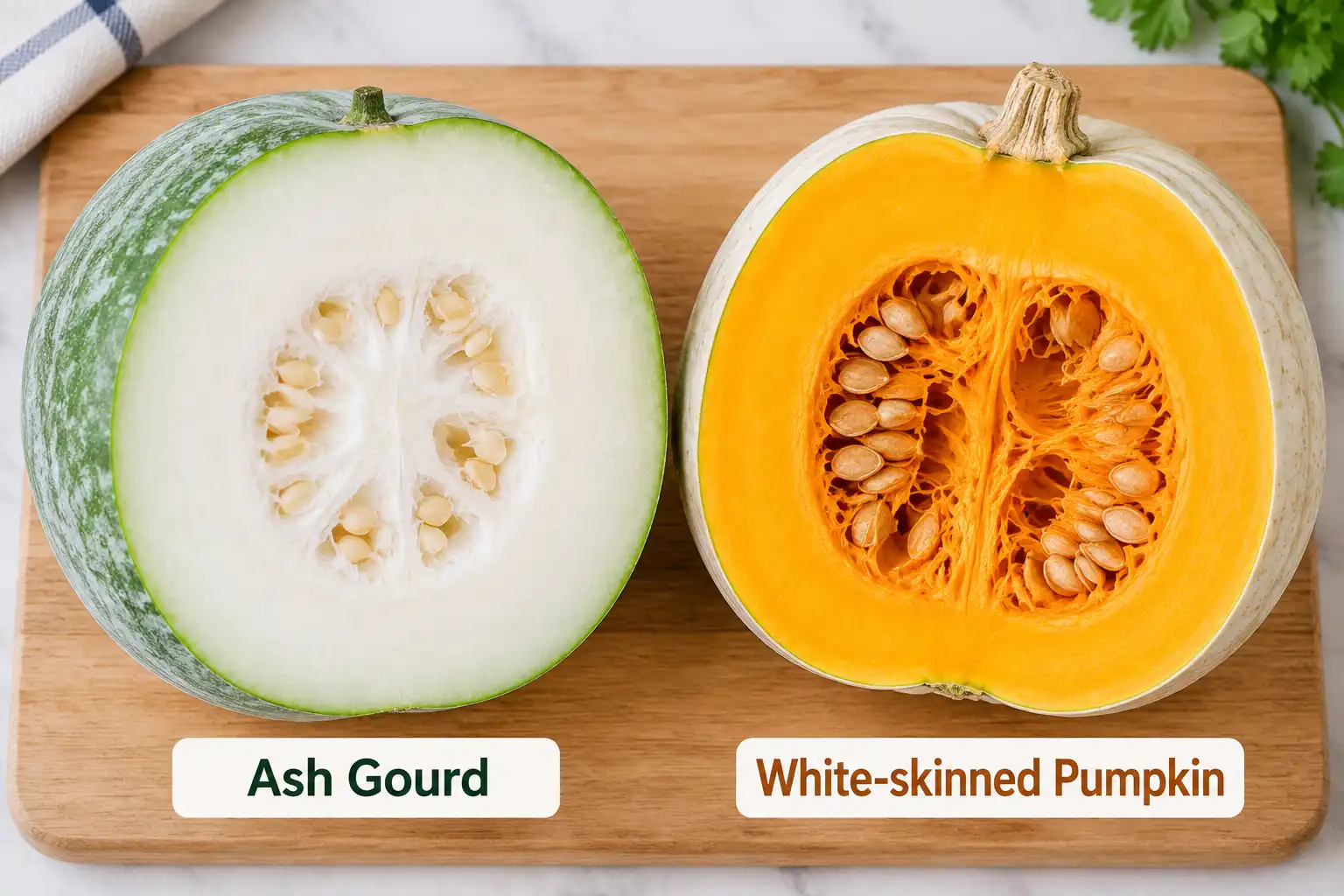
Iowa State University Extension describes white varieties such as ‘Lumina’ as having white skin and orange flesh. People grow them mainly for looks, but the flesh is fine for cooking.
So the easiest test is to cut one open. White, crisp flesh under a chalky rind means ash gourd. Orange flesh under a smooth white rind means a pumpkin, a relative of the other Cucurbita squash and pumpkins. Before you buy for a recipe or a seed order, check which plant the writer means.
Ash Gourd and Its Look-Alikes Compared
This table pulls the identification points from UF/IFAS, UC ANR, and Iowa State Extension into one place.
| Feature | Ash gourd | Bottle gourd (lauki, opo) | US white pumpkin |
|---|---|---|---|
| Botanical name | Benincasa hispida | Lagenaria siceraria | Cucurbita types such as ‘Lumina’ |
| Flower color | Golden yellow | White | Yellow |
| Young fruit | Hairy | Smooth, hairless | Smooth |
| Mature skin | Green under white, chalky wax | Dries to a hard shell | White |
| Flesh | White, crisp, mild | Whitish green pulp around seeds | Orange |
| Usually eaten | Mature, or young as fuzzy melon | Young, about 10 to 12 inches long (opo) | Mature |
Is Ash Gourd a Fruit or a Vegetable?
Both, depending on who is asking. Botanically, ash gourd is a fruit, because it forms from the flower’s ovary and carries the seeds. In the kitchen, however, it is a vegetable. It goes into soups and stir-fries rather than fruit bowls. That double status is normal across the cucumber and gourd family, from cucumbers to pumpkins.
What Is Ash Gourd Called in the USA?
US stores and seed catalogs most often call it winter melon or wax gourd. In fact, the USDA National Agricultural Library lists wax gourd, waxgourd, and ash gourd as names for Benincasa hispida.
Watch for these names when you shop:
- Winter melon or Chinese winter melon: the names Michigan State and UC ANR use
- Wax gourd: the name UF/IFAS and USDA use
- Dong gua: the Chinese name, also written donqua or dong qua
- Petha: the Hindi name, common in Indian grocery stores
- Fuzzy melon, hairy melon, or moqua: the young, fuzzy form picked before it waxes over
Shopping for seed? Check the packet for Benincasa hispida. Sellers use several of these names for the same plant. So a round “winter melon” and a long “wax gourd” can both be ash gourd.
Can You Grow Ash Gourd in a US Garden?
Yes, if your summer runs long and warm. UF/IFAS advises growing it like watermelon, and Michigan State University Extension says its needs are similar to watermelon’s. So watermelon timing is the best working guide.
When to Plant Ash Gourd
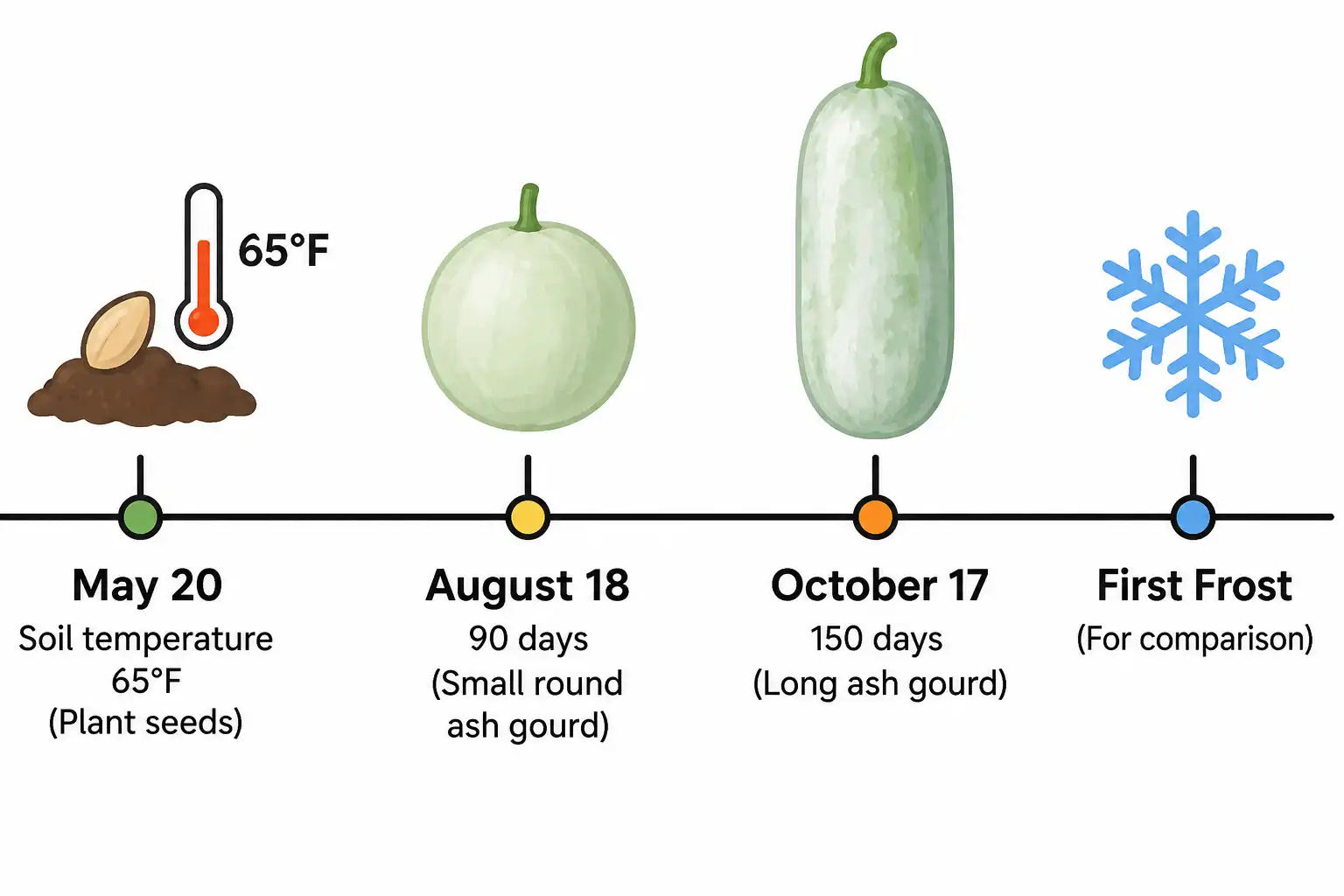
Plant only into warm soil. For melons, University of Minnesota Extension says to wait until the top 2 inches of soil reach 65°F. Nights should be warm as well as days. In southern Minnesota, that usually means after May 20. In the northern half of the state, it can take until mid-June.
The South has far more room. UF/IFAS says South Florida can fit three ash gourd crops a year, seeded in July, December, and March. The rest of Florida gets two, planted in March and July.
Cold soil also slows how fast cucurbit seed comes up, so a soil thermometer beats the calendar.
How Many Days Ash Gourd Needs
Season length decides which type you can grow. Michigan State ran a 2016 trial at its Southwest Michigan Research and Extension Center in Benton Harbor. There, eight varieties ripened from early September through October. Large Oblong came in first. Long Giant, however, needs 150 days or more, and the trial found it poorly suited to southwest Michigan. Large Round did best overall, averaging 23 pounds per fruit.
Shorter types exist. One seed catalog lists a round winter melon at 85 to 95 days to maturity. That is the seller’s figure, not a trial result.
Run the numbers for your own garden:
Harvest date = your planting date + days to maturity
- Planted May 20, a 90-day round type ripens around August 18.
- Planted May 20, a 150-day long type ripens around October 17.
Next, compare the result with your average first fall frost. University of Minnesota Extension warns that frost is likely by mid-September in northern Minnesota. If the math runs past your frost date, choose a short-season round type.
Space, Water, and Pests
Give each plant plenty of ground. UC ANR notes that Chinese winter melon is too big to trellis, so growers let it spread over the soil. The smaller fuzzy melon, by contrast, does go on a trellis.
Water as you would for melons. University of Minnesota Extension recommends 1 to 2 inches of water a week for melons. Apply it at the soil so the leaves stay dry. One inch over 1 square foot is about 0.62 gallon. So a 4 by 8 foot bed (32 square feet) needs about 20 to 40 gallons a week without rain. A drip line laid along the bed delivers that water without wetting the vines.
UC ANR lists spider mites, aphids, nematodes, and viruses on winter melon. Still, leaf curling, stippling, and mottling can come from several causes. Your county extension office or local Master Gardener volunteers can confirm the cause before you treat anything. Meanwhile, check leaf undersides often, because aphids tend to cluster there before damage shows.
How Long Ash Gourd Keeps After Harvest
Pick ash gourd once white wax covers the skin. UC ANR says growers harvest mature winter melon after that wax bloom forms. In Michigan State’s trial, Large Oblong also showed a second sign. Its vines died back as the fruit matured, leaving the fruit open to sunburn.
A whole, waxed fruit stores for months. The sources, however, give different ranges:
| Source | Storage figure for whole fruit |
|---|---|
| UF/IFAS Extension | 2 to 6 months or more in a cool, dry place |
| UC ANR Small Farms Network | 3 to 4 months over winter |
| Michigan State University Extension | Several months at room temperature |
Across these sources, the range runs from 2 to 6 months or more. Cool, dry storage, as UF/IFAS describes, gives you the best odds at the long end.
Frequently Asked Questions
Can you eat ash gourd raw?
Yes, you can eat it raw, though cooking is more common. UF/IFAS Extension notes that people usually boil it or add it to cooked dishes, and some slice it raw like cucumber.
Why is the skin on my ash gourd powdery?
The powder is the natural wax coating that forms as the fruit matures. Michigan State University Extension notes this wax rubs off easily on hands and clothes, and it signals the fruit is nearing harvest.
Do you need gloves to handle ash gourd?
Gloves help, especially with young or hairy fruit. Michigan State University Extension reports stiff hairs that irritate skin, and UF/IFAS notes some varieties keep fine hairs even when full grown.
Can you grow ash gourd on a trellis?
Full-size ash gourd is too heavy for most trellises. UC ANR’s Small Farms Network notes that growers let Chinese winter melon sprawl on the ground, while the smaller fuzzy melon type goes on a trellis.
How do I know when an ash gourd is ripe?
Look for a white, waxy bloom over the skin. UC ANR says growers pick mature winter melon once that bloom forms, and Michigan State’s trial recorded vines dying back as one variety matured.
Key Points for Your Garden
Check the botanical name before you buy seed or produce. Benincasa hispida is ash gourd, whatever the label says, while lauki and opo are bottle gourd. If a white pumpkin has orange flesh, it is a Cucurbita pumpkin. To grow it, add the variety’s days to maturity to your planting date. Then compare the result with your first fall frost. In short seasons, pick a quick round type over a long giant.