How Many Asparagus Plants Per Person? 10 to 25 Crowns, Explained
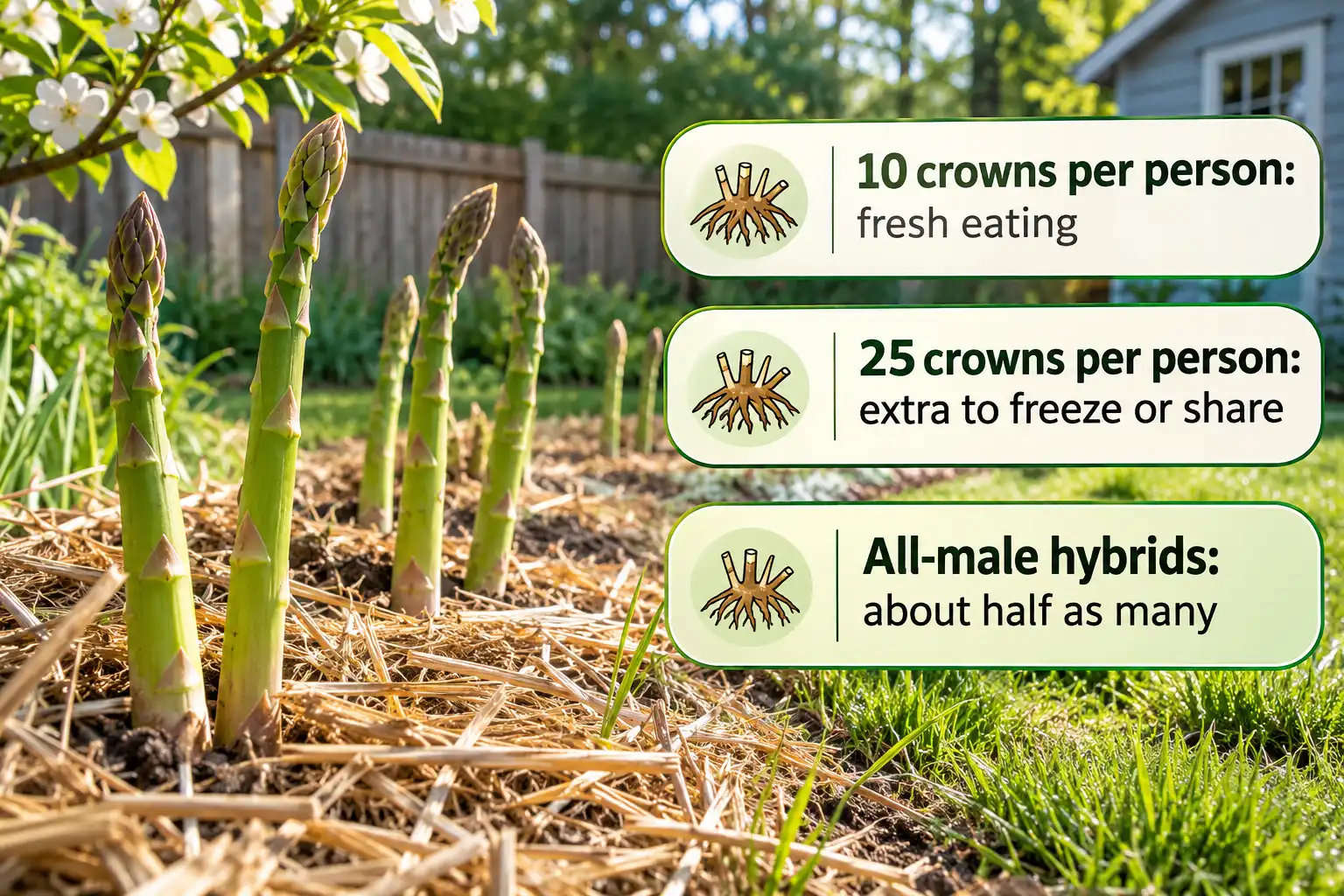
NC State Extension notes a well-kept asparagus bed can produce for 15 years or more. So the number you plant once sets your harvest for a long time. Here is how many asparagus plants per person you need, what each one yields, and how to size the bed.
Most households need about 10 asparagus plants per person for fresh eating and 25 for extra to freeze or share, per NC State Extension. With all-male hybrids such as Jersey Knight, plant about half as many.
How Many Asparagus Plants Per Person?
Plan on 10 to 25 crowns per person for standard varieties. The low end covers fresh spears in season, and the high end leaves extra to freeze or give away.
Extension services don’t print one number, so we give the range and name each source.
| Extension source | Region | What it says | Crowns per person |
|---|---|---|---|
| NC State Extension | North Carolina | 10 crowns per family member for fresh use, at least 25 for a surplus | 10 to 25 |
| Virginia Tech | Virginia | Raise about 6 pounds per person; expect 3 to 4 pounds per 10 feet of row | About 10 to 13, by the math below |
| Texas A&M AgriLife | Texas | A 20-foot row of 20 crowns suits a family of four | About 5 |
| Utah State Extension | Utah | 25 plants cover fresh use plus storage | Not stated per person |
So why the spread? Mostly appetite, not the plants. Texas A&M’s family of four gets about 10 pounds a season, or 2.5 pounds each. Virginia Tech, by contrast, plans on 6 pounds per person.
The Virginia Tech math runs like this. At its 18-inch spacing, 10 feet of row holds about 7 crowns. Six pounds takes 15 to 20 feet of row, or about 10 to 13 crowns.
Utah State’s figure needs a caution: it doesn’t say whether its 25 plants mean per person or per household.
Learn more: Asparagus Growing Time
How Much Does One Asparagus Plant Produce?
A mature asparagus plant produces roughly 1/2 to 1 pound of spears per season. Region, variety, and care move it within that range.
Texas A&M AgriLife equates 20 crowns with about 10 pounds a season in Texas. That’s about 1/2 pound per crown. Virginia Tech’s row figure lands in the same place, at roughly 1/2 pound per crown in Virginia.
Other states report more. Utah State Extension says a mature plant in Utah can produce 3/4 pound during the harvest period. Meanwhile, Oklahoma State Extension, whose guide centers on Mary and Martha Washington, puts an established plant at about 1 pound. It calls that an average and notes some beds do better.
For planning, use 1/2 pound per crown. Two sources share that figure, and a bed that beats it gives you extra instead of a shortfall.
Keep in mind these are full-season numbers for established beds. A bed in its second or third year gives far less, as the timeline below shows.
How Many Spears Does One Asparagus Plant Produce?
One mature plant gives roughly 11 to 28 harvest-size spears a season. The count depends on spear size and how heavily the plant yields.
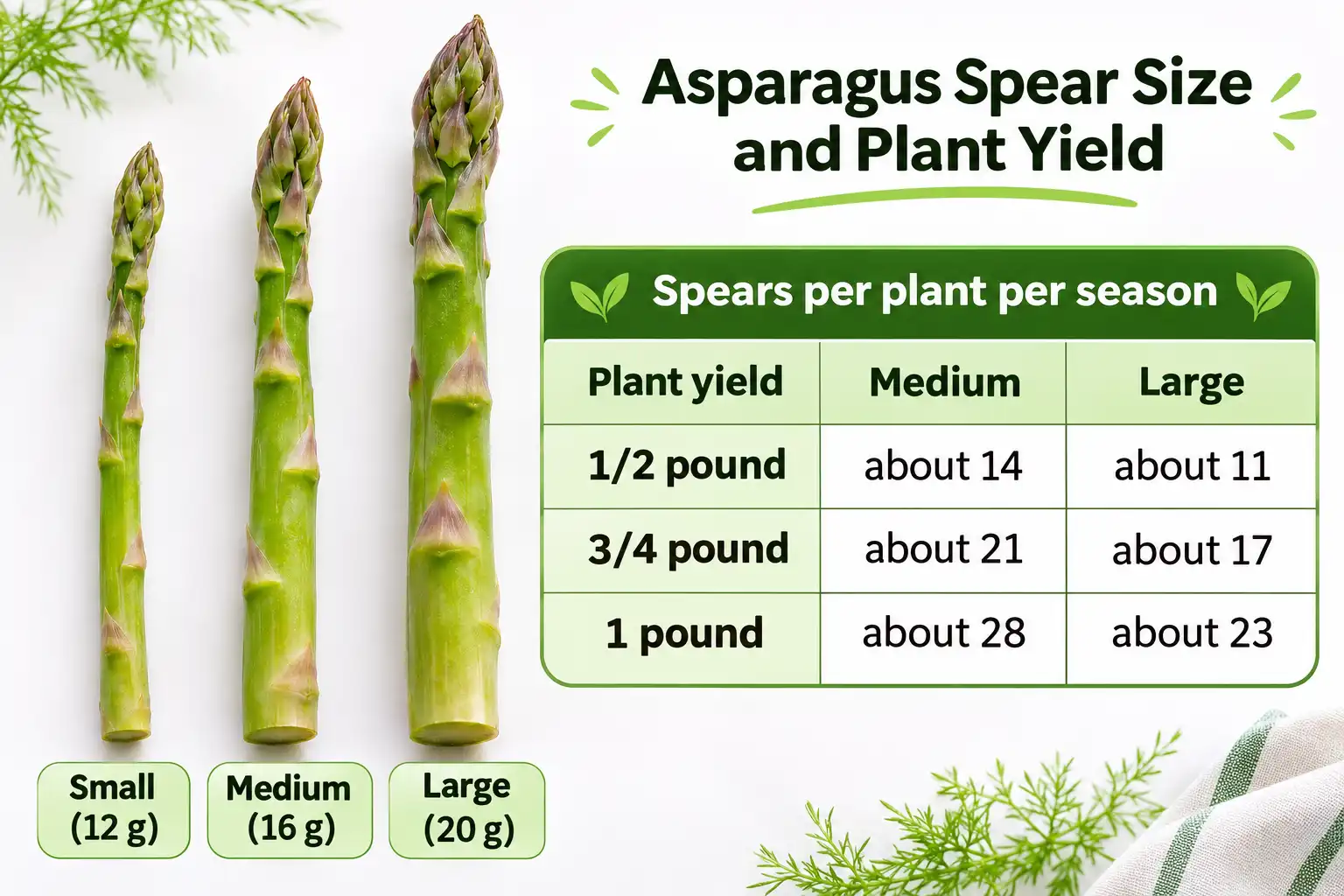
USDA FoodData Central lists a small raw asparagus spear (5 inches or less) at about 12 grams. A medium spear (5.25 to 7 inches) weighs about 16 grams, and a large one (7.25 to 8.5 inches) about 20. Virginia Tech suggests snapping spears at 6 to 8 inches. So most garden spears fall in the medium and large sizes.
Divide the plant’s yield by the spear weight, and you get this:
| Yield per plant per season | Medium spears (16 g) | Large spears (20 g) |
|---|---|---|
| 1/2 pound (227 g) | About 14 | About 11 |
| 3/4 pound (340 g) | About 21 | About 17 |
| 1 pound (454 g) | About 28 | About 23 |
Now spread that over NC State’s 6 to 8 week harvest for an established bed in North Carolina. Each plant sends up only about 1 to 5 spears a week. That’s why one or two crowns per person never fills a plate.
Standard or All-Male: How Variety Changes the Count
All-male hybrids cut the count roughly in half. NC State Extension says to plant half as many crowns when you choose the newer hybrids.
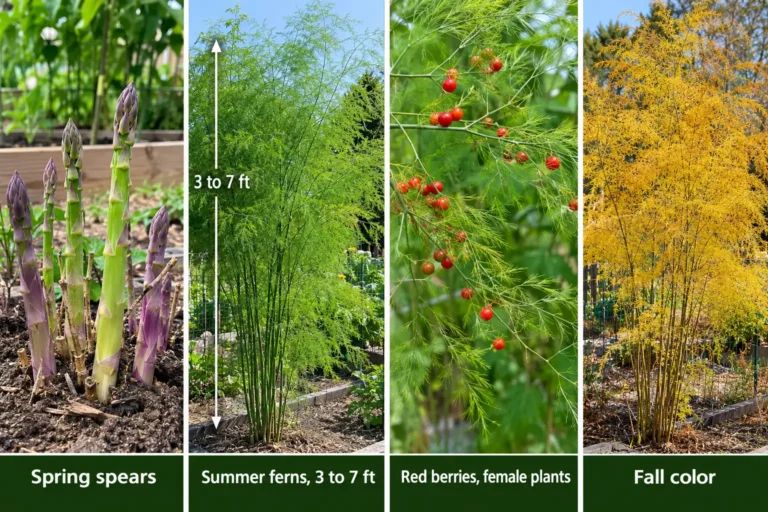
The reason is yield. NC State reports that Jersey Gem and Jersey Knight produce significantly more than Mary Washington, the older standard variety. Texas A&M AgriLife adds that Jersey types out-yield female plants and resist disease better. Female plants also drop red berries, and those seeds sprout as weedy seedlings in the bed.
| Variety type | Examples | Fresh eating | Extra to freeze or share |
|---|---|---|---|
| Standard, male and female plants | Mary Washington | 10 per person | 25 per person |
| All-male hybrid | Jersey Knight, Jersey Gem | About 5 per person | About 12 to 13 per person |
Both rows follow NC State’s guidance for North Carolina gardens.
Region shapes the choice as well. For example, Utah State no longer recommends Mary Washington in Utah. Instead, it lists Jersey Giant and Jersey Knight as strong performers there. Your county extension office can tell you which varieties hold up in your area.
If a seed catalog prints a yield figure for a hybrid, treat it as the seller’s own claim. Then plan from the extension numbers instead.
Work Out Your Own Number
Divide the pounds you want per person by the pounds one mature crown yields. Then multiply by the people you feed.
Crowns per person  = pounds wanted per person / pounds per mature crown
Crowns for the bed = crowns per person x people in the household
Row length in feet = crowns x in-row spacing in feet
For example, take Virginia Tech’s 6 pounds per person and a planning yield of 1/2 pound per crown. That gives 12 crowns per person. With Utah State’s 3/4 pound figure, it drops to 8. So a household of four needs about 32 to 48 standard crowns.
What does 6 pounds look like? Spread over Texas A&M’s typical 8-week harvest for established beds in Texas, it’s 3/4 pound a week per person. By USDA’s medium spear weight, that’s about 21 spears a week, or 3 a day.
If that sounds like more than you eat, use Texas A&M’s lighter 2.5 pounds per person instead. At 1/2 pound per crown, that’s 5 crowns each.
The pounds-per-person target is your own number. The yield per crown comes from the sources above. So change it only if your county office reports something different.
How Much Space Your Asparagus Plants Need
Extension guides from Utah to North Carolina give each asparagus crown about 4 to 7.5 square feet in rows. In a wide bed, it needs closer to 2.25 square feet.
NC State spaces crowns 12 inches apart in rows 5 feet apart for North Carolina gardens. That’s 5 square feet per crown, which matches Texas A&M’s 100 square feet for 20 crowns in Texas. Utah State uses 12 inches in the row and 4 feet between rows in Utah. Virginia Tech and Oklahoma State both set crowns 18 inches apart, with rows 4 to 5 feet apart.
At NC State’s 12-inch spacing, each crown takes 1 foot of row:
| Household | Standard crowns (10 to 25 each) | Row length at 12-inch spacing | Mature yield at 1/2 pound per crown |
|---|---|---|---|
| 1 person | 10 to 25 | 10 to 25 feet | 5 to 12.5 pounds |
| 2 people | 20 to 50 | 20 to 50 feet | 10 to 25 pounds |
| 4 people | 40 to 100 | 40 to 100 feet | 20 to 50 pounds |
Long rows can split into two or three shorter ones. Once you have your count, setting crowns in a trench covers depth and backfilling.
Fitting Asparagus in a 4 by 8 Raised Bed
Using Virginia Tech’s wide-bed spacing, a 4 by 8 foot raised bed holds about 15 asparagus crowns. That’s enough for roughly one person.
Virginia Tech allows wide beds in Virginia with three rows and plants 18 inches apart in every direction. Here is how that fits a 4 by 8 bed:
Crowns per row = 96 inches / 18 inches = 5.3, so 5 crowns
Crowns per bed = 5 crowns x 3 rows = 15 crowns
Mature yield   = 15 crowns x 1/2 to 3/4 pound = about 7 to 11 pounds a season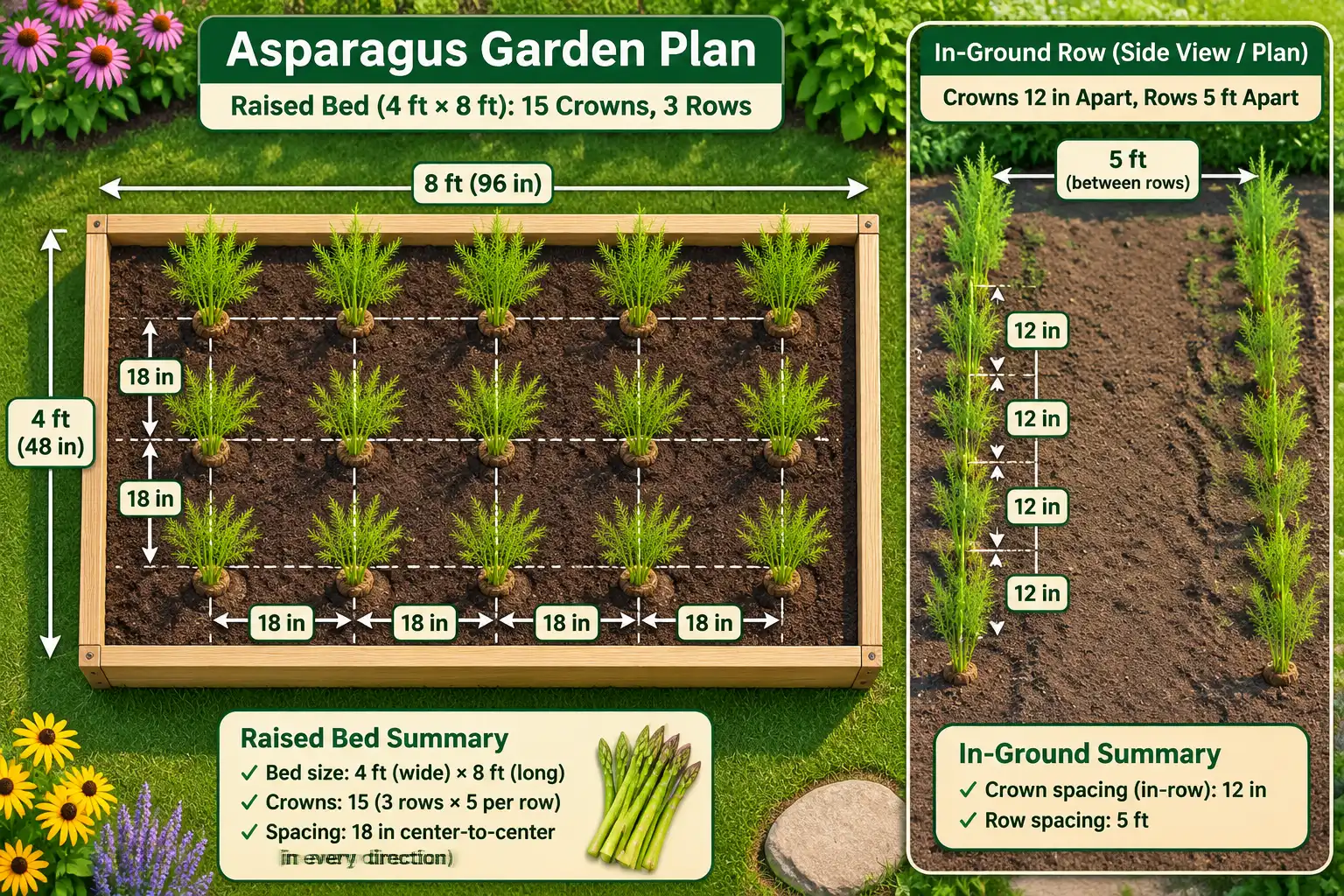
At that yield, one bed covers about one person at Virginia Tech’s 6-pound target, with some to spare. For a household of four eating fresh, that means about two beds of all-male hybrids (20 crowns) or three of standard ones (40 crowns). A pot holds only a fraction of that, so growing asparagus in a container suits a small taste.
Year-by-Year Harvest: What a New Bed Gives
A new asparagus bed gives no harvest in the planting year and only a short cut after that. Across the NC State and Utah State guides, full harvests start in year three to five.
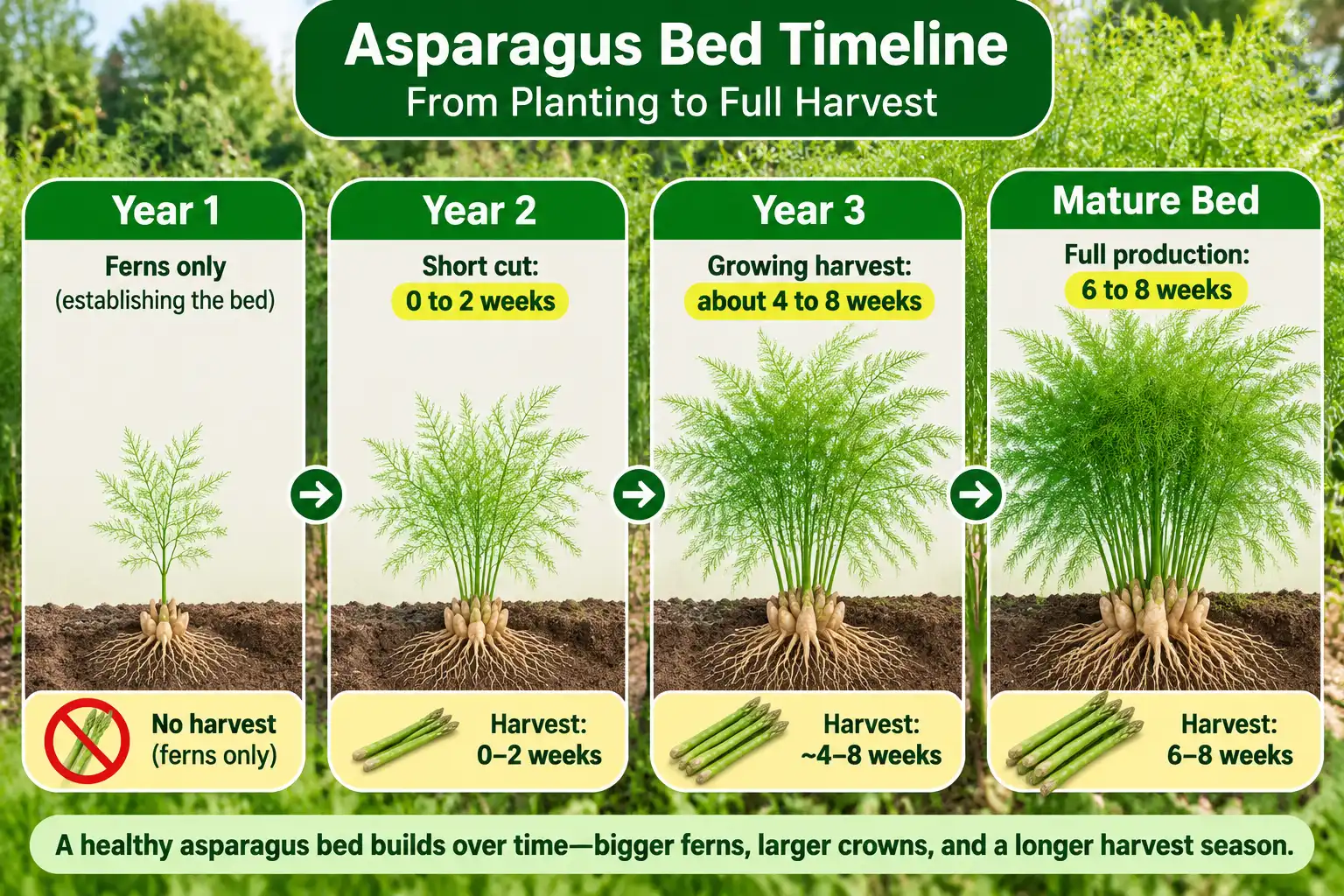
| Season after planting crowns | NC State (North Carolina) | Utah State (Utah) |
|---|---|---|
| Year 1 | No harvest | No harvest |
| Year 2 | Up to 2 weeks | No harvest |
| Year 3 | 6 to 8 weeks | Up to 4 weeks |
| Year 4 | 6 to 8 weeks | 6 weeks |
| Mature bed | 6 to 8 weeks | Up to 8 weeks |
Texas A&M is stricter for Texas: no harvest for the first 2 years, then about 8 weeks once established.
Virginia Tech explains why the wait matters. It cites research plots first cut one year after planting. Over five years, those plots yielded 23 percent less than plots first cut after two years. Even so, Virginia Tech allows a light cut of 3 to 4 weeks in year two.
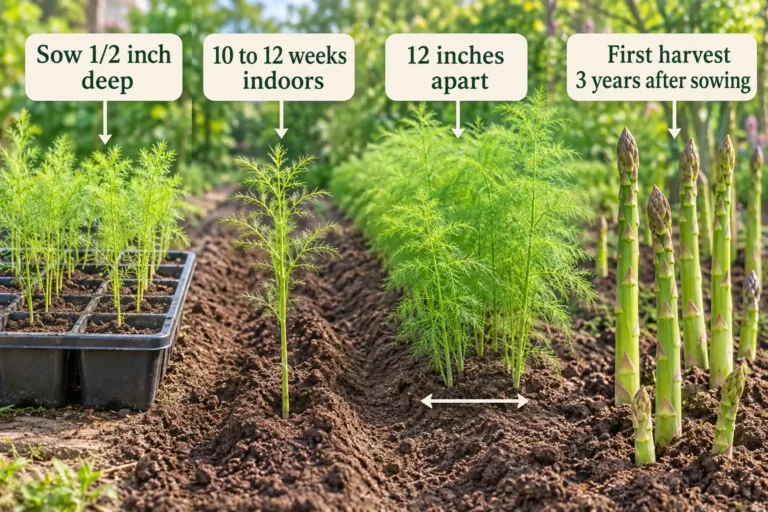
None of these guides puts a pound figure on a young bed. So size your planting for mature yield, and count the early cuts as a bonus. Also, starting from seed adds a year to every stage, per Virginia Tech and NC State. That means raising your own crowns from seed brings a longer wait for the same count.
When to Plant More Than 10 Per Person
Plant toward 25 per person, or double your count, in three cases.
- You want a surplus. NC State suggests at least 25 crowns per family member in North Carolina for extra to share or preserve.
- You want a late-season cutting. Virginia Tech describes a method for gardeners with plenty of space. You plant twice what the household needs. Then you harvest half the bed in spring while the other half grows ferns. In Virginia, you cut those ferns in late July, and the crowns send up new spears into fall.
- Your climate is marginal. Texas A&M notes asparagus produces poorly where winters are mild and summers are long and hot. In those areas, extra crowns can offset some of the lower yield.
One caution applies to the late-season method. Virginia Tech says to cut each half in only one season, or the crowns weaken.
Mistakes That Throw Off Your Count
Most shortfalls come from crowding, cutting too early, or cutting too long. Each one can lower yield for years, not just one spring.
- Crowding crowns. Texas A&M sets crowns 12 to 14 inches apart in Texas and warns that closer planting gives small spears. NC State adds that narrower rows may shorten the bed’s life.
- Cutting a young bed hard. Virginia Tech links weak, spindly plants and too few spears to harvesting too early or too heavily.
- Cutting too long each spring. Utah State says to stop when most spears are thinner than a pencil. Texas A&M stops once spears drop below 3/8 inch across.
- Keeping volunteer seedlings. Female plants drop berries that sprout as weedy seedlings, per Texas A&M. Pull them early, as you would any weed.
Sun matters as well. NC State calls for full sun and well-drained soil. So confirm you have a sunny, well-drained site before you order crowns.
Frequently Asked Questions
How many asparagus crowns should a family of four plant?
NC State Extension suggests about 40 standard crowns for a family of four eating fresh asparagus, or 20 crowns of an all-male hybrid. Texas A&M AgriLife sets a lighter target for Texas: 20 crowns in a 20-foot row.
How long until a new asparagus bed reaches full production?
Texas A&M AgriLife says a new bed in Texas takes 2 to 3 years to reach full production. Utah State Extension, writing for Utah, holds the full 8-week harvest until about five years of growth.
Can you plant asparagus crowns closer to get more spears?
Closer spacing can raise total yield, but the spears come up thinner. NC State Extension says closer in-row spacing increases yield, while Texas A&M AgriLife warns that crowns tighter than 12 to 14 inches in Texas give small spears.
Do you need both male and female asparagus plants?
No, because asparagus spears are stems that both male and female plants produce. All-male hybrids such as Jersey Knight set no seed, and NC State Extension notes they yield significantly more.
How long does an asparagus bed keep producing?
Usually 10 to 25 years, depending on the region. NC State Extension says 15 years or more, Utah State Extension expects 10 to 15, and Texas A&M AgriLife gives crowns 15 to 25 years where the climate suits them.
How much asparagus seed do you need for a bed?
Very little, because NC State Extension says one ounce of seed produces about 700 crowns. Expect an extra year before the first harvest, since Virginia Tech adds a year to the schedule for seed-grown plants.
Before You Plant
Pick a pounds-per-person target first, then size the bed to it. For most households, 10 standard crowns or 5 all-male crowns per person covers fresh eating. For freezing too, plan on 25 standard or about 12 all-male crowns each.
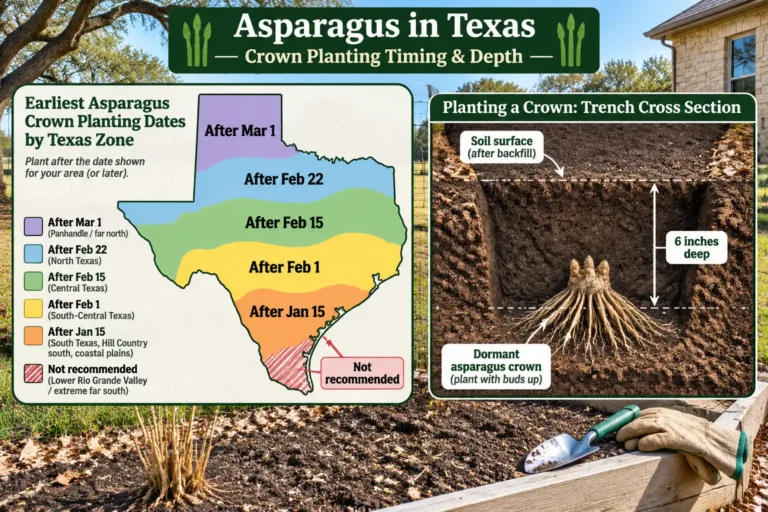
Use 1/2 pound per mature crown so the bed doesn’t come up short. Next, check the best window for setting crowns in your area. After planting, caring for an asparagus bed through its early seasons turns your count into a full harvest.