How to Grow Asparagus in Pots: Pot Size, Depth, and First Harvest
In the ground, asparagus can produce for more than 15 years, per University of Minnesota Extension. A pot gives it far less room. You can grow asparagus in pots, but pot size, planting depth, and harvest timing all change.
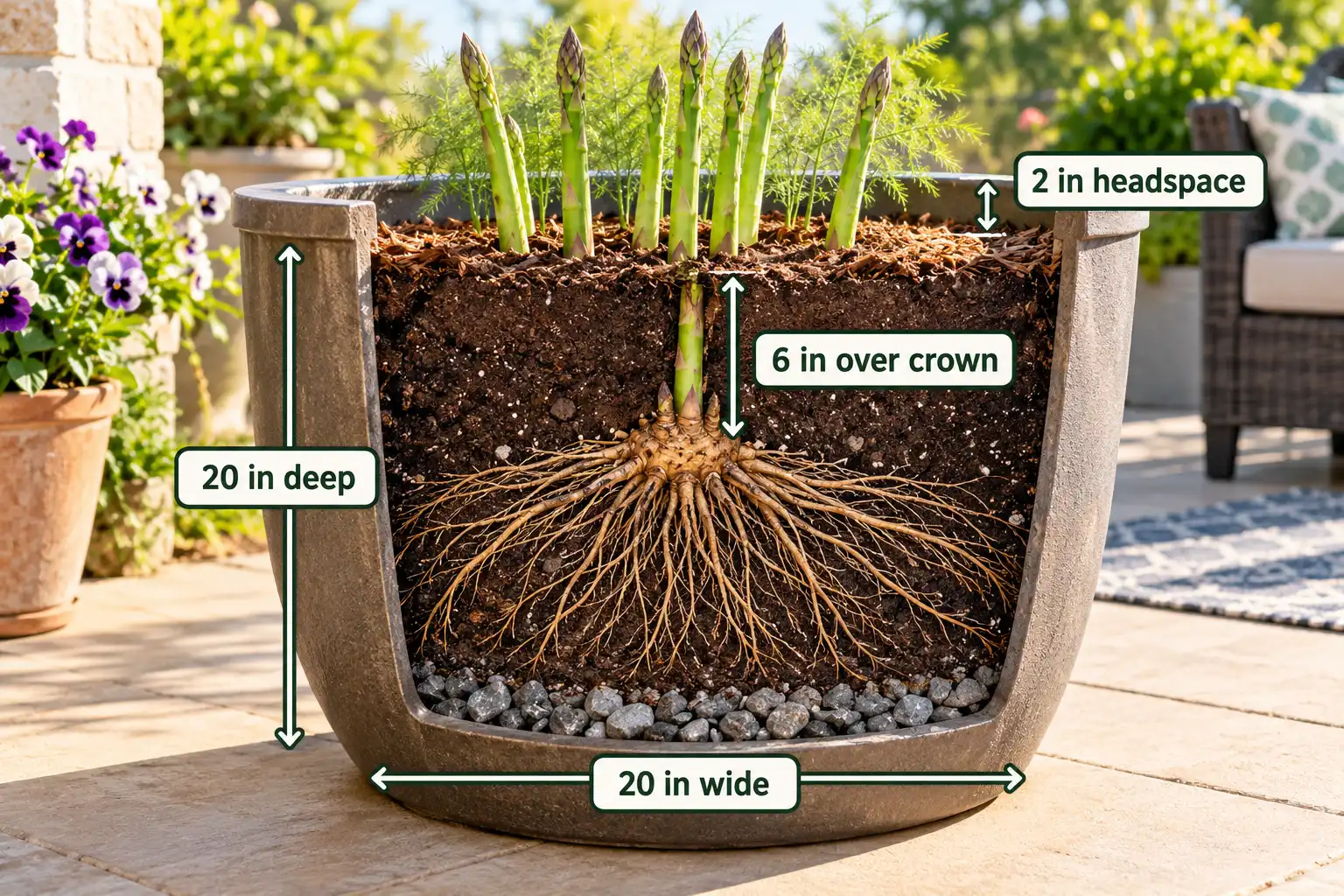
You can grow asparagus in pots at least 20 inches deep and wide. Set one crown under about 6 inches of mix and give it 8 hours of sun. Then wait until the third spring to harvest.
Can You Grow Asparagus in Pots?
Yes, asparagus can grow in containers, but treat the pot as a short lease. Extension guides focus on in-ground beds, which last for years. Illinois Extension expects a bed to stay productive for at least 15 to 20 years.
No university has published yield trials for asparagus in pots. So any per-pot yield figure online is a guess. Still, the in-ground research explains the limit. Each spring’s spears run on energy the crown stored the summer before, according to University of New Hampshire Extension. A pot caps how much root, and so how much stored energy, the crown can build.
Container asparagus suits three situations:
- A patio, balcony, or rental with no room for a permanent bed
- A holding pot until an in-ground bed is ready
- A small trial before you commit to a 15-year bed
Expect a modest picking. Otherwise, the basics match other vegetables grown in pots: open drainage, fresh mix, and steady water.
How Deep Do Asparagus Roots Grow?
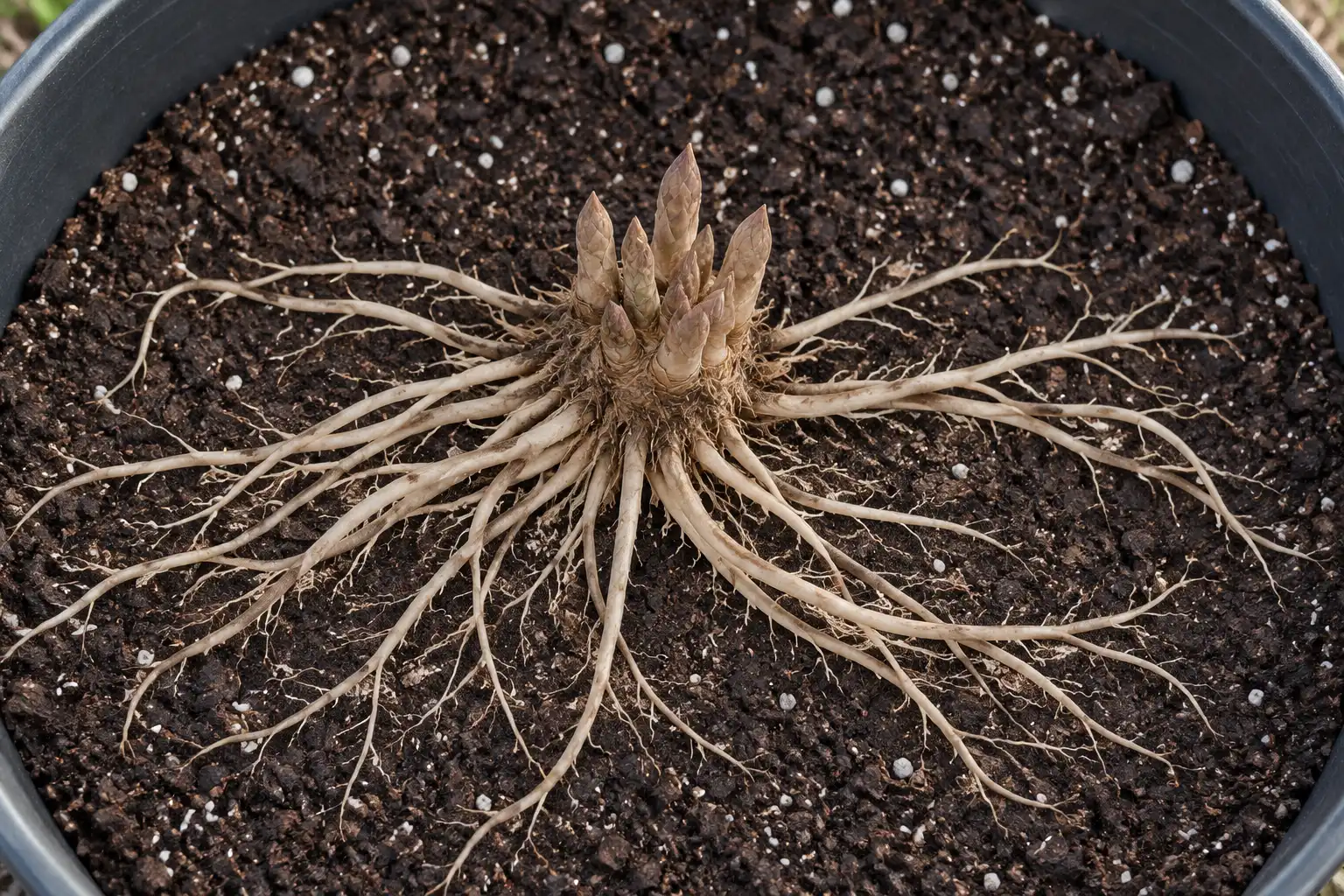
In open ground, asparagus roots can grow 10 to 15 feet deep, per University of New Hampshire Extension. The crown and root system can also spread 5 to 6 feet across.
No pot holds that, but a pot doesn’t need to. Illinois Extension describes the root mass as a mat that spreads more sideways than down. Meanwhile, the crown does the storing. University of Minnesota Extension explains that it holds carbohydrates over winter to fuel the next season.
So a pot only needs room for a young crown’s roots to lie flat. It also needs enough depth for a few seasons of new growth. When the crown runs out of room, the spears show it, as the harvest section explains.
One figure sets the minimum size. UMN notes that many crowns arrive with roots 8 to 12 inches long.
What Size Pot Does Asparagus Need?
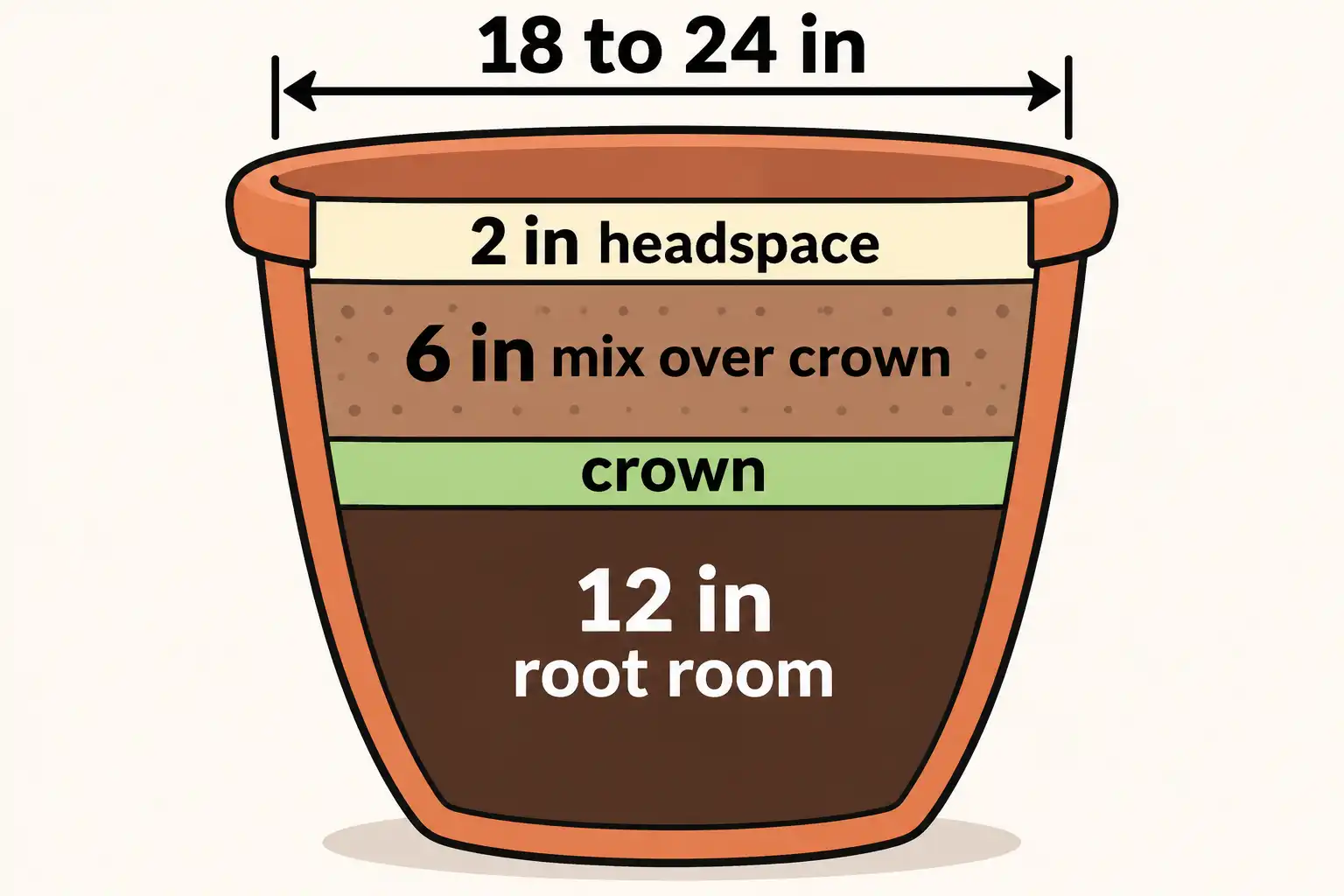
Asparagus needs a pot at least 20 inches deep and 18 to 24 inches across for one crown. No extension service publishes a container size, so these numbers come from in-ground figures.
Width. UMN gives crown roots as 8 to 12 inches long. Across a center crown, that’s 16 to 24 inches. So the roots can lie flat instead of curling up the wall.
Depth. Add up three layers:
- 2 inches of headspace, so water soaks in instead of spilling
- About 6 inches of mix over the crown, the depth UNH gives for a filled trench
- About 12 inches below the crown for new roots, matching UMN’s longest crown roots
That totals about 20 inches. Extra depth also helps drainage. University of Missouri plant scientists explain that taller containers drain better than short ones with the same mix.
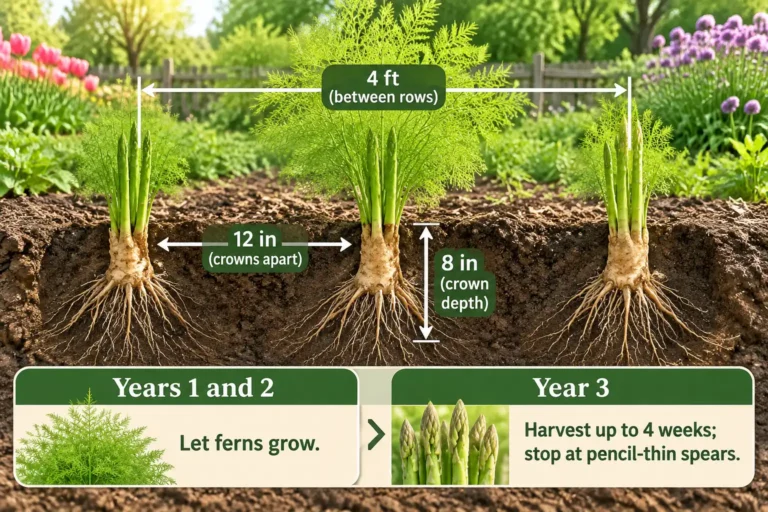
For several crowns, use a long planter and space them 12 inches apart, UMN’s in-row spacing. Crowns per planter = length in inches ÷ 12. So a 36-inch trough of the same depth holds 3.
How Much Potting Mix a Pot Needs
Measure the inside of your pot, then run the numbers. These fill depths leave 2 inches of headspace.
- Cubic feet = 3.14 × (width in feet ÷ 2)² × fill depth in feet
- Gallons = cubic feet × 7.48
- Bags = cubic feet ÷ bag size, rounded up
| Pot, inside width x depth | Pot volume | Mix to fill | 1.5 cu ft bags |
|---|---|---|---|
| 18 x 20 inches | About 22 gallons | 2.7 cubic feet | 2 |
| 20 x 20 inches | About 27 gallons | 3.3 cubic feet | 3 |
| 24 x 24 inches | About 47 gallons | 5.8 cubic feet | 4 |
Nursery pot gallon sizes are approximate, so trust the tape measure. Use a bagged potting mix made for containers. And because a filled 20-inch pot is heavy, set it in its final sunny spot before filling, or put it on a plant dolly.
Choosing Crowns and Varieties
Start with one-year-old crowns, which Illinois Extension prefers over seed.
For a pot, choose an all-male hybrid. Asparagus plants are either male or female. Illinois Extension notes that male plants make thicker spears, since they spend no energy on seed. Female plants drop berries that sprout into weedy seedlings, and a pot has no room for them.
UMN recommends these hybrids for Minnesota, a useful cold-winter benchmark:
- Millennium
- Jersey Knight
- Jersey Giant
- Jersey Supreme
Mary Washington and Purple Passion are open-pollinated, so they include female plants. UMN notes their yields generally run lower.
Keep crowns refrigerated until planting day, as UMN advises, because exposed roots dry out.
Starting From Seed Instead
Seed adds a year. Illinois Extension sows asparagus seed 1/2 inch deep once soil reaches 60°F. Then it moves the young crowns the following spring. Asparagus seed comes up slowly in cool soil, so check how soil temperature changes sprouting time before you sow.
When to Plant Asparagus in Containers
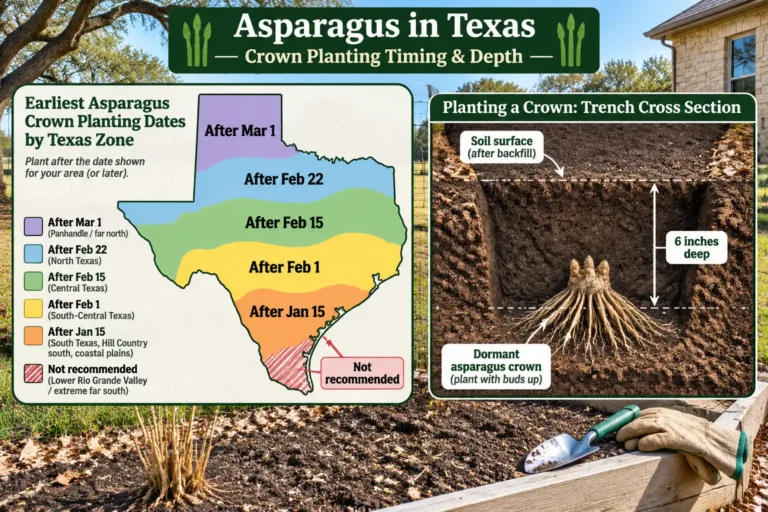
Plant asparagus crowns in spring. Illinois Extension says to plant as soon as you can work the ground. In Minnesota, UMN lists early May through the first week of June.
Potting mix doesn’t wait on wet garden soil, so you can plant soon after crowns arrive. Then watch the forecast once spears appear. In southern New Hampshire, UNH notes spears emerge around the first week of May, when soil reaches about 40°F.
If a hard freeze threatens, move the pot into an unheated garage overnight. Illinois Extension notes that frozen spear tips turn brown and taste off.
How to Plant Asparagus in a Pot
Planting takes an afternoon, but filling continues through the first summer.
- Check the drainage. The pot needs open holes in the base. Skip the gravel layer, since Missouri’s plant scientists explain it raises the wet zone into the roots.
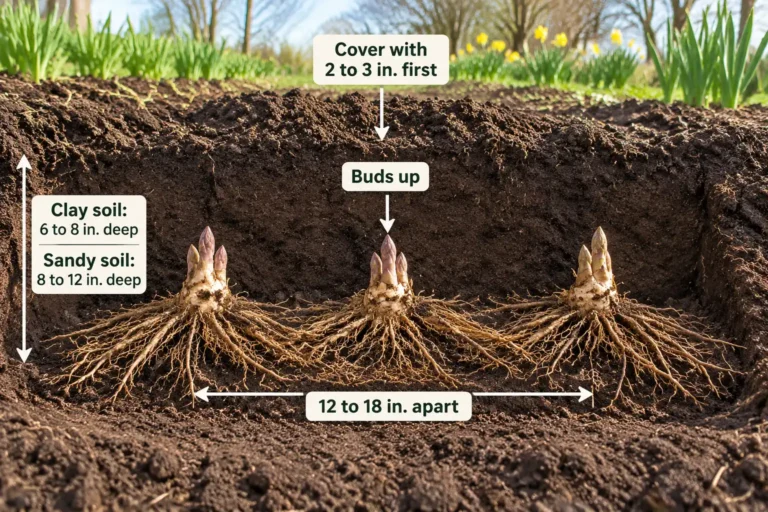
- Fill to crown depth. Add mix until the surface sits about 8 inches below the rim. That leaves room for 6 inches of cover plus 2 inches of headspace.
- Set the crown. Place it buds up in the center. Spreading the roots in a circle is optional, since UMN reports no proven gain in vigor. Just keep roots from bending up the wall.
- Cover and water. Cover the crown with 2 to 3 inches of mix, as UMN directs. Then water until it drains from the base.
- Fill as spears grow. UMN says thin spears appear within 2 to 3 weeks. Once they’re sturdy and several inches tall, add 3 to 4 more inches. Never bury the growing tips.
Those layers bring the cover to about 6 inches, matching UNH’s filled trench. UMN’s field guide finishes filling by August. So aim for the mix to sit 2 inches below the rim by then.
Sun, Water, and Soil pH
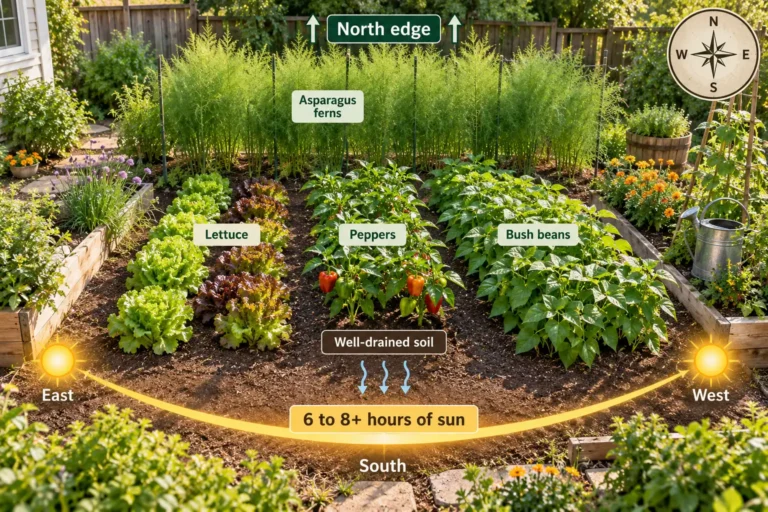
Give the pot at least 8 hours of sun a day, the minimum UNH sets for asparagus.
Water matters most in the first season. UMN stresses irrigation in the planting year, especially in fast-draining sandy soil. In a pot, the mix is the only water supply. So in summer, push a finger into the mix often. When it feels dry below the surface, water until it runs from the base. For several pots, a drip line on a timer keeps watering steady through hot weeks.
Sources differ slightly on pH. UMN targets 6.5 to 7.0, while UNH narrows it to 6.5 to 6.8. Each writes for its own state’s soils, so 6.5 to 6.8 is the safe overlap. If you blend garden soil or compost into the mix, a lab soil test shows where it sits.
When and How to Feed Potted Asparagus
Feed on a schedule, and let the product label set the amount. Illinois Extension feeds young beds in spring for the first 3 years. From the fourth year, it feeds right after the final harvest instead. UMN explains why: feeding then builds bigger ferns, which store more energy for next spring.
A pot holds a small, fixed volume of mix, so it relies on you for nutrients. Use a fertilizer labeled for vegetables and follow its container directions. If your mix includes garden soil, test it first to see what it already holds.
Caring for the Ferns
Let every spear you don’t pick grow into a fern. UNH calls ferns the plant’s factory, because they make the food the crown stores.
Ferns get top-heavy in a pot. So keep the container out of strong wind, or ring it with three stakes and twine.
Leave ferns standing until they turn fully yellow or brown. UMN warns that cutting green ferns shrinks the winter energy store. Then cut them at the soil line in late fall or early spring, and carry the old stems away. UMN’s asparagus beetle guide notes the beetles spend winter in hollow stems and leaf litter.
How to Overwinter Asparagus in Containers
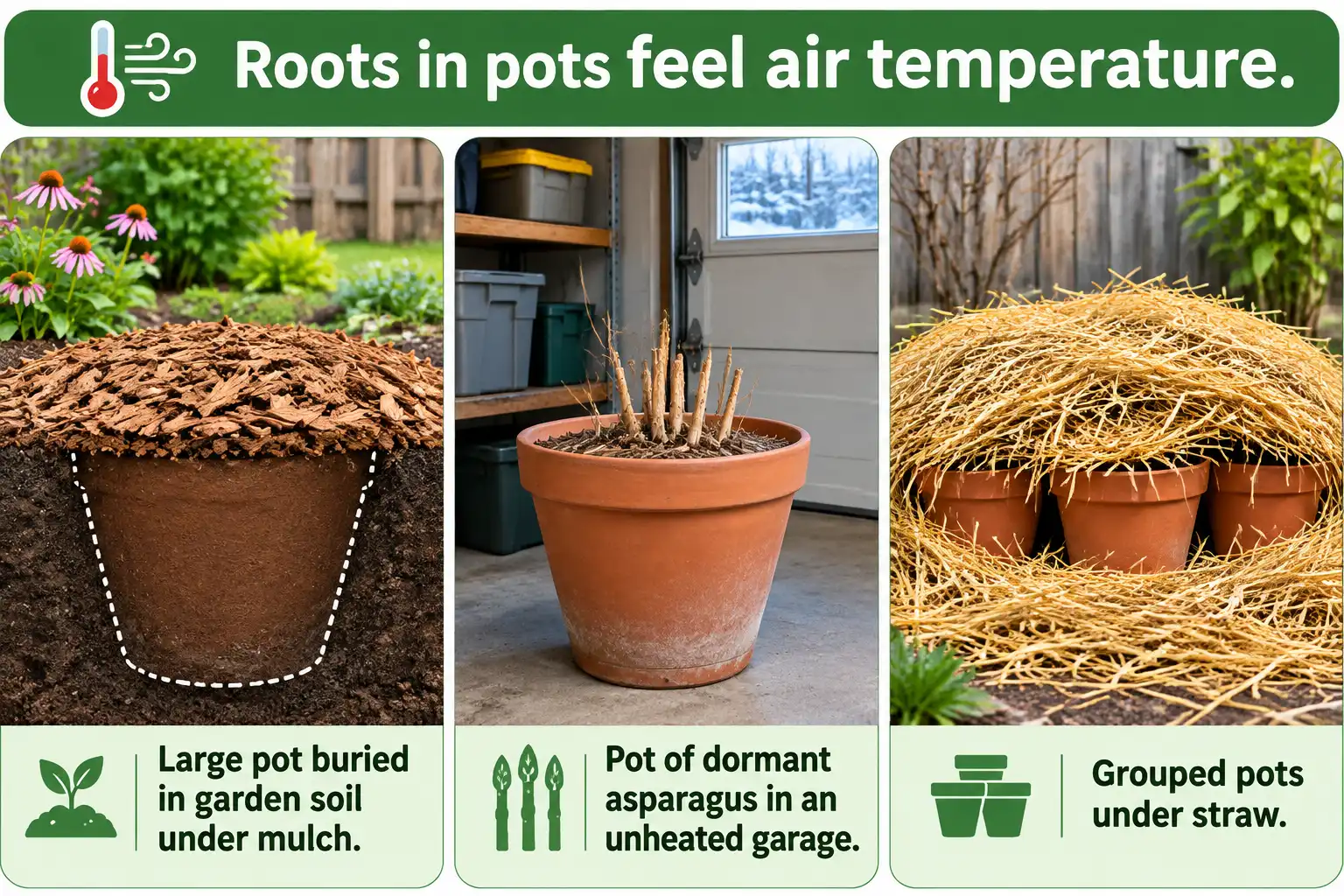
Protect a potted crown more than an in-ground bed. Penn State Extension explains that roots in an above-ground pot can be as cold as the winter air. So it advises treating a container plant as if you were two zones colder. It also notes that larger pots insulate better.
Find your zone on the USDA Plant Hardiness Zone Map, last updated in 2023. For example, on a zone 6b patio, plan as if the roots face zone 4b winters.
Penn State lists three ways to protect a pot:
- Bury the whole pot in the ground and cover it with soil or mulch
- Move it to an unheated garage, shed, or cold frame
- Group pots in a sheltered spot under straw, shredded leaves, or a thermal blanket
If you bury the pot, call 811 before you dig so buried utility lines get marked. Either way, water well before the mix freezes, since dry soil freezes faster. In a garage, check moisture now and then without overwatering. Wrap clay or glazed pots left outdoors, because Penn State warns they may crack. In spring, remove covers gradually.
When Can You Harvest Asparagus Grown in Pots?
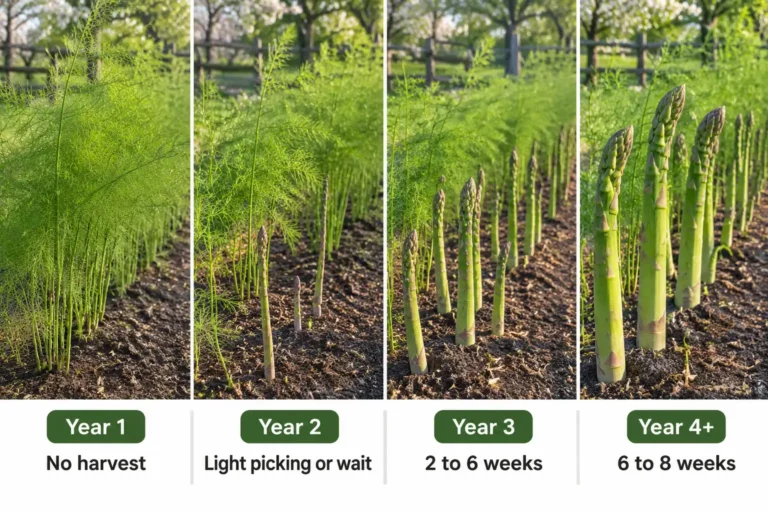
Plan on the third spring after planting for the first real harvest. Sources split on the second spring, so here are three side by side.
| Spring | UMN (Minnesota) | UNH (New Hampshire) | Illinois Extension |
|---|---|---|---|
| Planting year | None | None | None |
| Second spring | Up to 1 week | None | None |
| Third spring | Shortened harvest | 2 to 3 weeks | Up to 1 month |
| Mature planting | 6 to 8 weeks | 6 to 8 weeks | 8 to 10 weeks |
UMN’s figures come from its harvest guide for commercial growers. For a pot, the slower UNH schedule is the safer choice. A potted crown has less room to rebuild reserves, so skipping a second-spring picking costs little.
How to Pick and When to Stop
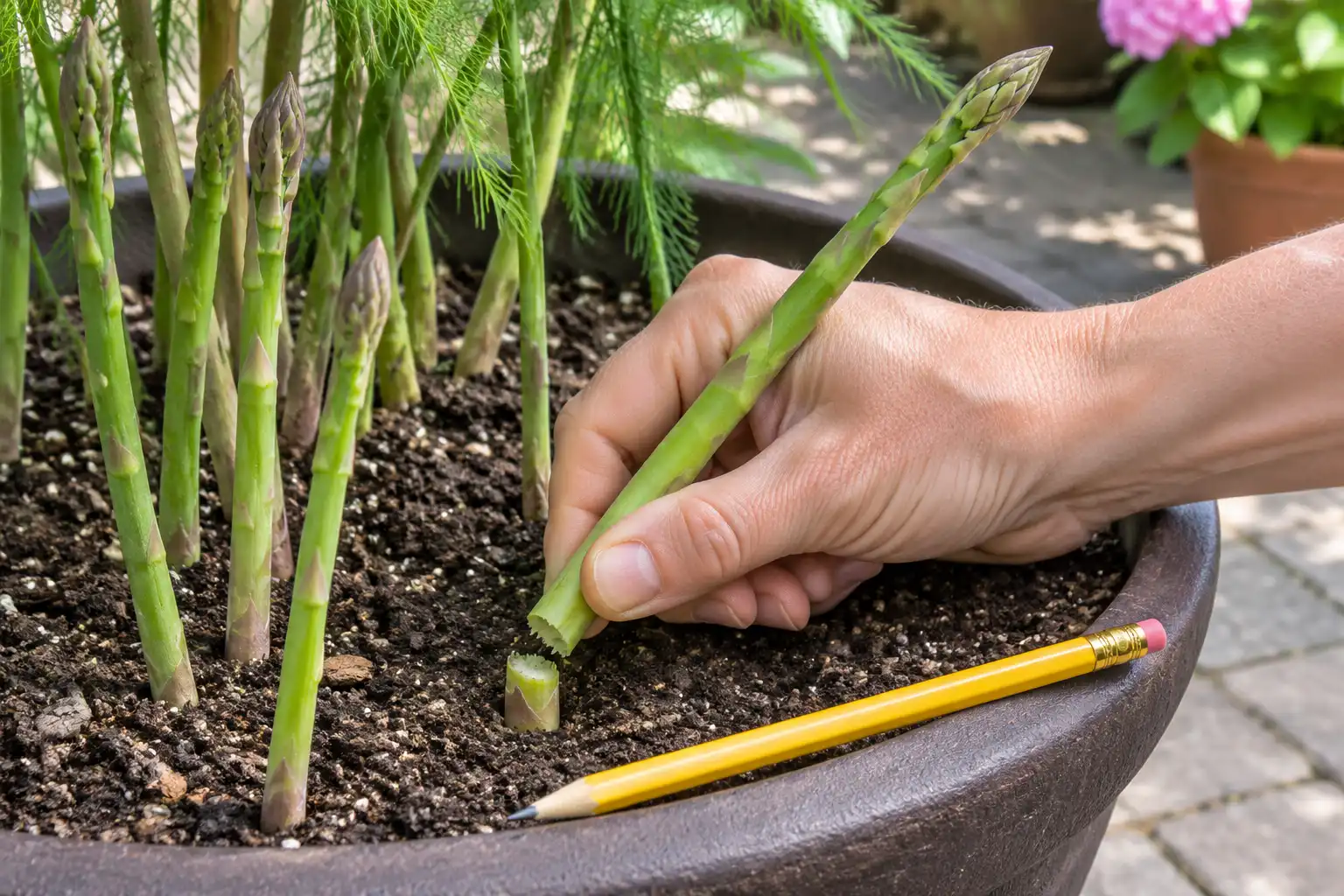
Pick spears at 6 to 10 inches tall, the height UMN gives. Snap them by hand near the mix line. UMN notes that snapping is less likely than a knife to injure buried spears.
Stop when new spears come up thinner than a pencil, or when tips open on spears under 6 inches. UMN treats both as signs the crown is running low. In a pot, watch for these signs rather than counting weeks.
Asparagus Beetles in Potted Asparagus
The notes below describe what to look for, not a diagnosis. Your county extension office or local Master Gardener volunteers can confirm what is on your plants.
UNH names the asparagus beetle as the most serious insect pest of asparagus. UMN describes two kinds, both about 1/4 inch long:
- Common asparagus beetle: bluish-black with six cream-colored spots
- Spotted asparagus beetle: reddish-orange with twelve black spots
Adult feeding can turn spears brown and bend them into a hook. Common asparagus beetles also lay dark brown, oval eggs in rows on spears.
With a pot or two, handpicking works. UMN suggests dropping beetles and larvae into soapy water and scraping eggs off spears. Check on warm, sunny afternoons, when beetles are most active. However, spare lady beetles, whose larvae eat beetle eggs and larvae.
If you choose an insecticide, the label sets every detail and must list asparagus or vegetables. UMN also notes many of these products are toxic to bees. So avoid spraying while plants flower.
Other Problems to Rule Out
Several problems look alike. Rule out these causes, drawn from Illinois Extension, UMN, UNH, and University of Missouri guidance.
| What you see | Causes to rule out |
|---|---|
| Spears brown and hooked | Beetle feeding (UMN) or frost on emerging tips (Illinois) |
| Crooked spears | Injury from tools, insects, or wind-blown grit (Illinois) |
| Loose, opening tips | Hot weather speeding growth (Illinois) |
| Spears thinner each spring | Long harvests, under 8 hours of sun (UNH), or roots filling the pot |
| Soggy mix, weak ferns | Blocked holes or a gravel layer holding water (Missouri) |
How Many Years Will Potted Asparagus Produce?
No trial data shows how long a potted crown stays productive. So treat any firm number as a guess. Instead, let the spears tell you. If early spears come up thin year after year despite good care, the crown has likely filled the pot.
Then you have two options. First, you can move the crown into an in-ground or deep raised bed at spring planting time. Or replace it with a fresh crown and new mix. Either way, a permanent bed is the long-term home for asparagus and other perennial crops.
Frequently Asked Questions
Can asparagus grow in a 5-gallon bucket?
Only as a short-term holding pot, moved to a bigger container by the next spring. A 5-gallon bucket holds about 0.7 cubic feet of mix, roughly a fifth of a 20 by 20 inch pot.
How many asparagus crowns can go in one pot?
Plant a single crown in a round pot that measures 18 to 24 inches across. In a long planter, space crowns 12 inches apart, matching University of Minnesota Extension’s in-row spacing.
Do I need both male and female asparagus plants?
No, because spears grow from buds on the crown, not from flowers. Illinois Extension notes all-male plants make thicker spears and drop no weedy seedlings, which suits a crowded pot.
Why are my potted asparagus spears so thin?
Thin spears usually point to a crown short on stored energy, from long harvests, low sun, or crowded roots. University of Minnesota Extension treats pencil-thin spears as the signal to stop picking.
Can I move potted asparagus into the ground later?
Yes, at the normal spring planting time, which Illinois Extension sets as soon as you can work the soil. Set the crown at the same depth it grew in the pot.
Before You Plant
Check three things first. You need a pot at least 20 inches deep and wide, 8 hours of sun, and a winter plan. Then buy all-male crowns and plant them in spring. Leave the spears alone for two seasons, because this year’s ferns feed next year’s spears.