How to Grow Asparagus in Texas: Planting Dates, Varieties and Care
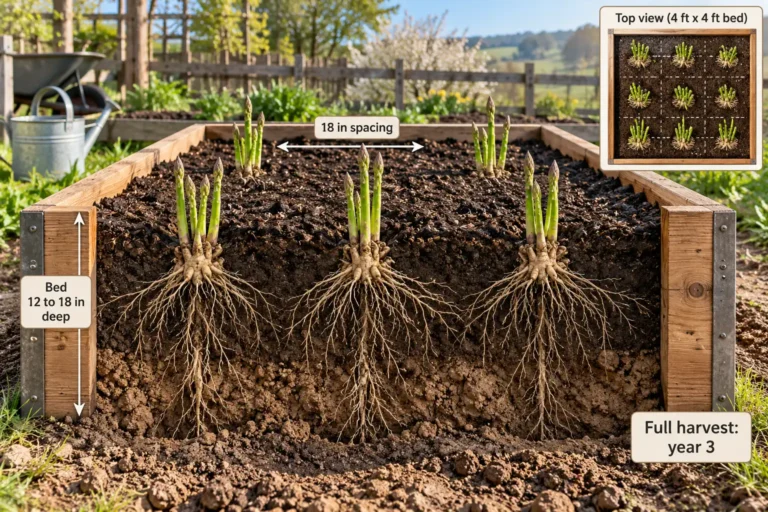
How to grow asparagus in Texas depends on where you live. Texas A&M AgriLife Extension says the crop does best in cooler North and West Texas. It still grows around Dallas and Houston but struggles where winters stay mild. A well-sited bed can last 15 to 25 years.
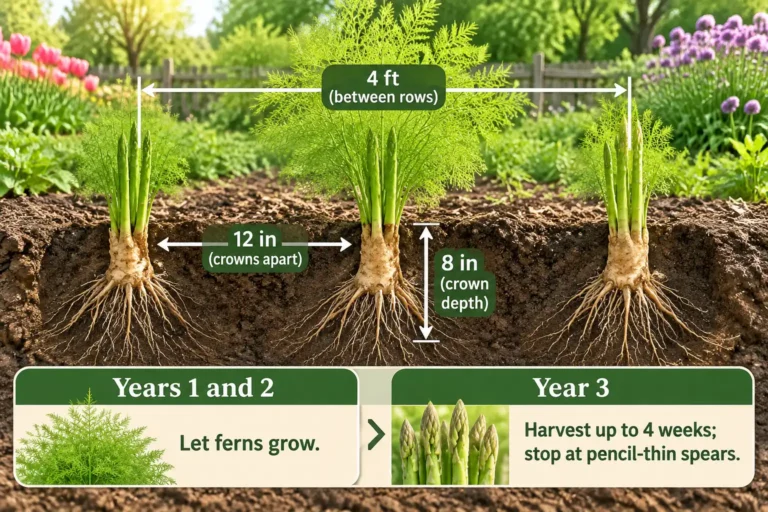
Plant dormant asparagus crowns in January or February in most of Texas, 12 to 14 inches apart and 4 to 12 inches deep. Part of how to grow asparagus in Texas is patience: skip harvest for one to two years.
Where Asparagus Grows Best in Texas
Asparagus does best where Texas winters get cold. Texas A&M’s asparagus guide names North and West Texas as the best fit. Still, gardeners in Dallas and Houston can grow it.
Trouble starts where winters stay mild and summers run long. In South Central and South Texas, Texas A&M’s gardening Q&A reports that spears often shrink year after year. Heat, especially in fall, drains the food that crowns store for next spring.
So your location changes three things: when you plant, when you cut the ferns, and how long the bed lasts. Most basic care matches asparagus growing in Florida. In Texas, the differences come down to timing, heat and drainage.
When to Plant Asparagus in Texas
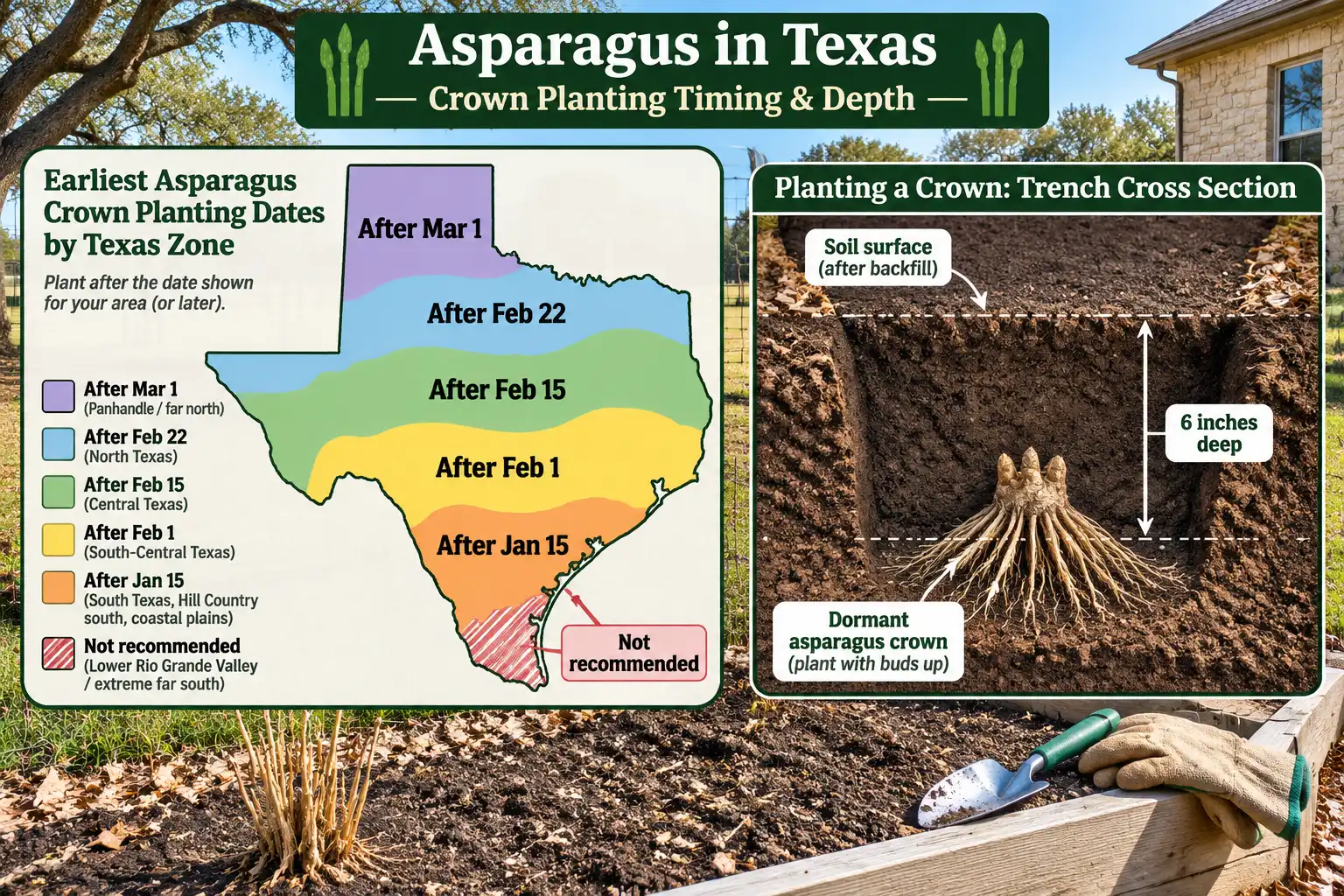
Plant asparagus crowns in January or February in most of Texas, while they’re still dormant. That’s the window Texas A&M’s asparagus guide gives, or as soon as the soil is workable.
Texas A&M AgriLife’s PlantAnswers spring planting guide narrows it by region, using each region’s average winter low:
| Texas gardening region | Average winter low | Earliest crown planting |
|---|---|---|
| Region I | -10 to 0°F | After March 1 |
| Region II | 0 to 10°F | After February 15 |
| Region III | 10 to 20°F | After February 1 |
| Region IV | 20 to 25°F | After January 15 |
| Region V | 25 to 30°F | Not recommended |
To find your region, enter your ZIP code in the USDA Plant Hardiness Zone Map. Then match its average winter low to the table. The map changed in 2023, and its developers report that about half the country moved into a warmer half zone. So an older chart may show your county colder than it is now.
How the window lines up with your last freeze
Texas A&M AgriLife’s Lubbock planting calendar, updated January 2021, lists February 18 to March 4 for bare-root asparagus. Lubbock’s average last spring freeze is April 15. That puts South Plains planting about 6 to 8 weeks before the last freeze.
Choose a Site That Drains
Asparagus needs deep, well-drained soil and a spot it can keep for decades. Texas A&M calls for full sunlight and sandy or light soil. It also suggests a garden edge or fence line.
Check the spot before you commit:
- Look for yellow nutsedge. Texas A&M treats it as a sign of poor drainage, which asparagus can’t handle.
- Clear perennial grasses. Remove johnsongrass and bermudagrass before the crowns go in.
- Test the soil. Asparagus grows poorly below pH 6.0, per Texas A&M. Add lime only if the test calls for it, aiming for 6.5 to 7.5.
- Ask about lead. Near an older house, a painted fence or a busy road, request a lead test before you grow food there for 15 years.
Heavy clay needs more work. Texas A&M’s gardening Q&A suggests digging out poor soil and refilling the bed with one-third sand, one-third soil and one-third compost or sphagnum moss. If you’d rather build up than dig out, the same loose texture is the goal in raised bed soil mixes.
Because the bed is permanent, picking the right asparagus spot saves years of trouble.
Pick Asparagus Varieties for Texas
All-male hybrids are the safer choice for most Texas gardens. Texas A&M says male Jersey types, such as Jersey Giant, Jersey Knight and Jersey Supreme, outyield the older Washington types. They also resist disease better. Washington types include female plants, which drop red berries that sprout as weeds.
Regional picks vary. The Lubbock calendar lists Jersey Giant and UC 157 for the South Plains. Texas A&M also suggests Purple Passion, a purple type with large spears, for home gardens.
For South Texas, one small trial adds data. A Southern SARE producer trial near Lyford, in the Rio Grande Valley, compared five varieties. Each had 25 feet of row. These are its second-year totals, covering 16 months:
| Variety | Spears harvested | Total weight |
|---|---|---|
| Jersey Supreme | 1,024 | 20.1 lb |
| Jersey Knight | 890 | 19.0 lb |
| Mary Washington | 774 | 15.7 lb |
| Purple Passion | 457 | 12.8 lb |
| UC 157 | 478 | 8.5 lb |
UC 157 came last at Lyford, even though the Lubbock calendar recommends it. The two places have very different winters. Still, the trial covered one farm over 28 months, so treat it as a lead, not a verdict.
How to Grow Asparagus in Texas From Crowns
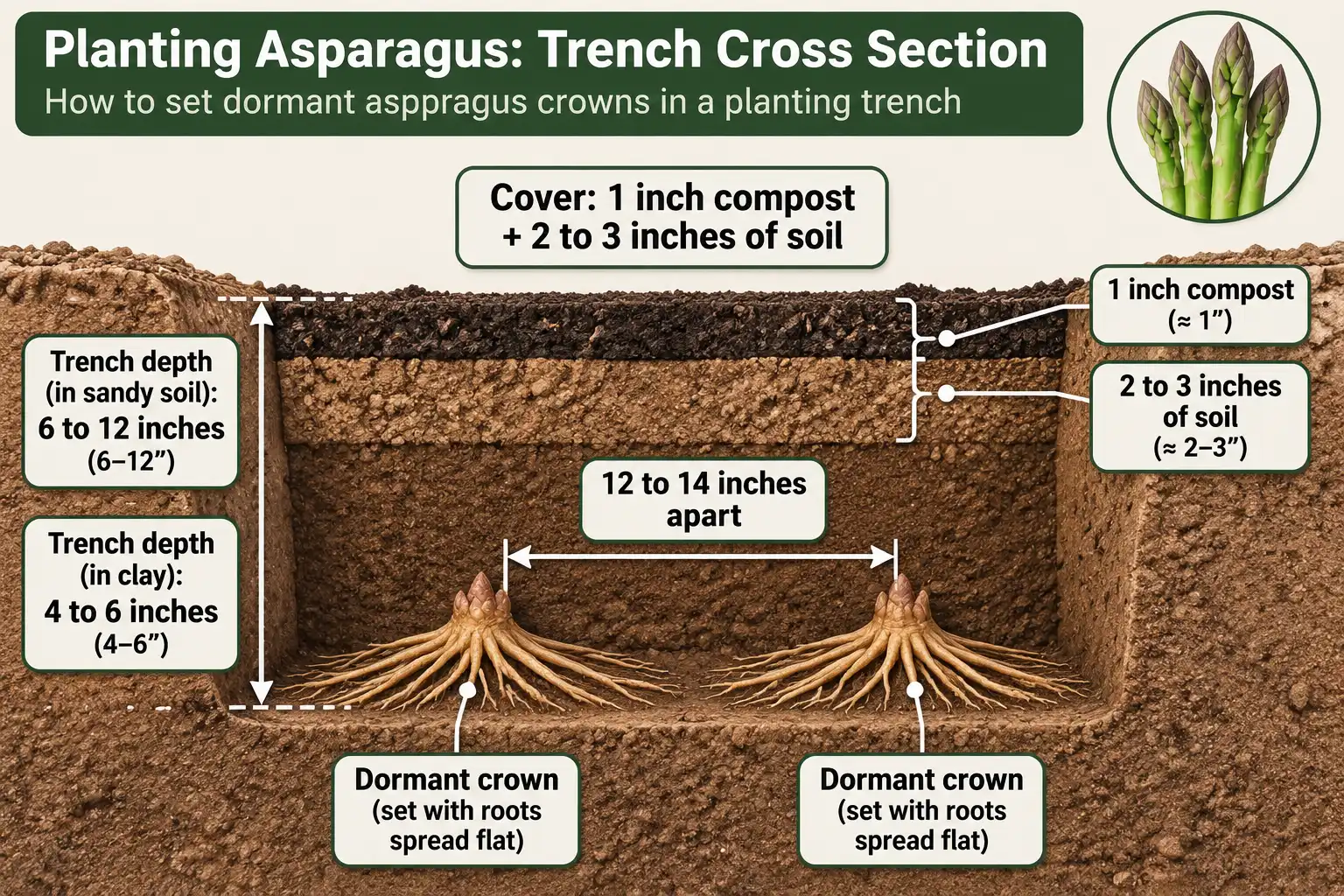
Plant dormant 1- or 2-year-old crowns rather than seed. Texas A&M notes a good crown takes at least a year to grow, so starting asparagus from seed delays your first harvest. Crowns go straight into a planting trench instead.
These steps follow Texas A&M’s asparagus guide:
- Prepare the bed in late fall. Spread 3 inches of compost and till it 10 to 12 inches deep. Call 811 first so the utility can mark buried lines.
- Mark rows 5 feet apart. That leaves room to weed and harvest each row.
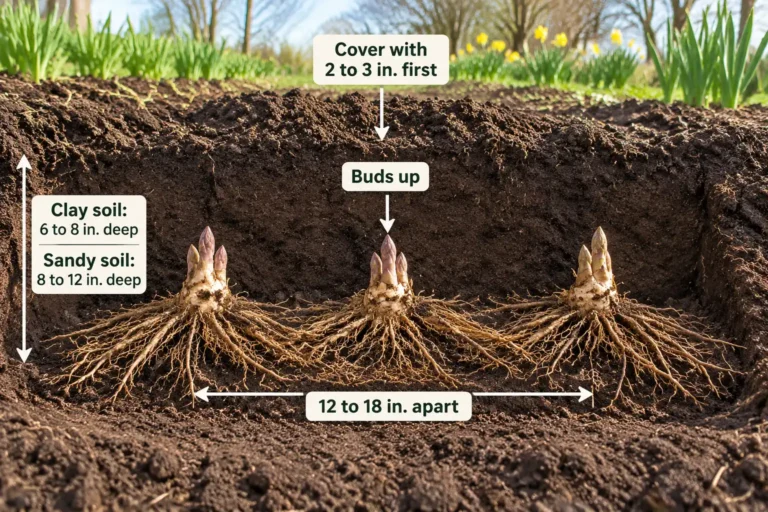
- Dig furrows. Make them 4 inches wide and 4 to 12 inches deep.
- Band phosphorus in the furrow. Texas A&M suggests 0.75 ounce of superphosphate (0-46-0) per 20 feet of row, unless your soil test says otherwise.
- Sort crowns by size. Grouping similar crowns gives more even spears.
- Set crowns 12 to 14 inches apart. Spread the roots flat.
- Match depth to your soil. Plant 6 to 12 inches deep in loose soil and 4 to 6 inches deep in heavier soil.
- Cover lightly. Add 1 inch of compost and 2 to 3 inches of soil, then firm it.
- Fill the furrow as shoots grow. Reach ground level by season’s end. The gradual fill also smothers small weeds.
Texas A&M also allows filling the furrow at once if the soil over the crowns stays loose.
How Many Asparagus Crowns to Plant
Texas A&M sizes a family of four at about 20 crowns: one 20-foot row, or 100 square feet of bed. Once established, that planting yields about 10 pounds of spears a season.
To size your own row, use this formula:
Crowns per row = row length in inches ÷ spacing in inches
| Spacing | Crowns in a 20-foot row (240 inches) |
|---|---|
| 12 inches | 20 |
| 14 inches | 17 |
| 18 inches | 13 |
| 24 inches | 10 |
Spacing advice differs within Texas A&M. Its asparagus guide uses 12 to 14 inches, while its gardening Q&A uses 18 to 24 inches. The guide explains the trade-off. Closer crowns give smaller spears, and wider spacing gives bigger spears but less total yield. So choose the wide end if spear size matters more to you than pounds.
Watering and Weeding Asparagus
Asparagus needs deep, infrequent watering. Texas A&M says to soak the bed, then let the top inch of soil dry before you water again. That usually means every 3 to 5 days, depending on soil type and heat. In sandy soil, the roots can reach 10 feet deep when moisture allows.
A drip line along each row makes those deep soakings easier.
Weeds are the bigger threat in young beds. Texas A&M says to keep them under control for the first 1 to 2 years. A 4- to 6-inch layer of hay, straw, compost or wood chips holds most of them back. Pull or hoe weeds before spears come up, so you don’t break the new spears.
If you’re weighing a weed killer, the product label decides whether, where and when you can use it near asparagus.
Fertilizing Asparagus in Texas
Start with a soil test. Before planting, Texas A&M suggests working in ¼ pound of nitrogen, phosphate and potassium per 20 feet of row, or whatever the test report calls for.
For established beds in most of Texas, the guide lists two feedings:
- Late January or early February: 2 pounds of 10-20-10, or an equivalent, per 20 feet of row before spears start.
- After the last harvest: 1 to 2 pounds per 20 feet of row, ideally a nitrogen fertilizer such as 21-0-0.
Water the fertilizer in each time. For your own row, multiply its length in feet by 0.1 pound for the late-winter feeding. A 30-foot row, for example, gets 3 pounds of 10-20-10 in late winter and 1.5 to 3 pounds after harvest. At planting, that same row needs about 1.1 ounces of superphosphate.
Using Manure Without Cutting the Safety Margin
Raw manure carries food safety risks, and asparagus timing makes it easy to misjudge. Texas A&M’s guide suggests manure for fall soil prep and as mulch after the first freeze. Under the National Organic Program, growers must work raw manure into the soil at least 120 days before harvest when the edible part touches the soil. Spears push up through the soil, so use the 120-day figure. The rule reads the same as of October 2026.
Run the dates for your own bed:
Latest raw manure date = first expected harvest minus 120 days
- A first cut around March 1 means working raw manure in by about November 1.
- Raw manure spread after a late-November freeze sits only about 90 days before late-February spears.
Texas A&M’s seasonal chart puts the harvest between late February and early May. So for the after-freeze mulch, use finished compost instead. The 120-day rule binds certified organic growers, but it’s a sensible food safety margin for any home bed.
Harvesting Asparagus in Texas
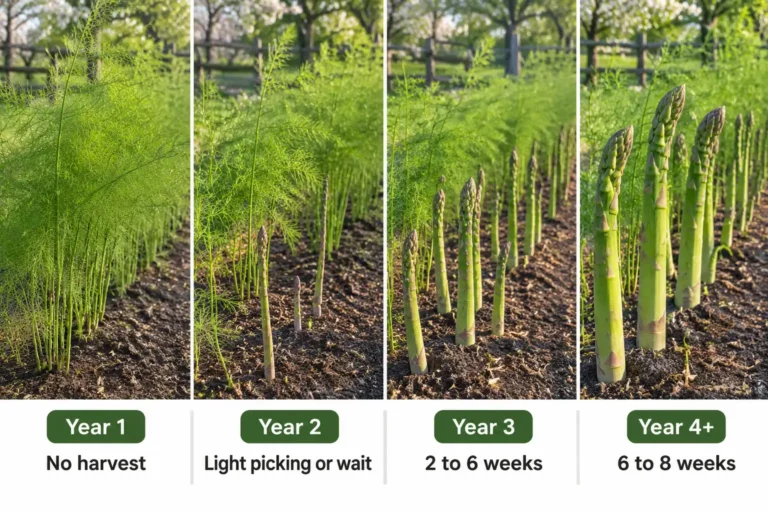
Harvest only after the crowns have built reserves. Texas A&M’s asparagus guide says to skip harvest for the first 2 years after planting. Its gardening Q&A allows a light pick the year after you plant 1-year-old crowns. Both agree that picking too early cuts yields for years.
Season length differs too. The guide allows about 8 weeks from established beds, depending on area. The Q&A says 4 to 6 weeks from the first cut. In a young bed or a hot region, stay near the short end.
How to pick, per Texas A&M:
- Pick spears at 4 to 10 inches tall.
- Pick at least every other day, so spears don’t turn fibrous.
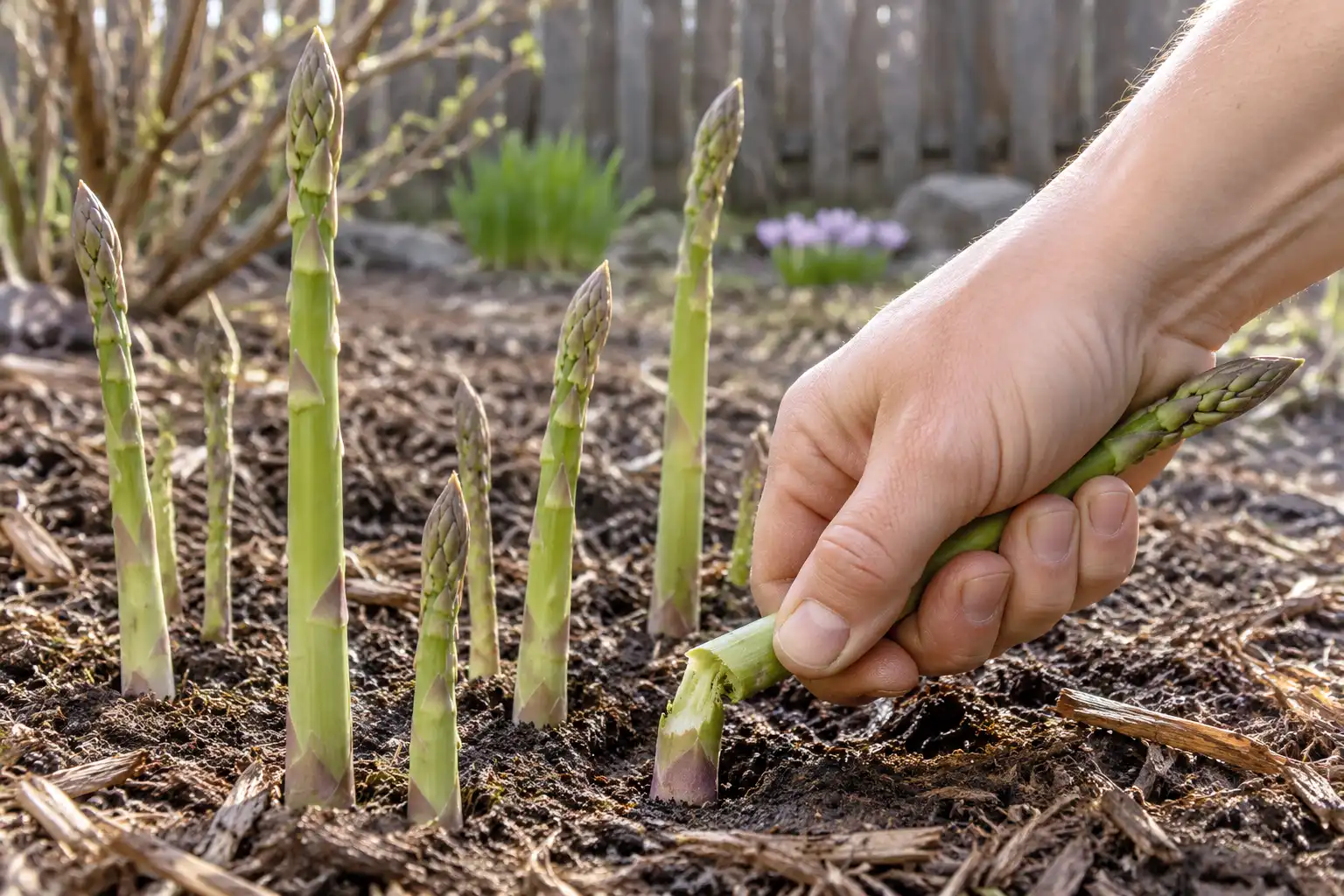
- Snap spears by hand at ground level, and leave no stubs.
- Stop when new spears are thinner than ⅜ inch, or when tips open as the weather warms.
For crowns planted in February 2027, the timeline looks like this:
| Spring | What to do |
|---|---|
| 2027 | No harvest. Let every spear become a fern. |
| 2028 | No harvest, or a light pick if you planted 1-year-old crowns |
| 2029 | First full season, about 4 to 8 weeks |
Fern Care After Harvest
After the last harvest, let every spear grow into a fern. The ferns make the food that crowns store for next spring. Texas A&M’s routine is simple:
- Rake or hoe lightly, 1 to 2 inches deep, to clear weeds.
- Apply the after-harvest fertilizer and water it in.
- Cover the bed with 3 inches of clean straw, compost or similar mulch.
- Water deeply and let the ferns grow for the rest of the year.
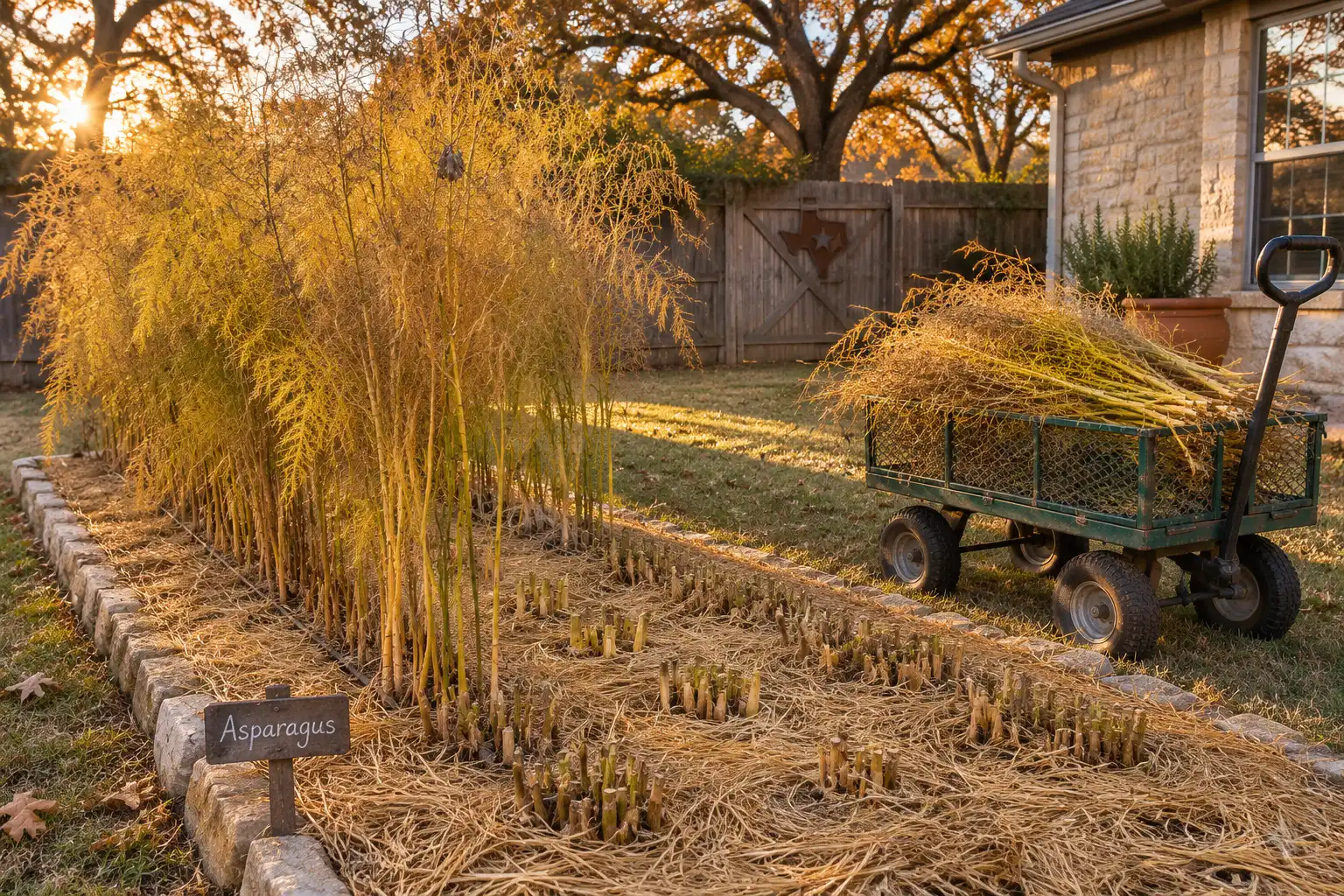
When you cut the ferns depends on your region. In North Texas, cut them at ground level after the first hard freeze. Farther south, a freeze may never kill them. There, Texas A&M says to remove them in late November, once they turn yellow. Its gardening Q&A adds that many South Texas beds need that cutback to produce the next crop.
Then haul the cut ferns out of the bed. Texas A&M notes that asparagus beetles spend the winter in crop debris.
Growing Asparagus in South Texas
South Texas is where the advice splits. The PlantAnswers guide lists asparagus as not recommended for Region V, the warmest part of the state. Texas A&M’s gardening Q&A explains the risk: heat drains crown reserves, so spears shrink year after year.
The Southern SARE trial near Lyford tested a workaround. The grower cut ferns below the soil surface every 10 months to mimic winter dieback. He staggered blocks 2 months apart and spread 2 inches of compost after each cut. Over the 28-month study, spears came up every month except January 2015. Production peaked from March to May and again from September to November.
The research here is thin, though. It came from one organic farm, and the report itself says asparagus lifespan in South Texas heat is unknown. A northern bed can last 15 to 25 years. A Rio Grande Valley bed may not.
So if you garden in Region V, treat asparagus as an experiment. Plant a short row of a Jersey type. Cut the ferns back each late fall, as Texas A&M advises for southern beds, and track spear size every spring.
Asparagus Beetles and Diseases
The descriptions below can’t confirm what’s on your plants. For that, start with your county extension office. The Texas Plant Disease Diagnostic Laboratory in College Station also accepts homeowner samples.
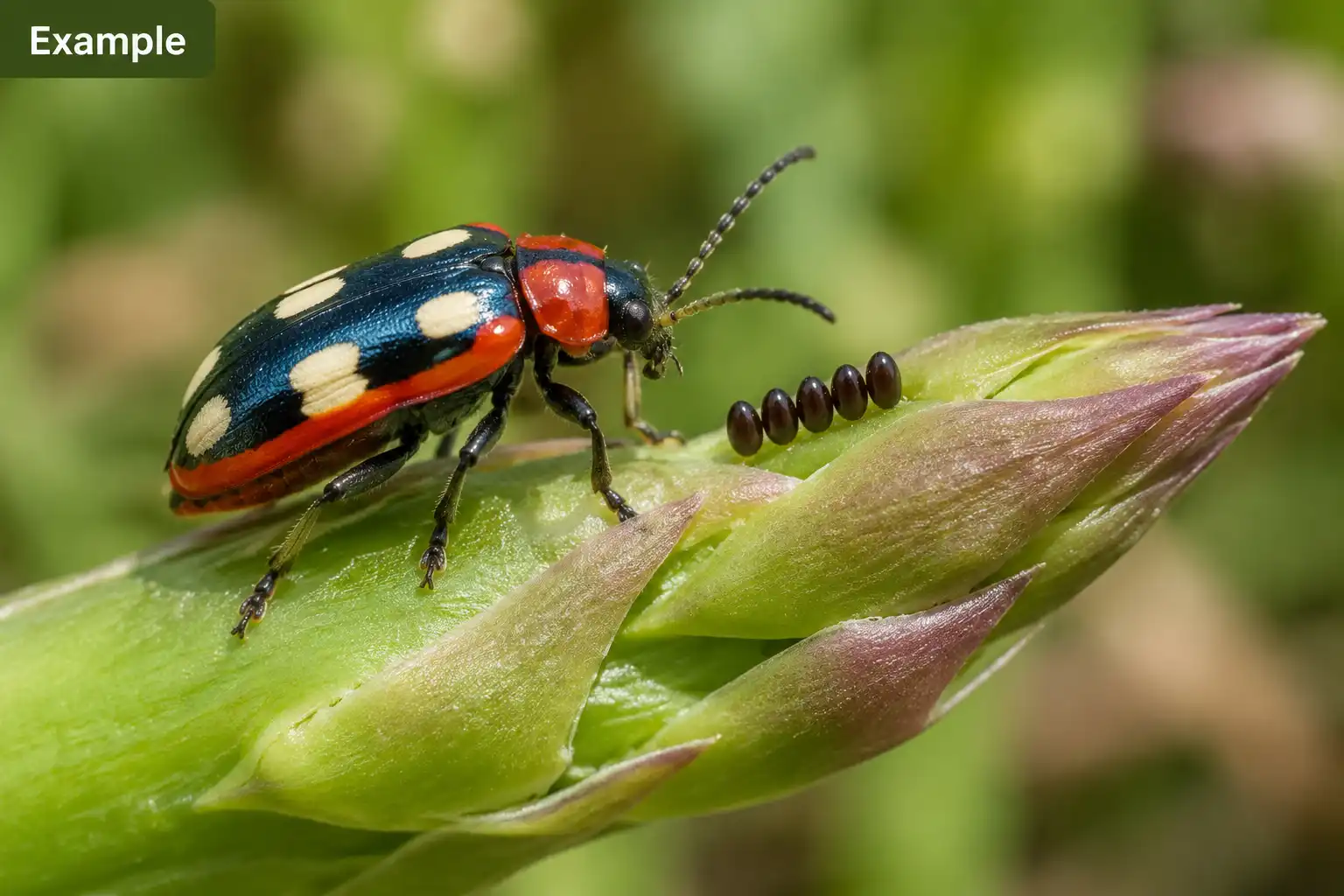
Texas A&M calls the asparagus beetle the crop’s most significant pest. K-State Research and Extension describes the adult as about ¼ inch long and metallic blue-black, with red edges and six cream spots. Females lay dark brown eggs on end, often in rows along spear tips. The slug-like larvae are olive-green to gray and about ⅓ inch long.
Both stages chew spears and strip ferns, which cuts the food stored for next year. So K-State suggests hand-picking eggs, larvae and adults into soapy water. It also advises clearing plant debris after the season, since adults spend the winter there.
If you consider an insecticide, the product label sets whether you can use it on asparagus, how, and how long to wait before picking. Many labels also carry pollinator directions you must follow.
Texas A&M names crown rot and rust as the common diseases. Good drainage and a correct pH prevent many of them, so site choice is your best defense.
Troubleshooting Common Asparagus Problems
The patterns below come from Texas A&M’s asparagus guide and gardening Q&A. They point to likely causes, not a diagnosis, so take anything that looks like disease to your county office first.
| Problem | Possible causes (Texas A&M) | What to change |
|---|---|---|
| Thin spears | Crowns planted too close together | Space new beds 12 to 14 inches or wider, and stop harvest below ⅜ inch |
| Spears smaller every year | Heat or poor growing conditions draining stored food, mostly in South Central and South Texas | Harvest less and keep ferns healthy through fall |
| Crooked spears | Injury from cultivation, insect feeding or blowing soil | Stop cultivating near spears and check for beetles |
| Tough, stringy spears | Overmature spears or low fertility | Pick every other day and follow the soil test |
| Red berries and volunteer seedlings | Female plants | Choose all-male Jersey types for new beds |
| Yellow ferns or dying crowns | Normal fall yellowing, or problems such as crown rot, rust or poor drainage | Send a sample before treating anything |
FAQs on Growing Asparagus in Texas
Can you grow asparagus in Houston?
Yes, Texas A&M AgriLife lists Houston and Dallas as places asparagus can grow, though cooler North and West Texas suits it best. Drainage matters most, so replace heavy, wet soil with a looser planting mix first.
How long does asparagus take to produce in Texas?
Texas A&M says a bed takes 2 to 3 years from planting to full production. Its asparagus guide skips harvest for 2 years, while its gardening Q&A allows a light pick in year two.
Should I plant asparagus seeds or crowns in Texas?
Plant crowns in January or February for a faster start. Texas A&M recommends 1- or 2-year-old crowns, and its Q&A says seed-grown plants need about 3 years before the first harvest.
Can you plant asparagus in fall in Texas?
Sometimes, depending on where you live. Texas A&M AgriLife’s Lubbock calendar lists a fall window of September 3 to October 15, but the statewide asparagus guide gives only January and February, so check with your county office.
How many asparagus plants do I need per person?
Texas A&M sizes a family of four at about 20 crowns, which works out to roughly 5 crowns per person. That planting yields about 10 pounds of spears a season once established.
Does asparagus tolerate salty soil?
Asparagus handles it better than most vegetables, according to Texas A&M’s gardening Q&A. Still, salt that builds up in the soil over several years can harm asparagus plants and reduce spear production.
Before You Plant
Start with your region and your drainage. North and West Texas gardeners can plan on a long-lived bed. From Dallas to Houston, loose soil and all-male varieties make the biggest difference. In Region V, a short trial row makes more sense than a full bed. Prepare and test the soil this fall, then have crowns ready for your region’s planting window.