What Is an Artichoke? The Thistle Flower Bud You Eat, Explained
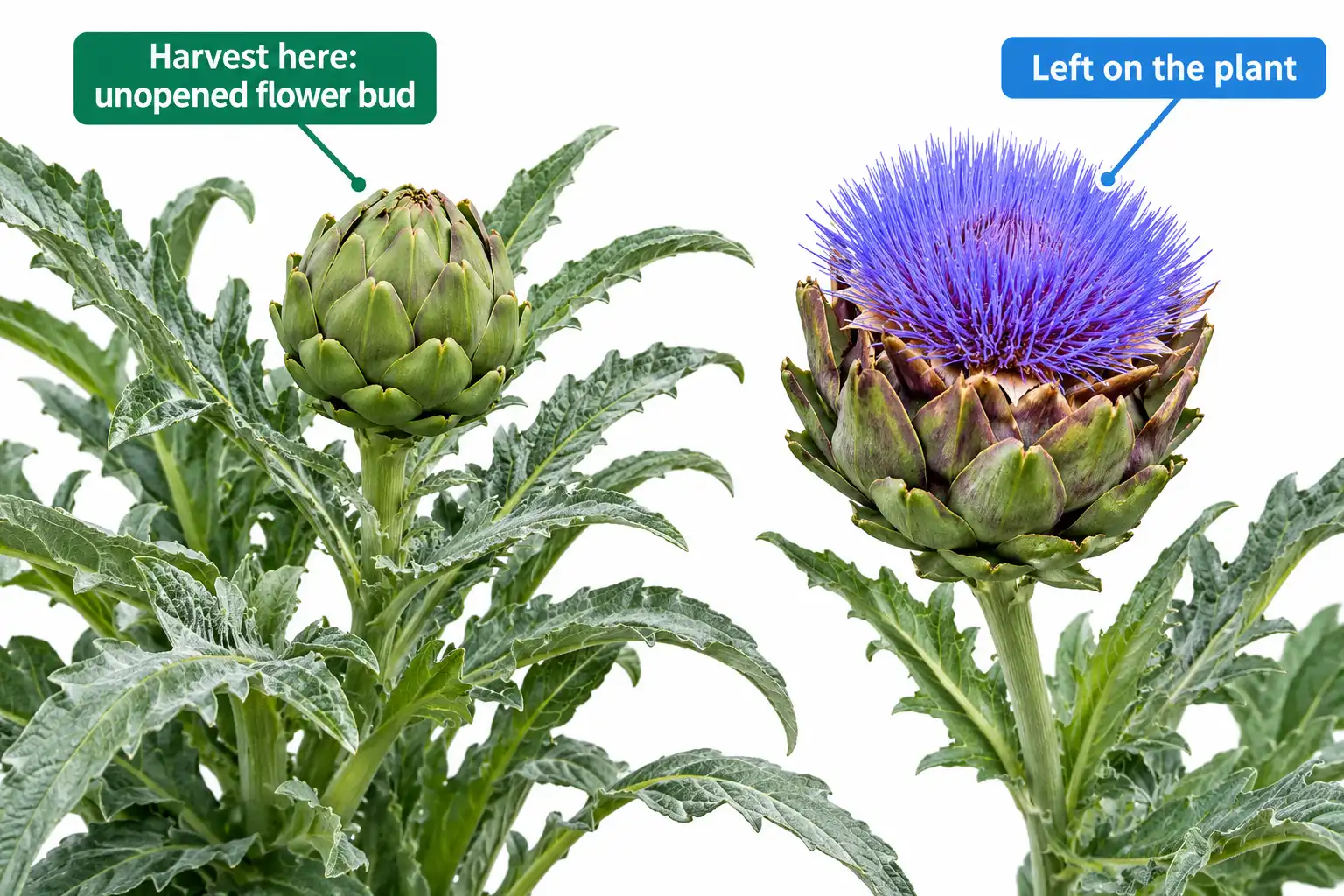
Artichokes look like scaly green pinecones, yet they come from a thistle. So what is an artichoke, exactly? Below, you’ll see the plant, the parts you eat, and where it grows in US gardens.
An artichoke is the unopened flower bud of a thistle in the sunflower family. Cooks treat it as a vegetable. You eat the fleshy base of each scale-like bract, the heart underneath the fuzzy choke, and the tender stem.
What Is an Artichoke, Botanically?
An artichoke is a cultivated thistle, Cynara cardunculus var. scolymus. Older books call it Cynara scolymus. University of Maine Cooperative Extension places it in the Asteraceae family, along with lettuce, chicory, sunflowers, and thistles.
That family shares one odd trait. What looks like a single flower is really many tiny florets packed onto one base. On an artichoke, each floret would become a seed if the bud bloomed. So growers cut it long before that, while the bracts still wrap tightly around the center.
Artichokes come from the Mediterranean. UMaine notes the first US record dates to 1806. By the mid to late 1800s, French and Italian immigrants grew them in Louisiana and California. Today, much of the US commercial crop comes from Monterey County, California. In fact, the UC Master Gardener Program points out that Castroville, a Monterey County town, is known as the artichoke capital of the world.
Is an Artichoke a Vegetable?
Yes, in the kitchen. The UC Master Gardener Program classes artichokes as a cool-season vegetable, and cooks handle them like one. Botanically, though, the part you buy is a flower bud.
That makes it neither a fruit nor a leaf. A fruit develops only after a flower blooms and sets seed. And the “leaves” you pull off a cooked artichoke are bracts, the stiff scales that wrap the young flower. Broccoli works the same way, since its heads are clusters of unopened flower buds too.
| Question | Answer |
|---|---|
| How cooks use it | As a vegetable |
| Part you eat | The immature flower head, or bud |
| Plant family | Asteraceae (daisy, sunflower, and thistle family) |
| Life cycle | Perennial where winters are mild, annual where they’re cold |
Artichokes are also perennial, so one planting can produce for years in mild climates. Sources differ on how many. University of Arizona Cooperative Extension says established plants in Yavapai County stay productive for 4 to 7 years. The UC Master Gardener Program says 5 years or more for well-tended plants in California.
What Does an Artichoke Look Like?
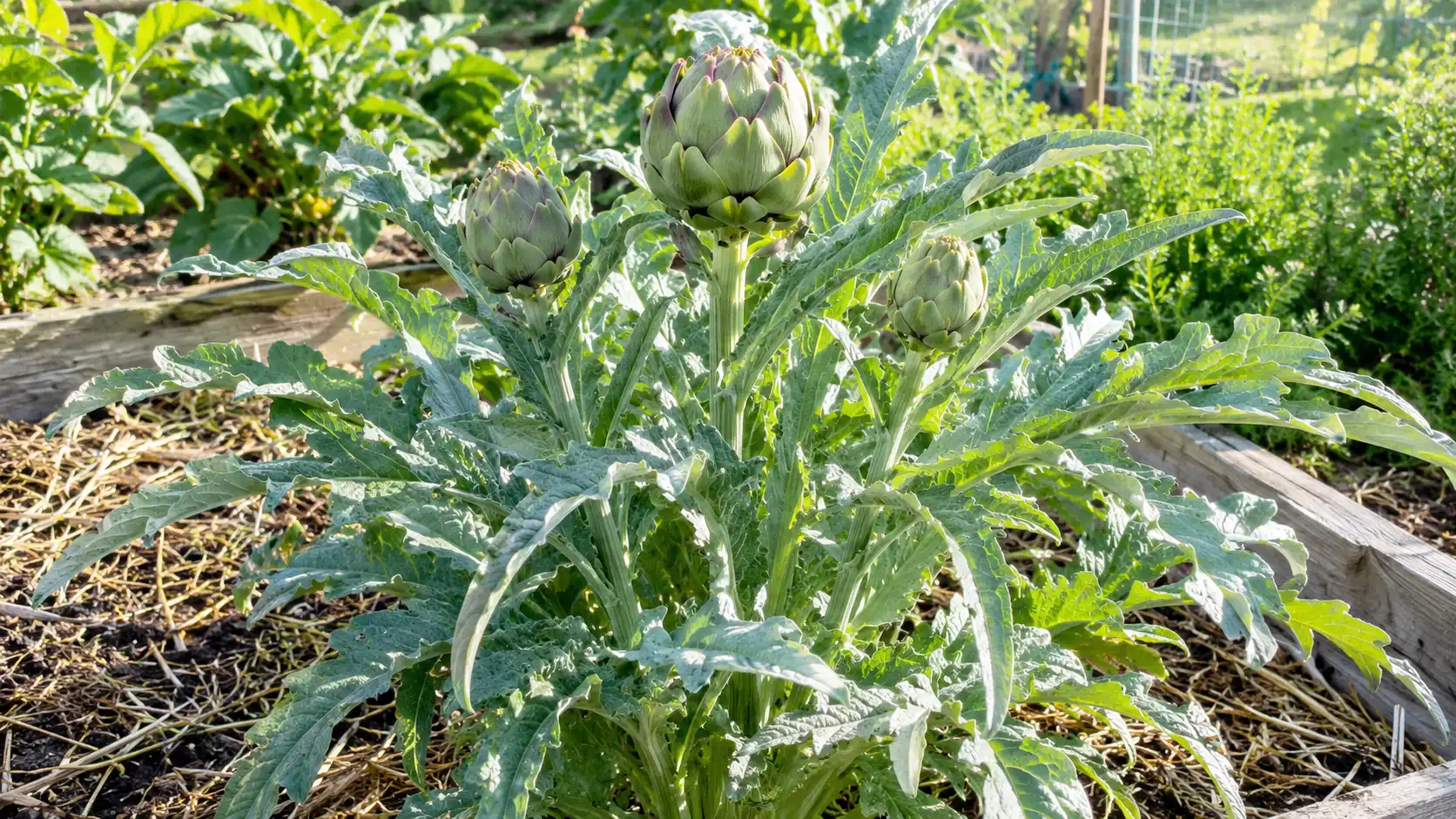
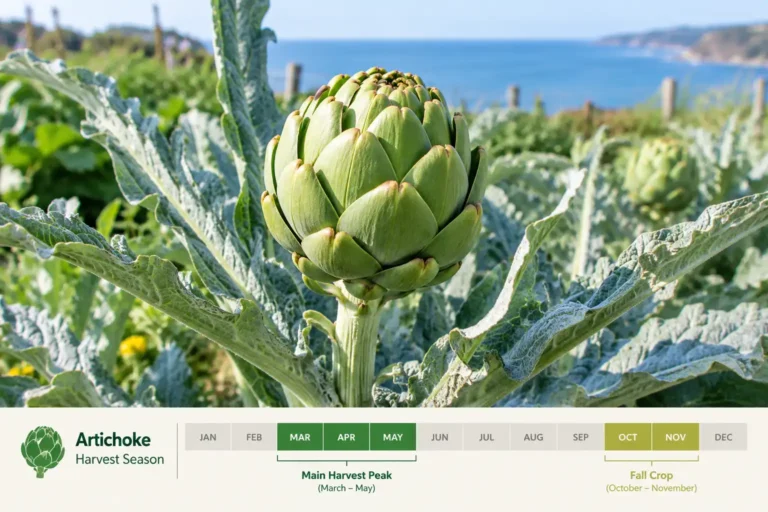
An artichoke bud looks like a tight, scaly globe on a thick stem. The plant around it looks like a giant silver thistle.
The Bud
Buds run from round to cone-shaped. The overlapping bracts are green on most varieties, and some carry a purple tint. UMaine notes that typical grocery-store buds measure 3 to 4 inches wide. Smaller buds grow lower on the same stalk.
Many varieties also have a small spine at each bract tip. Here the sources split. The UC Master Gardener Program lists ‘Imperial Star’ as spineless, while UMaine’s trials in Maine found its bracts fairly spiny. So read the variety description, and wear gloves either way.
The Plant
A grown plant forms a wide clump of long, arching, deeply lobed leaves in silver green. Size depends on climate. Arizona Extension puts a mature plant at 4 feet tall and 6 feet wide in Yavapai County. In Maine, artichokes grow as annuals. Even so, UMaine reports plants 4 to 5 feet tall and over 3 feet across by late summer.
Per UMaine, each flower stalk carries one large top bud. Below it sit two or three smaller buds and several tiny ones.
The Flower
Skip the harvest, and the bud opens into a big thistle bloom. Arizona Extension describes it as purple and up to 7 inches wide. However, the UC Master Gardener Program calls the color a bright sky blue, so expect a shade between the two. UC also notes the open flower isn’t edible. Still, it dries well for arrangements, Arizona Extension adds.
What Part of an Artichoke Can You Eat?
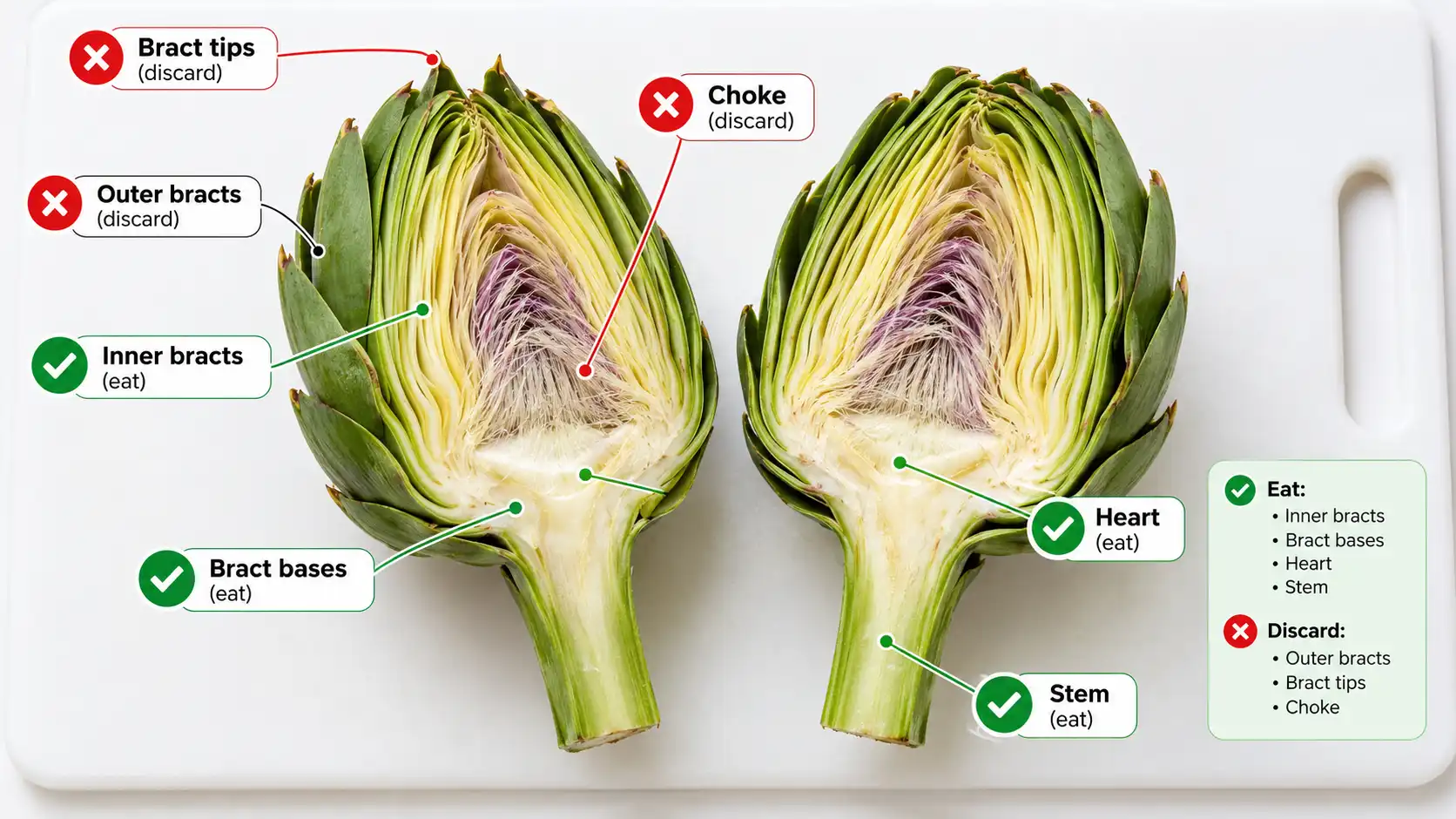
You eat three parts: the fleshy base of each bract, the heart, and the stem. The UC Master Gardener Program names the bract bases and the heart as the edible portions. It adds that the 2 to 3 inches of stem cut with each bud is usually tender and edible too. Leave out the tough upper bracts, the fuzzy choke, and any open flower.
| Part | What it is | Can you eat it? |
|---|---|---|
| Outer bracts | Tough green scales on the outside | Only the soft base |
| Inner bracts | Thin, pale scales near the center | Yes, often whole on small buds |
| Choke | Fuzzy mass of immature florets | No |
| Heart | Fleshy base where the florets sit | Yes |
| Stem | The 2 to 3 inches cut with the bud | Yes, usually tender |
| Open flower | The bloom on an unpicked bud | No |
How to Eat a Whole Cooked Artichoke
UMaine describes the usual way to eat a steamed or boiled bud:
- Pull off one bract at a time.
- Scrape the fleshy lower part off with your teeth, then discard the rest.
- Keep going until you reach the thin, pale bracts at the center.
- Scoop out the choke and eat the heart underneath.
Steaming and boiling aren’t the only options, either. UMaine also lists braising, stuffing, baking, and grilling.
What Are Artichoke Hearts?

An artichoke heart is the receptacle, the fleshy base that holds the florets. It sits at the bottom of the bud, right under the choke. Once you remove the choke, the whole heart is edible. You’ll also find hearts canned, frozen, and marinated, as UMaine notes.
Baby artichokes are not a separate variety. Instead, they’re the small buds that grow lower on each flower stalk. According to UMaine, these small buds tend not to form a choke. So you only strip a few tough outer bracts, then eat the whole bud.
Growing your own? Pick every bud while it’s firm and tight, before the bracts start to open. UMaine explains that soft buds with loosening bracts are maturing, and their eating quality drops.
Can You Eat Artichoke Plant Leaves?
Not as a vegetable. When people talk about eating artichoke leaves, they usually mean the bracts on the bud. The big leaves on the plant itself are a different part. The UC Master Gardener Program names the bracts, the heart, and the stem as the edible parts. The foliage isn’t on that list.
Artichoke leaf does have one use: herbal products. The European Medicines Agency explains that dried artichoke leaf goes into herbal teas and extracts. People use them traditionally for indigestion, fullness, and bloating. But the agency also says the clinical studies were too small and short for firm conclusions. Its summary rules these leaf medicines out for anyone allergic to plants in the Asteraceae family. It also rules them out for people with certain liver and bile duct disorders. So check with a doctor or pharmacist before trying one.
Want a leafy relative you can cook? That’s cardoon. UMaine describes it as a close artichoke relative grown for its fleshy stalks.
Handle the plant with care, too. UMaine recommends gloves at harvest to protect your hands from the spines and the plant’s sticky sap.
Globe Artichoke vs. Jerusalem Artichoke and Cardoon

Only the globe artichoke is a true artichoke. NC State Extension says plainly that the Jerusalem artichoke is not an artichoke and has no connection to Jerusalem. Instead, it’s a sunflower, Helianthus tuberosus. You eat its knobby tubers, which look like a cross between a potato and ginger root.
NC State lists the plant at 6 to 10 feet tall with yellow sunflower blooms. It also warns that sunchokes spread by rhizomes and can turn weedy. Cardoon, by contrast, is a true cousin. It belongs to the same genus, Cynara, but you eat its fleshy stalks rather than a bud.
| Plant | Botanical name | Part you eat | Close relatives |
|---|---|---|---|
| Globe artichoke | Cynara cardunculus var. scolymus | Unopened flower bud | Thistles, cardoon |
| Jerusalem artichoke (sunchoke) | Helianthus tuberosus | Underground tubers | Sunflowers |
| Cardoon | Cynara cardunculus | Fleshy stalks | Globe artichoke |
Where Do Artichokes Grow in the US?
Artichokes like cool, mild weather. The UC Master Gardener Program says they produce best near the California coast. Heat works against them. UC notes that warm conditions toughen the bud scales and cut yields. So it doesn’t recommend perennial plantings where hot weather is common.
Winter cold sets the other limit. UMaine says the plant survives as a perennial in USDA Plant Hardiness Zone 7 and warmer. Meanwhile, the UC Master Gardener Program lists a far wider range, zones 3 to 11. The gap likely comes from what each figure measures. UMaine’s number is about winter survival, while UC’s range also counts annual growing. Look up your zone on the USDA Plant Hardiness Zone Map, last updated in 2023.
In freezing parts of Yavapai County, Arizona Extension suggests cutting plants back to 12 inches before winter. Then cover them with a deep mulch of straw or leaves. For California gardens, the UC Master Gardener Program lists 100 to 150 days from planting to harvest. Because they stay put for years, artichokes belong in a permanent bed with other perennial vegetables.
Growing Artichokes as an Annual in Colder Zones
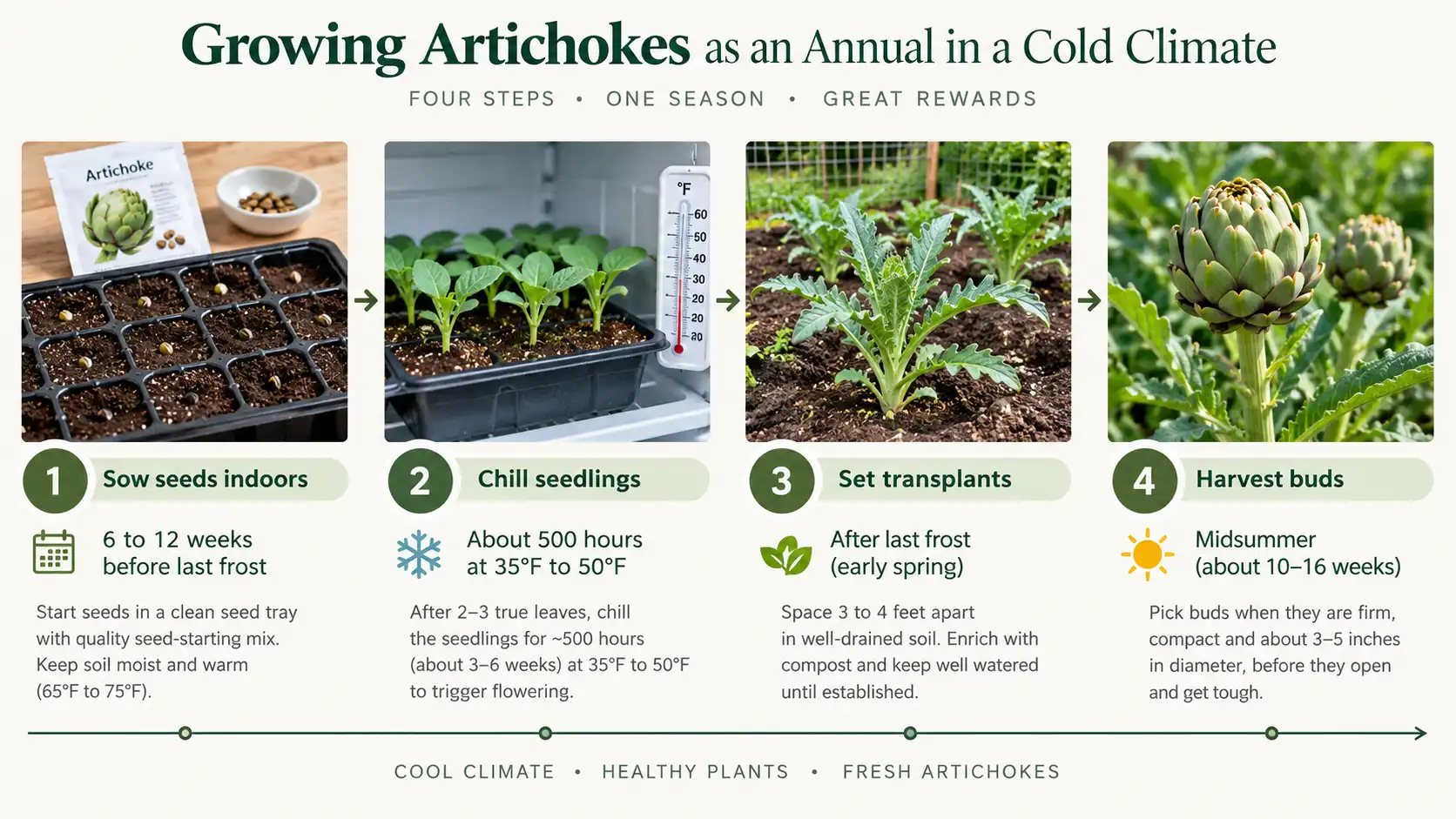
In zone 6 and colder, gardeners usually grow artichokes as an annual. The catch is chilling. UMaine explains that young artichoke plants need about 500 hours between 35°F and 50°F before they form buds. That works out to roughly 21 days of steady cold (500 hours ÷ 24).
UMaine gives Maine gardeners three ways to supply it:
- Soak the seeds for 2 days, then chill them in moist sphagnum moss in the refrigerator for 4 weeks.
- Hold young seedlings below 50°F for at least 3 weeks.
- Set transplants out early in spring and let cool weather do the work. This is the riskiest choice.
Next, pick a variety bred for the job. UMaine calls ‘Imperial Star’ the first artichoke bred for annual production.
Setting Your Sowing Date
For Maine gardens, UMaine advises sowing artichoke seed indoors 6 to 12 weeks before the expected last spring frost. Plug in your own frost date. For a May 15 last frost:
- 12 weeks earlier is February 20
- 6 weeks earlier is April 3
So you’d sow between February 20 and April 3. A heat mat at 70°F to 80°F speeds up artichoke germination, UMaine notes. That fits the wider pattern in germination times by soil temperature, where warmth shortens the wait for many crops. Still, keep artichoke seedlings below 80°F, since heat can undo the chilling.
In Maine, harvest usually starts in late July or early August and runs until a hard frost. Gardeners in zone 6b can line these steps up with a month-by-month zone 6b planting calendar.
Common Pests on Artichoke Plants
Aphids often gather on artichoke plants, according to Arizona Extension. It suggests washing them off with a hard stream of water early in the day. UMaine also reported thrips, stink bugs, tarnished plant bugs, and gray mold in its Maine trials. Several of these problems look alike. So your county extension office or local Master Gardener volunteers can confirm what you’re seeing. For the most common one, start with spotting aphids on garden crops.
Frequently Asked Questions
Is an artichoke a fruit?
No, an artichoke is an unopened flower bud, and a fruit forms only after a flower blooms and sets seed. Botanically it’s a flower head, while cooks and grocers treat it as a vegetable.
Are artichokes healthy?
Yes, they’re a filling, high-fiber vegetable with very little fat. USDA FoodData Central lists a medium raw artichoke (about 128 grams) at 60 calories and nearly 7 grams of fiber.
Do artichoke plants come back every year?
Yes, where winters stay mild enough, since UMaine Extension rates the plant hardy in USDA zone 7 and warmer. In colder zones, gardeners usually grow artichokes as an annual from seed or transplants each spring.
Why are some artichokes purple?
Some varieties, such as ‘Violetto’ and ‘Colorado Star’, have purple-tinted bracts. UMaine Extension notes the color on both deepens in cooler weather, so cool spells bring out the most purple.
How long do fresh artichokes keep?
Harvested buds keep about 2 to 3 weeks in the refrigerator, according to UMaine Extension. Keep them above 32°F, because colder storage causes cold damage that shows up as browned bracts.
Can you grow artichokes in a container?
Yes, UMaine Extension says a five-gallon pail of lightweight soilless mix works for artichokes in Maine. Container artichokes may need daily water, and you can overwinter the pot somewhere dark at 32°F to 35°F.
Key Points for Your Garden
An artichoke is a thistle flower bud picked before it opens. Eat the bract bases, the heart, and the tender stem, and skip the choke and the plant’s big leaves. In zone 7 and warmer, one planting can produce for several years. In colder zones, follow UMaine: start ‘Imperial Star’ 6 to 12 weeks before your last frost and chill the seedlings. They can bear buds the first summer. Starting from bare ground? Begin with the basics of setting up a vegetable garden.