How to Transplant Asparagus Plants (and When Not to Move Them)
Asparagus stays in one spot for years, so a poor location or a house move raises a fair question. Here is how to transplant asparagus plants, which ones are worth moving, the spring timing that matters, and when an old bed should be replaced instead.
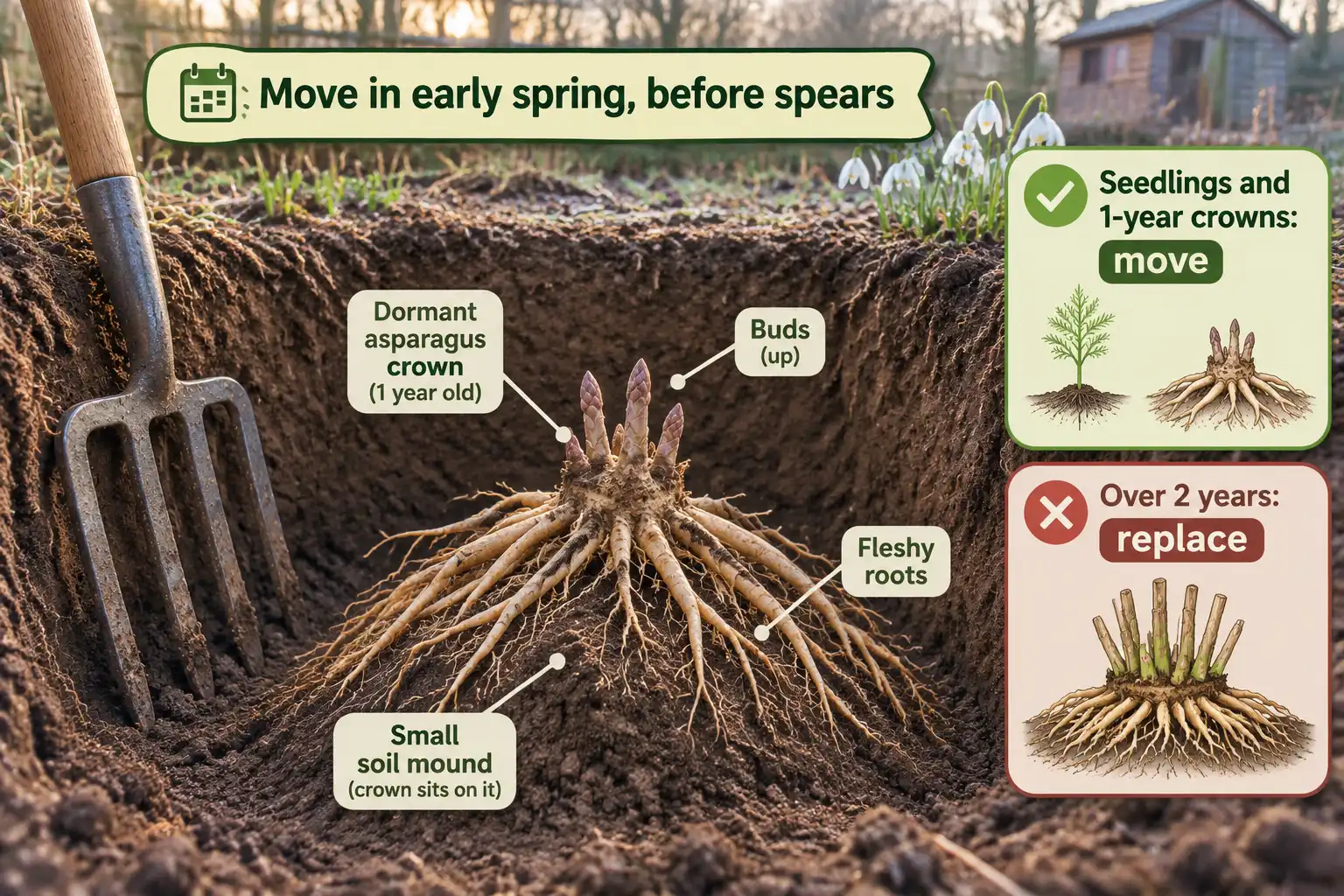
To transplant asparagus plants, lift dormant crowns in early spring before spears emerge and reset them in a prepared trench. Seedlings and one-year crowns move well. Plants older than two years rarely recover, per Michigan State Extension.
Can You Move Asparagus Plants?
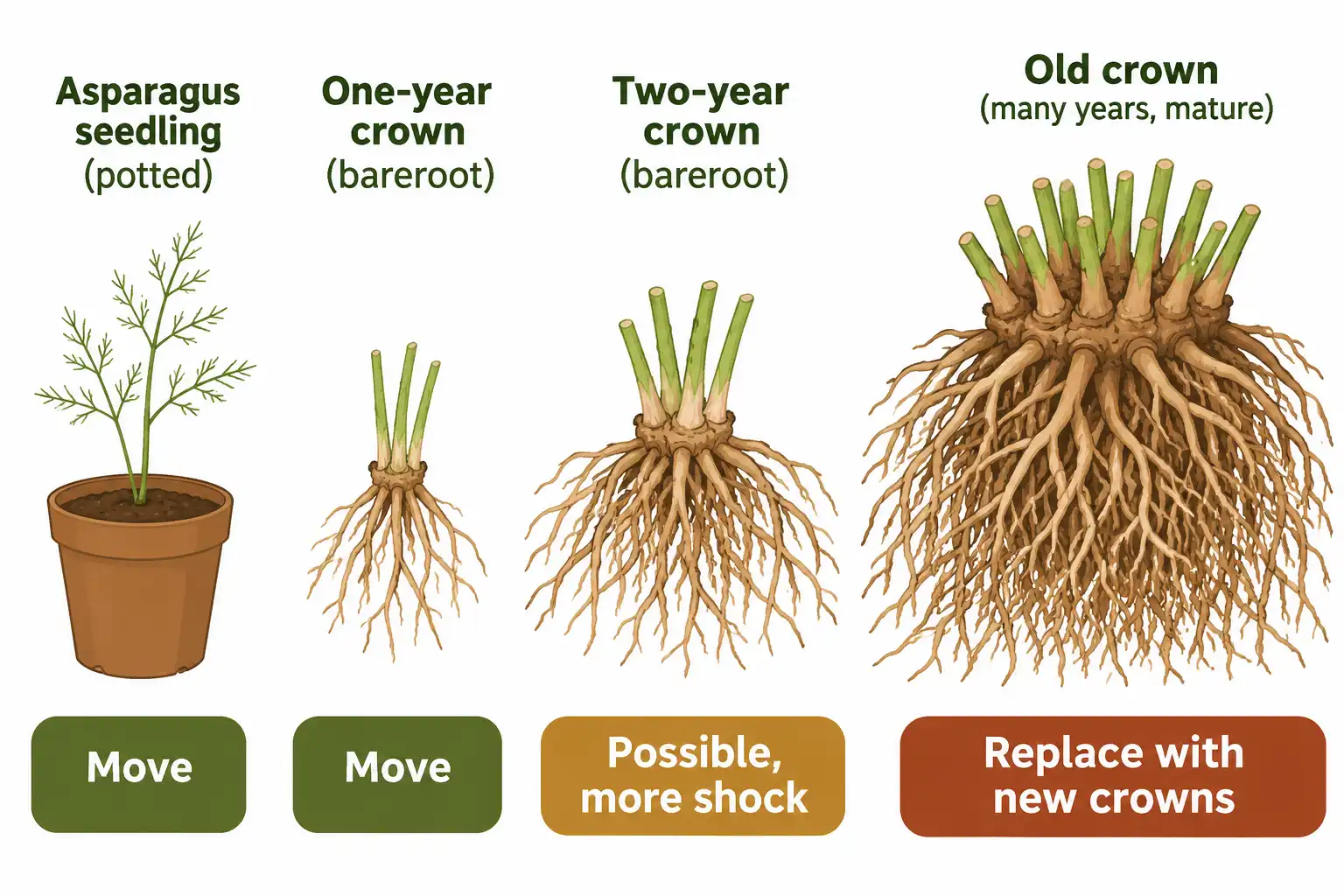
Yes, if the plants are young. Seedlings and one-year crowns move well, but established asparagus rarely comes through a move in good shape.
Iowa State Extension says established asparagus roots run deep and wide, so most moves fail. Large, old plants get badly injured. Some die. Survivors may never produce a good crop. So Iowa State recommends buying one-year-old crowns instead.
Michigan State University Extension is blunter. Its Michigan home garden guide says crowns older than two years are usually too big to lift in one piece. Moved crowns usually die. Even two-year-old nursery crowns suffer more transplant shock than one-year crowns, it notes. Old crowns also likely carry Fusarium root rot into the new bed.
So can asparagus be transplanted? Young plants, yes. For anything older, the plant’s age decides.
| What you have | Move it? | Reason |
|---|---|---|
| Seedlings in pots | Yes | Small roots, grown for planting out |
| One-year crowns | Yes | The standard size for new beds |
| Two-year crowns | Possible | Michigan State reports more transplant shock |
| Plants older than two years | Usually not | Iowa State and Michigan State report most fail |
When a bed is too old to lift, planting new asparagus crowns in fresh ground works better.
Read next: Asparagus Plants Per Person
When to Transplant Asparagus Plants
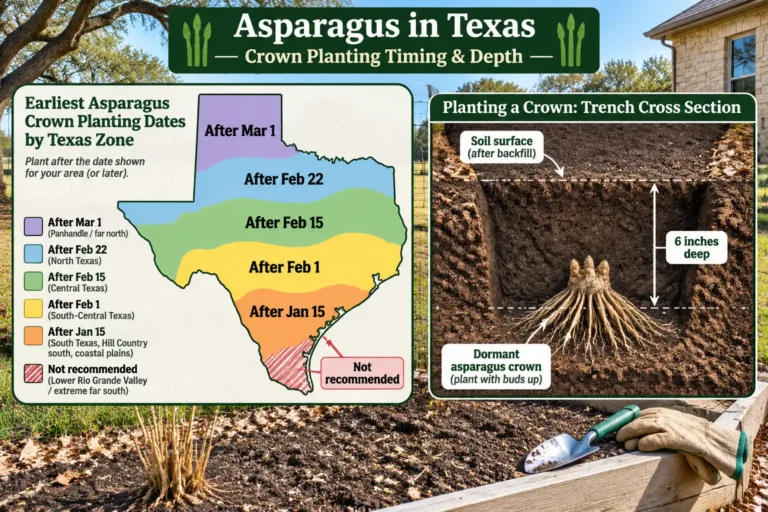
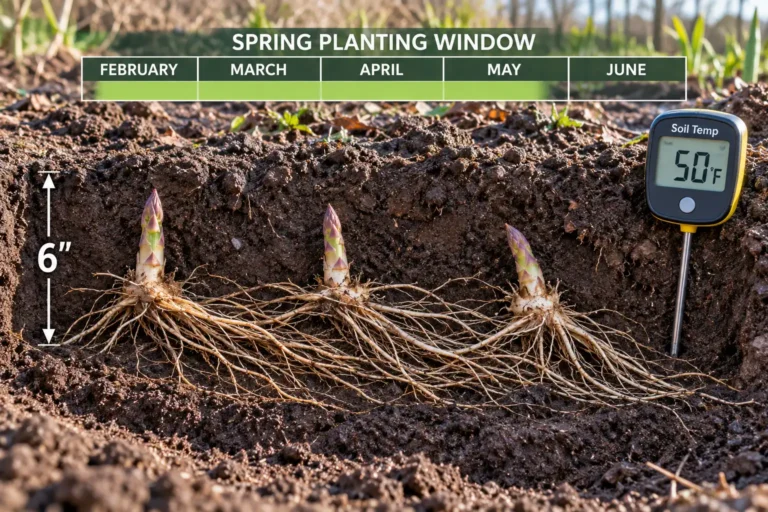
Transplant asparagus in early spring, while the crowns are dormant and before spears break the soil. At that stage, digging disturbs roots but no active growth.
Soil temperature tells you how much time is left. Purdue Extension notes that asparagus spears in Indiana start to emerge once soil reaches about 50°F. So plan the move for the weeks before that point.
Regional dates follow the same rule:
| What you’re moving | When | Source and region |
|---|---|---|
| One-year crowns | March or April | Virginia Tech, Virginia |
| One-year crowns | April | Utah State, Utah |
| Crowns from a nursery bed | The next spring, before growth starts | Virginia Tech, Virginia |
| Seedlings sown indoors in January | April | Utah State, Utah |
| Seedlings | June | Virginia Tech, Virginia |
Virginia Tech gives seedlings two options. You can plant them straight into the permanent bed, or into a temporary nursery bed for a year. The nursery bed is easier to weed. However, it means a second move the next spring.
Summer is the riskiest time to dig. Michigan State explains that summer ferns refill the crown’s energy for next year’s spears. Lifting the plant then cuts that supply short.
Fall moves do turn up in garden advice. Still, the extension guides cited here set plants out in spring, and fall moves have little published guidance behind them.
Prepare the New Bed Before You Dig
Get the new spot ready before you lift anything. That way, lifted crowns spend as little time out of the soil as possible.
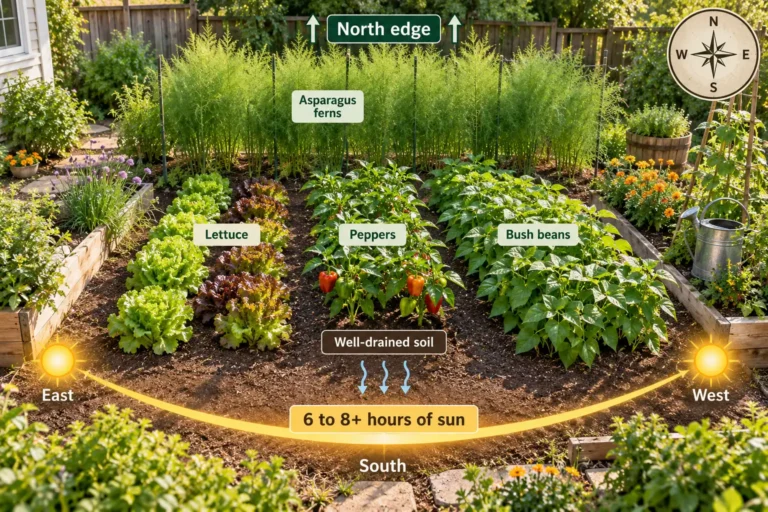
Pick Ground That Has Never Grown Asparagus
Choose a spot with no asparagus history. Michigan State explains that Fusarium root rot builds up in asparagus soil over time. As a result, a new planting in an old bed yields less and dies sooner. That rule covers moved crowns too.
Next, check sun and drainage. Colorado State University Extension, writing for Weld County, Colorado, calls for at least 8 hours of sun a day. It also wants well-drained soil. Then, Virginia Tech notes that tall asparagus ferns can shade nearby crops. So choose a permanent asparagus spot where the ferns won’t block shorter plants.
Test the Soil Before You Amend It
Start with a soil test. Sources set different pH targets. Virginia Tech lists 6.0 to 6.7 for asparagus in Virginia. Michigan State uses about 7.0 in Michigan, because its research links lower pH to more Fusarium. Follow the target your test report gives for your area.
If the site sits near an older house or a busy road, ask the lab to include lead. Asparagus will occupy that ground for years.
Colorado State suggests working 4 inches of compost into the top 12 inches of soil before planting asparagus. Use finished compost rather than raw manure, which carries food safety risks.
Dig the Trench
Call 811 before you dig, so buried utility lines get marked. Then dig the trench to the depth your soil calls for.
Trench depth varies by source, and soil type explains much of the gap:
| Source and region | Trench depth | Crown spacing | Row spacing |
|---|---|---|---|
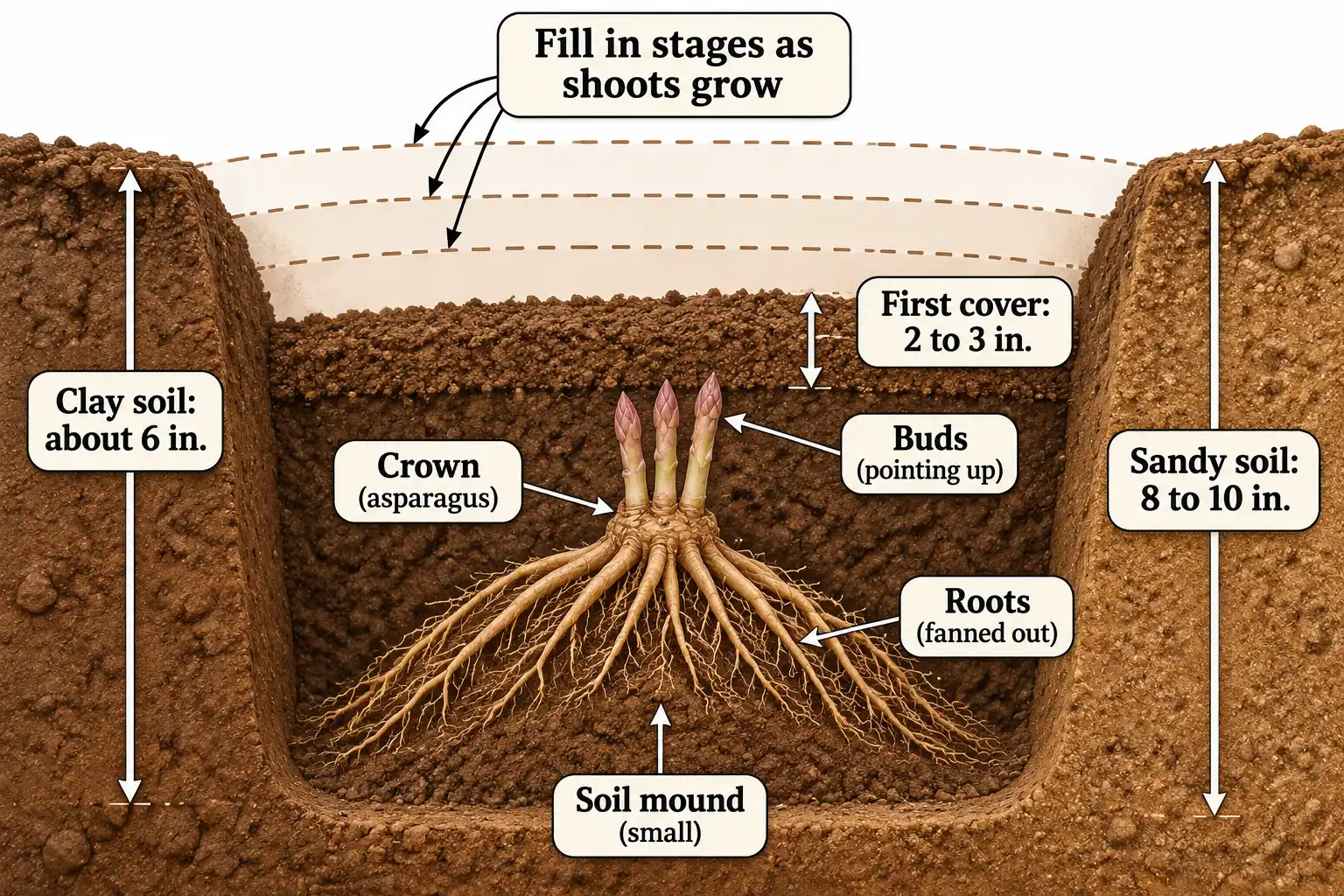
| Michigan State, Michigan | 8 to 10 inches in sand, about 6 inches in clay | 8 to 12 inches | 4 to 5 feet |
| Utah State, Utah | 8 inches | 12 inches | 4 feet |
| Colorado State, Colorado | 6 inches | 12 to 18 inches | Not listed |
| Virginia Tech, Virginia | About 12 inches, with 2 inches of soil mix in the base | 15 to 18 inches | 4 to 5 feet |
Utah State University Extension lands in the middle at 8 inches for Utah gardens. Michigan State’s rule is the easiest to apply: go shallower in clay and deeper in sand.
How to Transplant Asparagus Plants, Step by Step
These steps follow Virginia Tech’s method for lifting one-year crowns from a nursery bed. They also work for an older asparagus plant, though with lower odds of success.
Lift and Separate the Crowns
- Have the new trench ready. Bare roots dry out once they leave the soil, so finish the bed first.
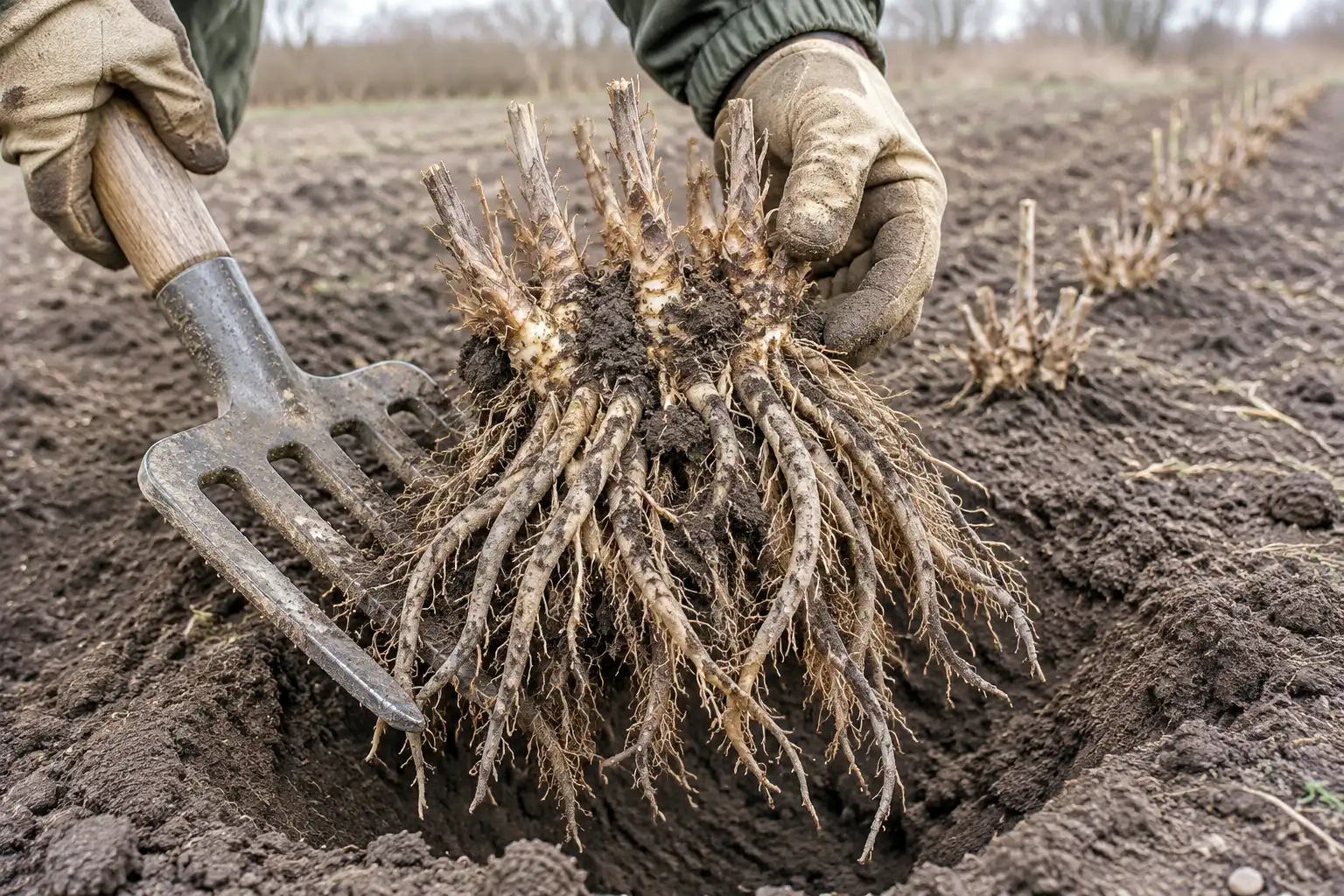
- Loosen soil under the plants. Virginia Tech pushes a spading fork about 6 inches under one-year crowns, then lifts gently. For older plants, loosen a wide circle first, since their roots spread deep and far.
- Pull tangled crowns apart by hand. Virginia Tech advises separating the intertwined roots of neighboring crowns. Avoid slicing through a crown, because Michigan State notes that cuts open crowns to Fusarium root rot.
- Inspect every crown. Healthy crowns look plump and grayish brown, per Virginia Tech, which also advises trimming off rotted roots. Michigan State describes Fusarium-infected crowns as having a brick-red rot that spreads inward. Other problems can look similar, so your county extension office or a plant diagnostic lab can confirm the cause. Leave crowns with spreading rot out of the new bed.
- Rehydrate dry roots. Colorado State suggests soaking bareroot asparagus crowns in warm water for 2 to 4 hours before planting. A crown dug from the garden is bareroot too.
Replant and Backfill
- Make a low mound. Virginia Tech spreads about 2 inches of soil and compost mix in the trench bottom. Then it mounds soil under each plant so the crown sits slightly above its roots.
- Set crowns buds up. Drape the roots over the mound. Then space the crowns using the figures in the trench table above.
- Cover lightly at first. Colorado State starts with 1 to 2 inches of soil. Virginia Tech uses 2 to 3 inches, and Michigan State about 3.
- Fill the trench in stages. Colorado State adds 1 to 2 inches a week as shoots grow. Virginia Tech adds about 2 inches every two weeks. Michigan State adds 3 more inches after about 6 weeks, then finishes once plants go dormant. Whatever the pace, follow Utah State’s rule: never bury ferns that have already grown out.
- Water when rain falls short. Virginia Tech advises watering the new asparagus planting if rainfall isn’t enough.
How Many Crowns Fit Your Row or Bed
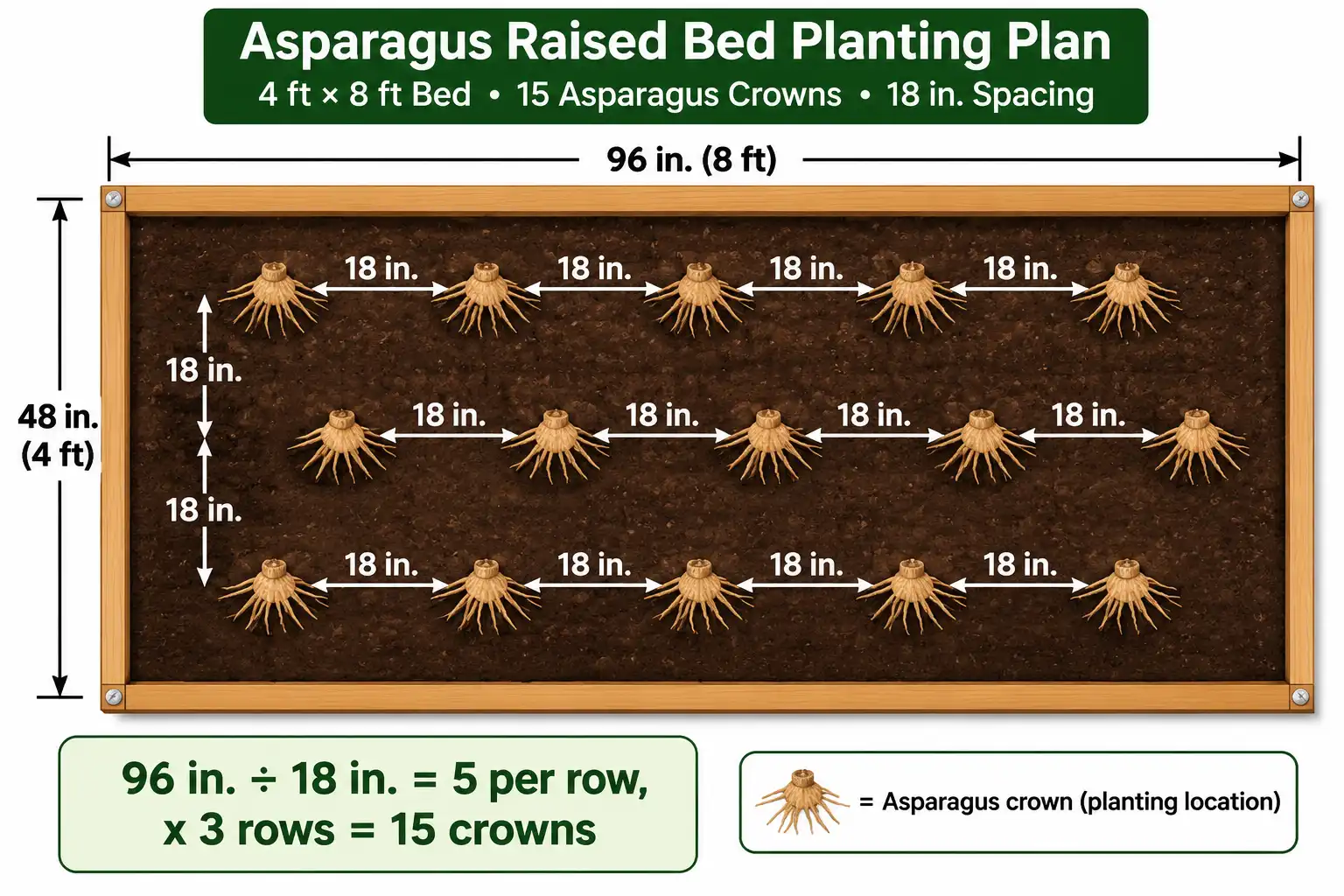
Use this formula: plants per row = row length in inches ÷ crown spacing in inches.
Take a 20-foot row, which is 240 inches. At Utah State’s 12-inch asparagus spacing for Utah, that’s 240 ÷ 12 = 20 crowns. At Virginia Tech’s 18-inch spacing for Virginia, it’s 240 ÷ 18, or about 13 crowns.
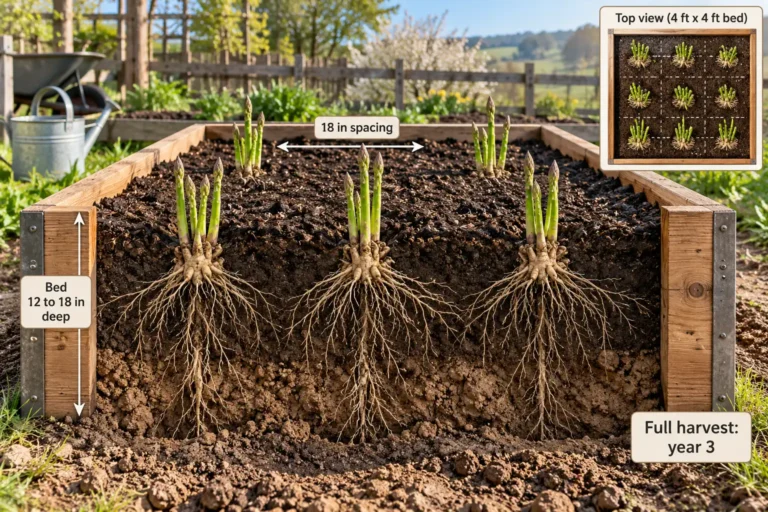
Raised beds work too. Virginia Tech describes a wide-bed asparagus layout for Virginia gardens: three rows, with plants 18 inches apart in all directions. In a 4 by 8 foot bed, three rows span 36 inches, which fits the 48-inch width. Along the 96-inch length, 96 ÷ 18 gives about 5 crowns per row. That’s 15 crowns in all, staggered.
Moving an old bed often turns up more crowns than you have room for. In that case, replant the plumpest, firmest ones and discard any with rot. If the new home is a raised bed, get the soil mix for the raised bed right first. Asparagus will grow in it for years.
Aftercare for Transplanted Asparagus
How Much Water Moved Crowns Need
Water needs depend on climate, and the sources show it:
- Colorado State: 1 to 2 inches per week for the first two years, in Colorado.
- Utah State: 1 to 2 inches every other week, in one application, for the first two years in Utah.
- Michigan State: irrigation is usually unnecessary in Michigan and most of the eastern US. Asparagus roots there run very deep.
A freshly moved crown has lost much of its root system, though. So check the soil during dry spells in its first season, even in the East.
To turn inches into gallons, use this: 1 inch of water over 1 square foot is about 0.62 gallons. A 4 by 8 foot asparagus bed covers 32 square feet, so 1 inch is about 20 gallons. At 1 to 2 inches, that’s 20 to 40 gallons per watering. Apply it weekly under Colorado State’s guidance, or every other week under Utah State’s.
Utah State recommends drip irrigation where possible. A drip line laid along the bed keeps water off the ferns. That matters, because Michigan State links overhead watering to foliage disease.
Weeds, Ferns, and Mulch
Pull weeds by hand near the crowns. Michigan State warns that tools cutting into crowns open them to Fusarium, and Virginia Tech also favors pulling over hoeing.
Let every spear grow into fern the first season. Michigan State calls healthy fern the plant’s energy supply and says not to cut it back during the season. After frost yellows the foliage, Virginia Tech cuts asparagus ferns to 2-inch stubs. Then it adds 4 to 6 inches of mulch, such as compost or leaves.
From there, routine asparagus care keeps the bed productive.
When Can You Harvest After Transplanting?
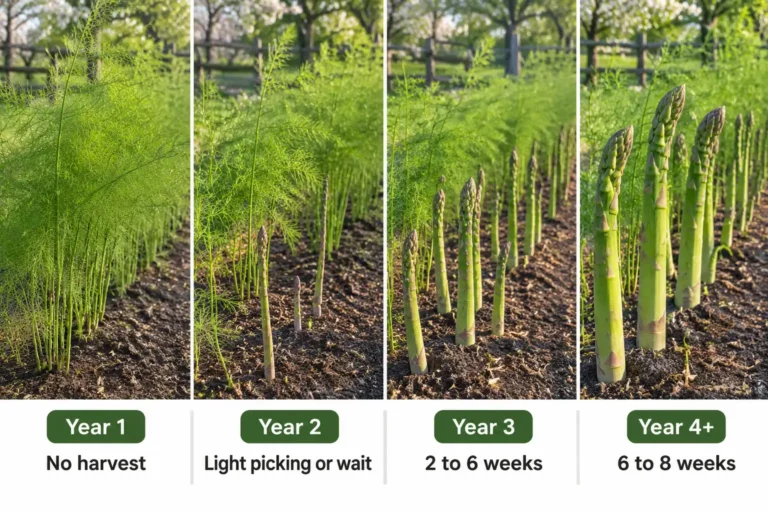
Skip the harvest entirely in the first season after the move. After that, extension sources split into two camps.
| Season after planting | Light-harvest camp (Iowa State, Purdue) | Wait camp (Michigan State, Utah State) |
|---|---|---|
| First | No harvest | No harvest |
| Second | 2 to 4 weeks, only if spears are thick | No harvest |
| Third | Until early to mid-June | About 2 to 4 weeks |
Iowa State allows a 3 to 4 week asparagus harvest in the second season in Iowa. Virginia Tech agrees for Virginia. Purdue allows 2 to 3 weeks in Indiana, but only from good-sized, thick spears. On the other side, Michigan State says not to harvest in the planting year or the year after. Colorado State also waits at least two years and notes that some sources say three.
Spear size breaks the tie. Colorado State says to harvest only spears thicker than a pencil. If most spears come up thinner, wait another year.
One gap is worth knowing. These schedules describe newly set crowns. None of the cited guides gives a separate schedule for relocated older plants. So treat a moved crown as a new planting and restart the count. Also, Virginia Tech adds a year for asparagus started from seed. That timing matters if you’re raising asparagus from seed.
Why Transplanted Asparagus Struggles
Several asparagus problems look alike. So your county extension office, local Master Gardener volunteers, or a state diagnostic lab can confirm the cause.
- No spears the next spring. Large crowns often don’t survive a move, as Iowa State and Michigan State report. Also, Purdue notes that spears wait for soil near 50°F in Indiana, so a cold spring can delay them.
- Thin, spindly spears. Virginia Tech links weak, spindly asparagus to harvesting too early or too heavily. Utah State adds that summer stress shrinks next year’s spears, because new spears form in July and August.
- Yellowing fern tips and dying stems. Utah State describes root rot diseases this way, along with small, skinny spears. Other problems cause similar signs, so have the plant checked.
- Steady decline in a replanted spot. If the site grew asparagus before, Michigan State’s Fusarium warning applies. Its guidance points any new planting to ground with no asparagus history.
- Ferns cut back in summer. Removing fern early drains the crown, per Michigan State. Leave it standing until frost.
Frequently Asked Questions
Can you replant asparagus in the same spot?
It’s not a good idea, according to Michigan State University Extension. Fusarium root rot builds up in old asparagus beds, so new crowns planted there yield less and die sooner.
Can you transplant asparagus in the fall?
Spring has the stronger support, since Virginia Tech and Utah State both set asparagus crowns out in spring. Fall moves have little published guidance, so wait for early spring before spears appear.
Can I move asparagus in the summer?
Summer is the riskiest time of year to move asparagus. Michigan State notes that summer ferns rebuild the crown’s energy for next year, and digging then cuts that supply short.
Should I divide asparagus crowns when I move them?
Only separate crowns that are already distinct plants, by gently pulling tangled roots apart as Virginia Tech advises. Avoid cutting into crowns, since Michigan State notes cuts open them to Fusarium root rot.
Can I take my asparagus with me when I move house?
You can try, but fresh one-year crowns usually do better. Iowa State reports that most moves of established asparagus fail, so plant new crowns at the new home in spring.
How long does transplanted asparagus take to produce?
Plan on at least one full season with no harvest after the move. Light picking starts in season two (Iowa State, Purdue) or three (Michigan State, Utah State), once spears are pencil-thick.
Before You Dig
Check the plant’s age first. Seedlings and one-year crowns move well in early spring, before the soil warms and spears appear. Older plants rarely recover, so new crowns in ground with no asparagus history usually come out ahead. Whatever you plant, skip the first season’s harvest and let the ferns rebuild the crown.