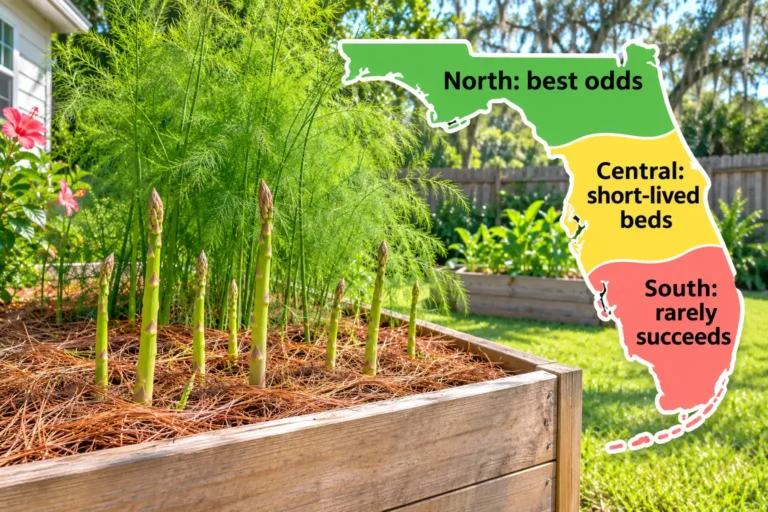
How to Grow Asparagus in a Raised Bed: Depth, Spacing, and Harvest
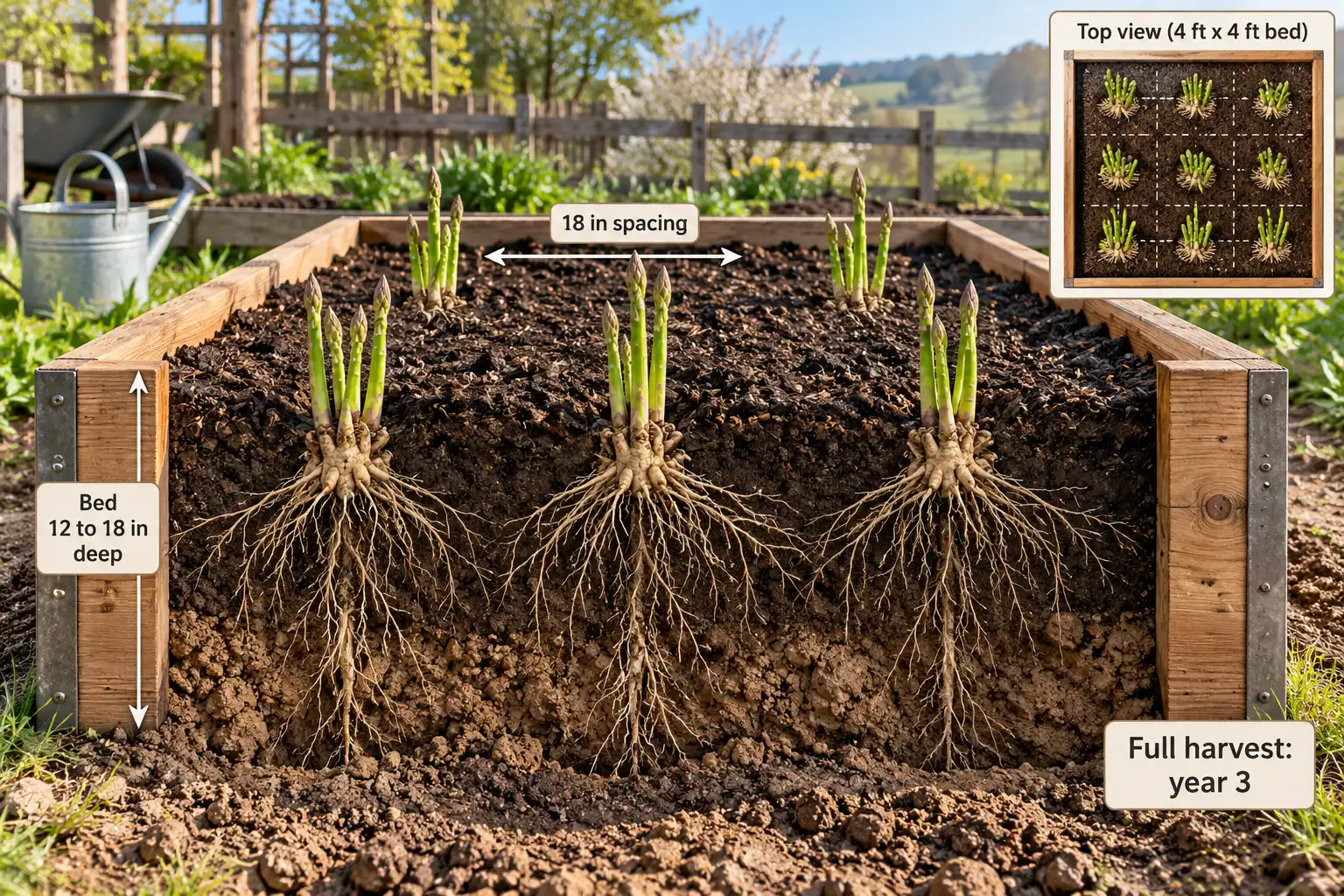
An asparagus bed is a long commitment. Iowa State Extension expects a good planting to produce for 15 to 20 years, but wet soil invites crown rot. This guide covers how to grow asparagus in a raised bed, from bed depth to the first full harvest.
Growing asparagus in a raised bed starts with a bed 12 to 18 inches deep. Set 1-year-old crowns 6 to 8 inches down and 18 inches apart in early spring. Expect the first real harvest in year three.
Can You Grow Asparagus in Raised Beds?
Yes. A raised bed gives asparagus the fast drainage it needs. Iowa State Extension recommends raised beds where soil drains poorly, because Phytophthora crown rot is a problem on wet sites. University of Missouri Extension also suggests raised beds to improve drainage.
A bed also gives a permanent crop its own space, away from the shovels and tillers of annual crops. Plus, the frame makes a clear edge for keeping out lawn grass. That matters, since Missouri Extension calls weed control the hardest part of growing asparagus.
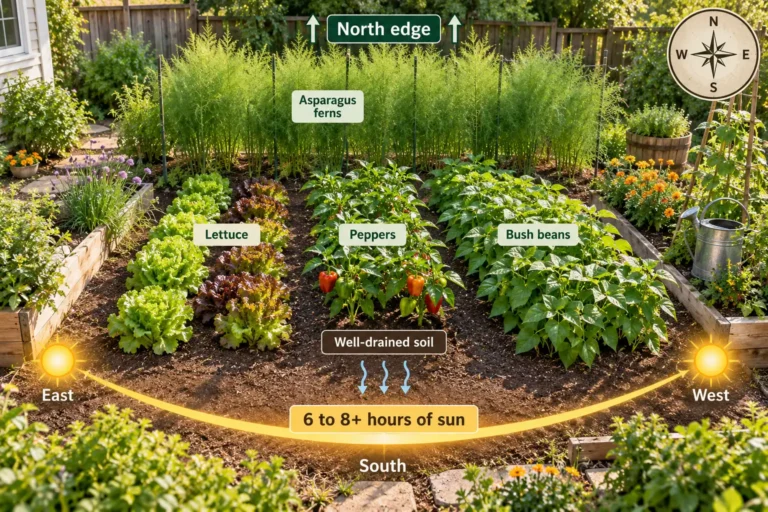
Pick the spot once, because moving it means starting over. Iowa State calls for at least 6 hours of direct sun a day. The ferns also grow tall enough to shade nearby crops, as Virginia Tech notes, so the north edge of the garden works well.
The basics of growing asparagus from crown to harvest still hold. The bed mainly changes depth, spacing, and water.
How Deep Should an Asparagus Raised Bed Be?
Build the bed at least 12 inches deep. Go to 18 inches if the ground underneath is heavy clay or stays wet.
Crown depth sets that number. University of Minnesota Extension digs asparagus furrows 8 to 10 inches deep, and 6 inches in heavy clay. Missouri Extension plants crowns 4 to 6 inches deep. Meanwhile, Utah State University Extension uses 8-inch furrows. Iowa State adds a simple rule: go deeper in light, sandy soil and shallower in heavy soil.
Depth trades spear size for timing. Virginia Tech reports that planting depth didn’t change total yield in research. Deeper crowns gave bigger but fewer spears. Shallow crowns came up earlier but risked frost damage. For a loose bed mix, 6 to 8 inches is a sensible middle.
| Bed depth | Crown depth | Loose mix under each crown | Suits |
|---|---|---|---|
| 12 inches | 6 to 8 inches | 4 to 6 inches | Native soil that drains well |
| 18 inches | 6 to 8 inches | 10 to 12 inches | Heavy clay or wet ground |
Roots don’t stop at the frame, though. Utah State waters established asparagus deep enough to reach 3 to 4 feet down. So build an open-bottom bed over loosened native soil, not a lined box.
Before you fork up that soil, call 811 so buried lines get marked. Also, near an older house or a busy road, test the native soil for lead, because the roots will grow into it.
Also know: Growing Asparagus in Pots
How to Fill and Prepare the Bed
Start with a soil test. University of Minnesota Extension prepares asparagus sites a year ahead, so a bed built in fall is ready for spring crowns.
The sources differ on pH. Missouri Extension and University of Minnesota Extension both target 6.5 to 7.0 for asparagus. Virginia Tech gives 6.0 to 6.7 instead. The ranges overlap at 6.5 to 6.7, and Missouri links crown rot partly to acidic, waterlogged soil.
For organic matter, Virginia Tech suggests compost or leaf mold at about 20% of the volume. Here’s that math for a 4 by 4 bed. Swap in your own size:
- 12 inches deep: 4 x 4 x 1 = 16 cubic feet. That’s about 3 cubic feet of compost and 13 of soil, or about 11 bags at 1.5 cubic feet each.
- 18 inches deep: 4 x 4 x 1.5 = 24 cubic feet. That’s about 5 cubic feet of compost and 19 of soil, or 16 bags at 1.5 cubic feet each.
If the soil test calls for phosphorus, add it now. Virginia Tech notes it moves slowly through soil, and Utah State says asparagus needs high levels to build its root system. Compare raised bed soil mixes before you buy fill.
Finally, skip any bed that grew onions, leeks, chives, or garlic. Missouri Extension warns those crops can pass diseases to asparagus.
When to Plant Asparagus Crowns
Plant crowns in early spring, as soon as the bed soil can be worked. Iowa State calls early spring the best time. However, the calendar date shifts with your region:
| Region | Planting window | Source |
|---|---|---|
| Southern Missouri | Late March to early April | Missouri Extension |
| Central and northern Missouri | Early to mid-April | Missouri Extension |
| Virginia | March or April | Virginia Tech |
| Utah | April | Utah State |
| Minnesota | Early May to the first week of June | Univ. of Minnesota Extension |
Outside these states, match the window to asparagus planting dates for your area. A raised bed doesn’t change the season. It just keeps the crowns out of soggy spring soil.
Choosing Crowns and Varieties
Buy 1-year-old crowns, as both Missouri Extension and Utah State recommend. Utah State looks for 8 to 10 large roots and a healthy bud cluster. Keep crowns refrigerated until planting day. Then plant similar sizes together, which Missouri says encourages even growth.
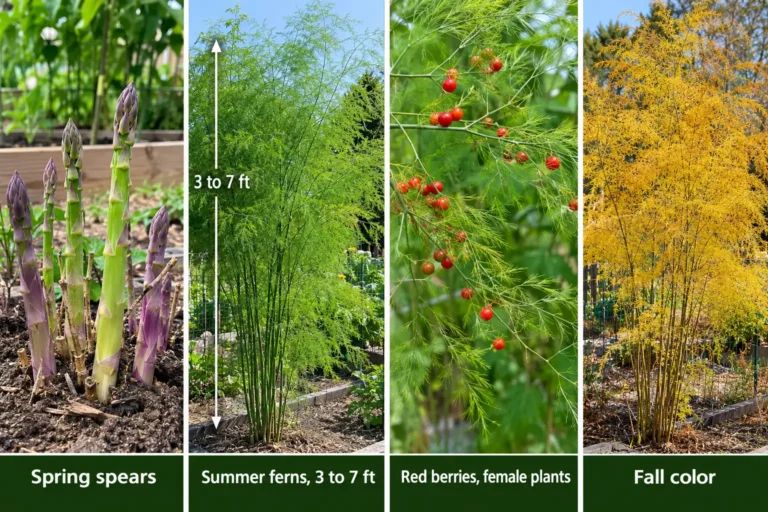
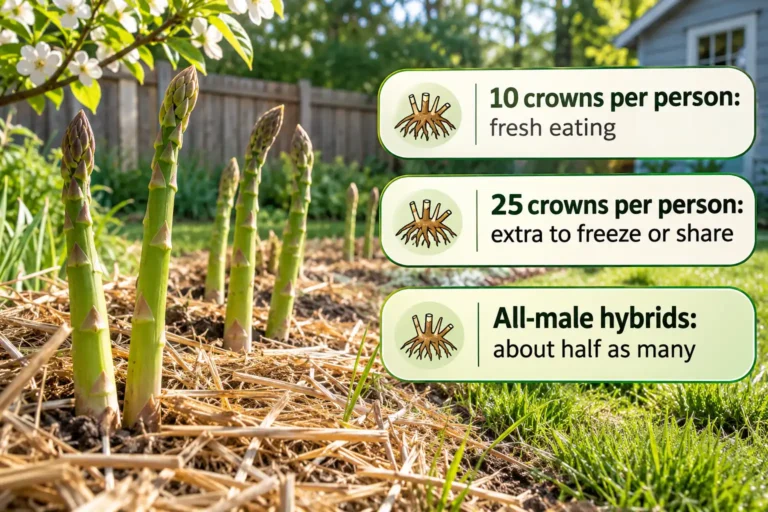
All-male hybrids suit a small bed best. Missouri Extension notes male plants produce more spears. Female plants, by contrast, drop red berries whose seedlings crowd the planting, a problem Virginia Tech also flags.
Missouri and Iowa State both list ‘Jersey Giant’, ‘Jersey Knight’, and ‘Jersey Supreme’. University of Minnesota Extension adds ‘Millennium’ for Minnesota. Meanwhile, Utah State no longer recommends ‘Mary Washington’.
‘Purple Passion’ is the spacing exception. Its spears run large, so Missouri cuts its in-row spacing to 8 inches. Seed costs less, but Virginia Tech notes it adds a year before your first harvest.
How to Plant Asparagus Crowns in a Raised Bed
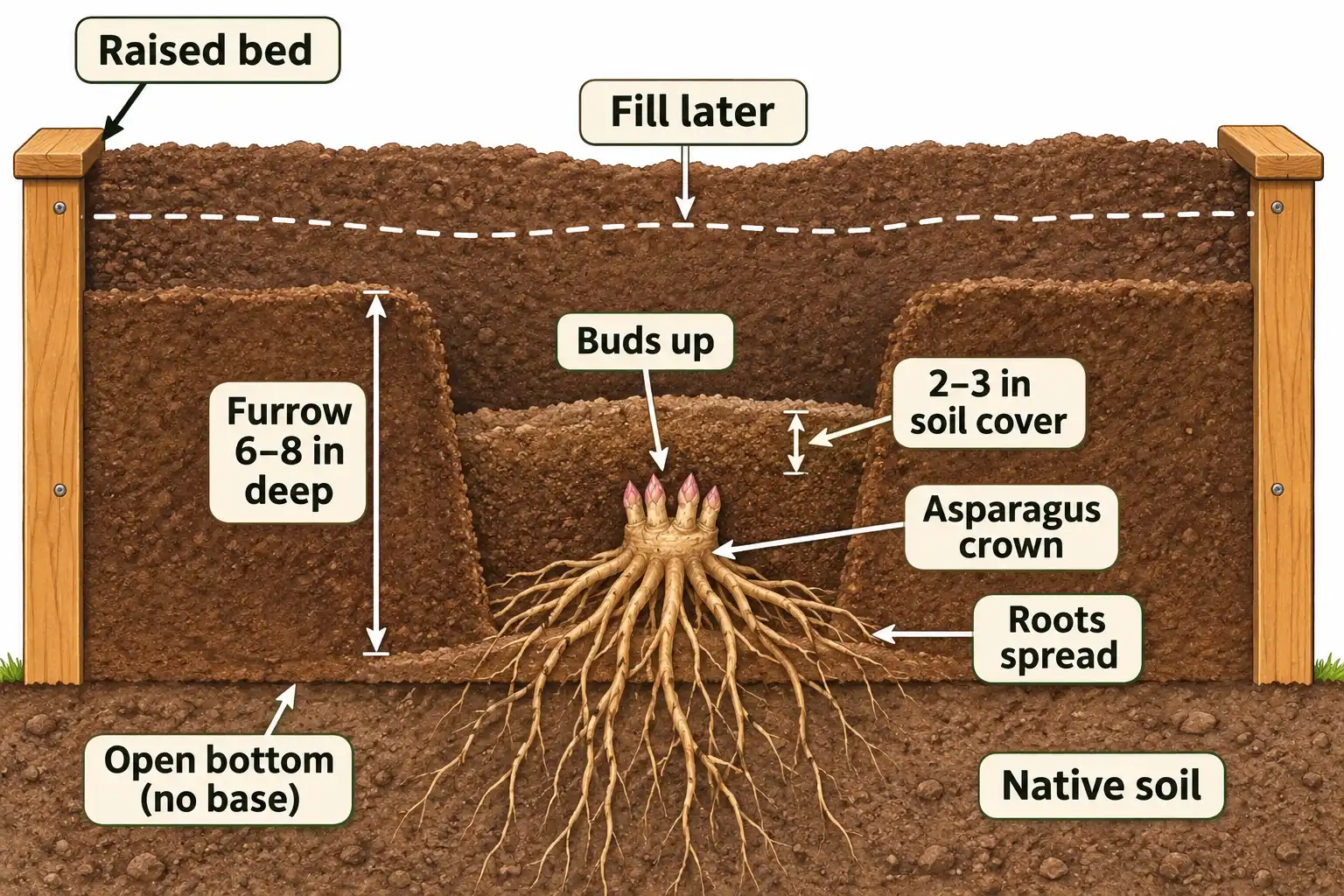
Plant when the bed mix is moist but not soggy. Then work through these steps:
- Dig three furrows across the bed. Make them 6 to 8 inches deep and 18 inches apart. Virginia Tech’s wide-bed layout uses three rows with plants 18 inches apart in all directions, which fits a 4-foot bed.
- Line the bottom. Missouri Extension spreads an inch of compost in the furrow, then adds an inch of soil on top. That puts organic matter where new roots start.
- Set crowns 18 inches apart, buds up. Spread the roots or lay them flat. University of Minnesota Extension says research doesn’t support fanning roots into an “octopus” shape.
- Cover with 2 to 3 inches of soil right away. University of Minnesota Extension warns that roots dry out when crowns sit uncovered.
- Water deeply. This settles the mix around the roots on day one.
- Save the leftover mix. You’ll need it to finish filling the furrows.
Thin spears should appear within 2 to 3 weeks, per University of Minnesota Extension. Let every one of them grow into a fern.
These steps match planting crowns in open ground, with one change. Here, you dig the furrow into the bed mix instead of native soil.
Fill the Furrow Gradually or All at Once?
Most sources fill gradually, but Iowa State says you don’t have to.
University of Minnesota Extension adds 3 to 4 inches of soil once spears are sturdy, then levels the furrow by August. Virginia Tech pulls in about 2 inches every two weeks. Utah State adds 2 inches every other month and warns against burying ferns that are already up. Iowa State, on the other hand, fills the trench completely at planting. It calls gradual filling an old habit that isn’t necessary.
So either method works. Gradual filling is still the more common advice. If you go that route, store the dug-out mix in a tub or a couple of bags beside the bed. Either way, the furrows should be level with the bed by late summer.
How Many Asparagus Plants in a 4×4 Raised Bed?
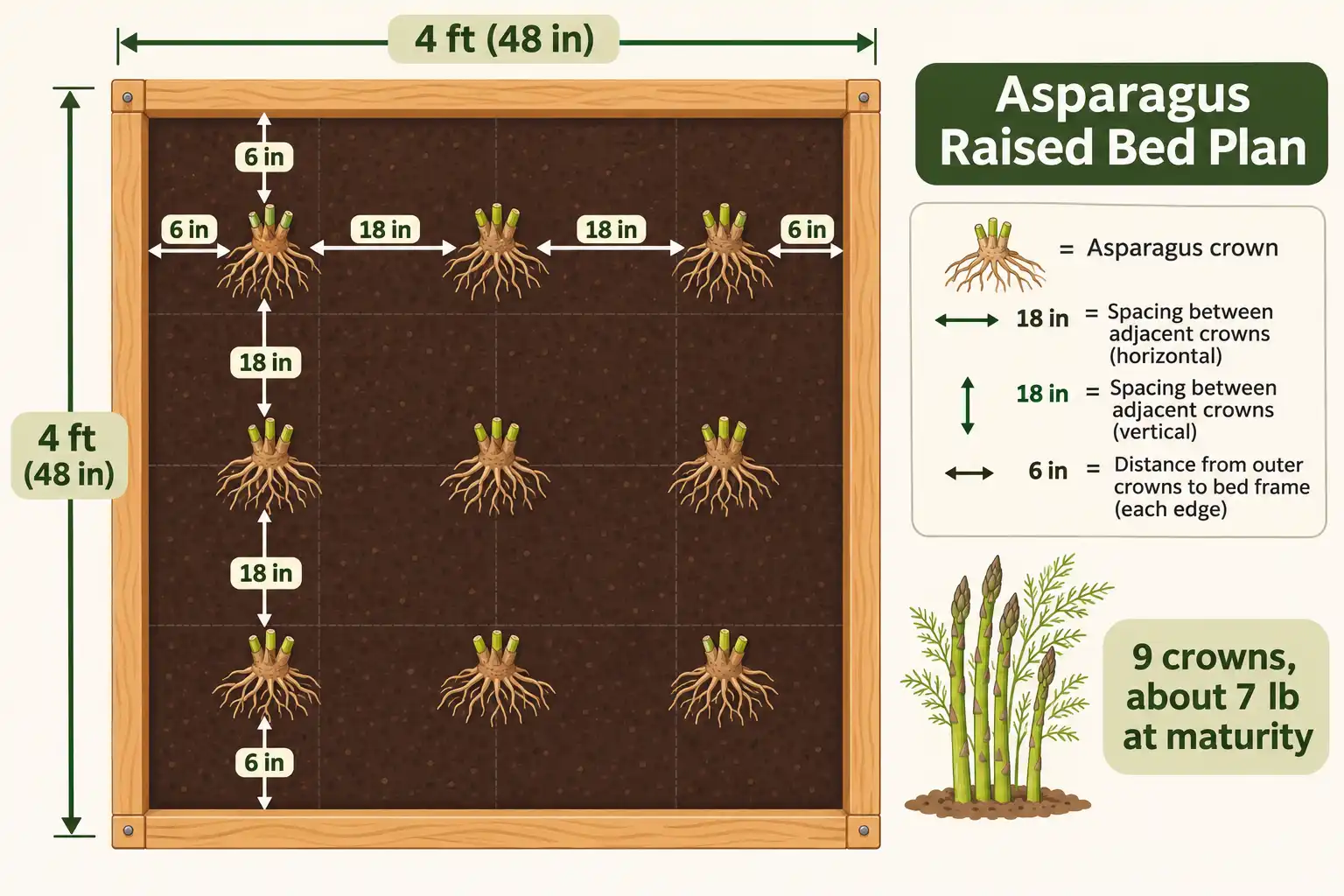
Nine crowns fit a 4 by 4 raised bed: three rows of three, 18 inches apart. That follows Virginia Tech’s wide-bed spacing, with each outer crown 6 inches from the frame.
You can squeeze in 12. Missouri Extension allows 12 to 18 inches between crowns in a row, so 12-inch spacing gives four per row. But Missouri also notes that tighter spacing shrinks spear size. On top of that, University of Minnesota Extension says plants widen as they mature. For a bed meant to last a decade or more, nine is the better start.
| Bed size | Crowns at 18 inches each way | Crowns at 12 inches in-row | Mature yield at 18-inch spacing |
|---|---|---|---|
| 3 x 6 feet | 8 | 12 | About 6 pounds |
| 4 x 4 feet | 9 | 12 | About 7 pounds |
| 4 x 8 feet | 15 | 24 | About 11 pounds |
| 4 x 12 feet | 24 | 36 | About 18 pounds |
The yield column uses Utah State’s figure of about 3/4 pound of spears per mature plant. Since yields build over the first few seasons, treat it as a target, not a year-three number.
How many crowns do you need? Virginia Tech suggests about 6 pounds of asparagus per person. At 3/4 pound per plant, that’s 8 crowns per person. So a 4 by 4 bed feeds about one person, and a 4 by 8 bed feeds about two.
Watering a Raised Asparagus Bed
Water deeply and less often. Utah State, writing for Utah’s dry climate, suggests 1 to 2 inches every other week for the first two years, all at once. After year three, it stretches that to every 3 weeks. Count rain toward the total where you live.
Here’s the math for your bed. One inch of water over 1 square foot is about 0.62 gallons.
- 4 by 4 bed: 16 square feet x 0.62 = about 10 gallons per inch, or 10 to 20 gallons every other week.
- 4 by 8 bed: 32 square feet x 0.62 = about 20 gallons per inch, or 20 to 40 gallons every other week.
Utah State prefers drip, and drip line run through a vegetable bed puts that water at the roots. Then mulch with compost or grass clippings to hold moisture.
Two stretches matter most. University of Minnesota Extension stresses irrigation in the planting year, especially on sandy soil, and a fast-draining bed mix behaves much the same. Later, Missouri Extension warns that drought stress after harvest can cut next year’s yield, because summer ferns feed the crowns.
Feeding Asparagus in a Raised Bed
Feed from the soil test, not from habit. Virginia Tech calls asparagus a medium to heavy feeder and says a soil test is always the best guide.
The timing advice differs by source. Virginia Tech uses a complete fertilizer in late winter or very early spring after the planting year. It also adds a compost topdressing then, and allows a side-dressing after harvest. Utah State, by contrast, feeds after harvest in early June. For Utah gardens, it suggests about 1 pound of 16-16-8 per 100 square feet. Scaled to a 4 by 4 bed of 16 square feet, that’s about 2.5 ounces.
Missouri Extension also feeds after harvest to push summer fern growth. So don’t skip that feeding, because the ferns build next year’s crop.
When Can You Harvest Asparagus From a Raised Bed?
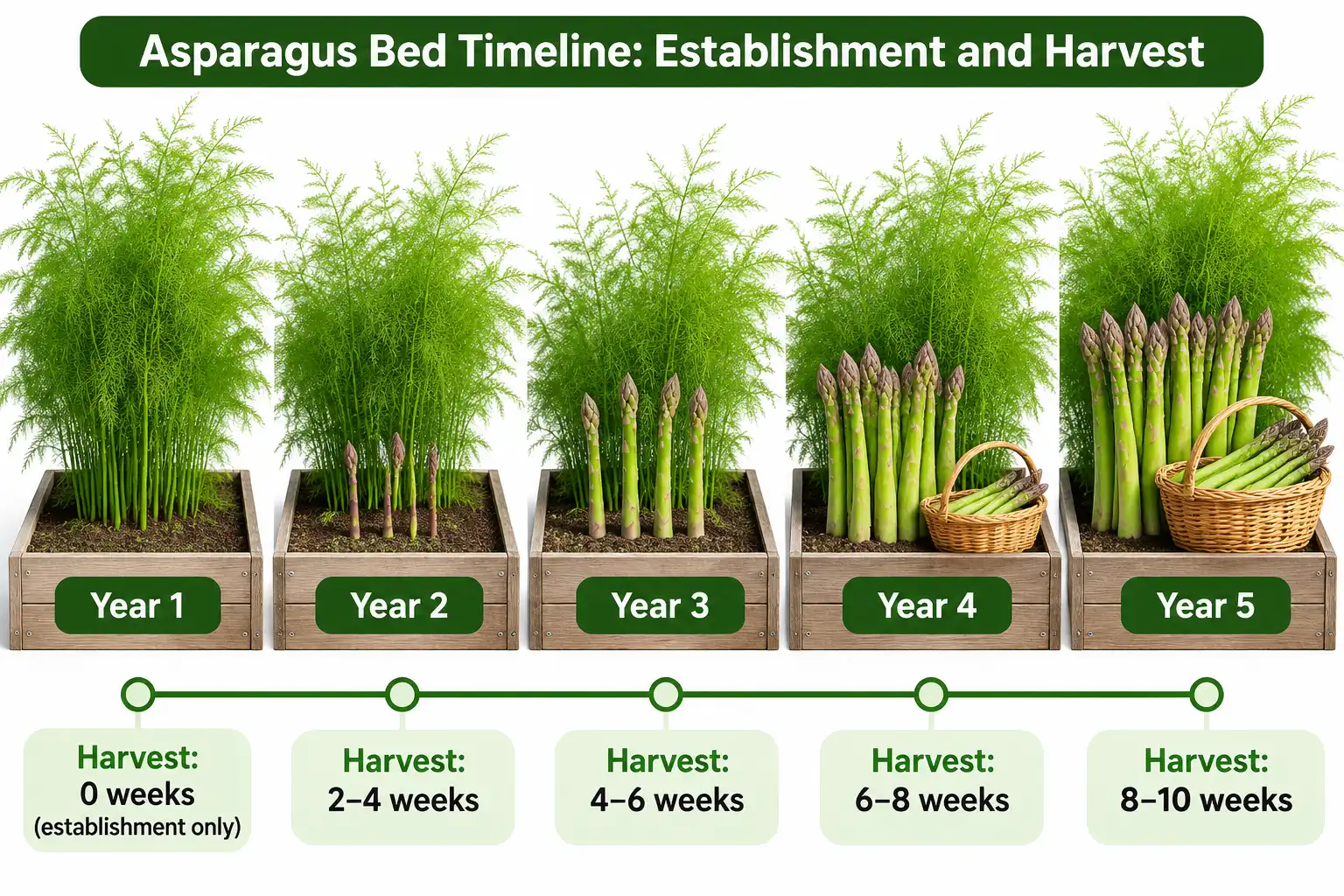
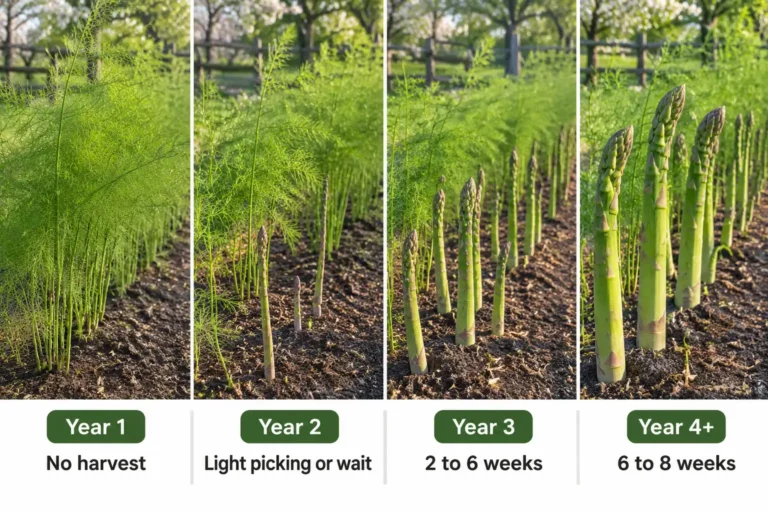
Never in the planting year. After that, extension guides split on year two, so here’s the full range:
| Year | What the sources say |
|---|---|
| Year 1 (planting year) | No harvest, in every source |
| Year 2 | Missouri: about 2 weeks. Virginia Tech: a light 3 to 4 weeks. Utah State and Iowa State: none |
| Year 3 | Missouri: 5 to 8 weeks. Utah State: up to 4 weeks. Iowa State: through early to mid-June |
| Year 4 | Utah State: 6 weeks. Virginia Tech: 8 to 10 weeks |
| Year 5 on | Utah State: up to 8 weeks |
Patience pays. Virginia Tech cites research plots first picked one year after planting. After five years, those plots had yielded 23% less in total than plots first picked two years after planting. Missouri Extension adds that overharvesting in one year can weaken plants the next.
So if you want the most asparagus over the bed’s life, skip year two or keep it very short.
How to Pick Spears Without Hurting the Crown
Snap spears off by hand near the soil line. Missouri Extension prefers snapping, since a knife can spread disease between plants. Virginia Tech adds that cutting too deep can injure the buds that make the next spears.
Spear height depends on the weather. Missouri picks at 7 to 9 inches below 70°F and at 5 to 7 inches above it. Either way, pick before the tip opens. As days warm, expect to pick every 1 to 3 days.
Stop when most spears are pencil-thin, under 3/8 inch across. Missouri, Utah State, and Virginia Tech all use that signal.
Also watch for frost. Missouri notes a freeze won’t hurt the crowns, but it damages spears already up. So pick them before a cold night.
Fern Care, Fall Cleanup, and Winter
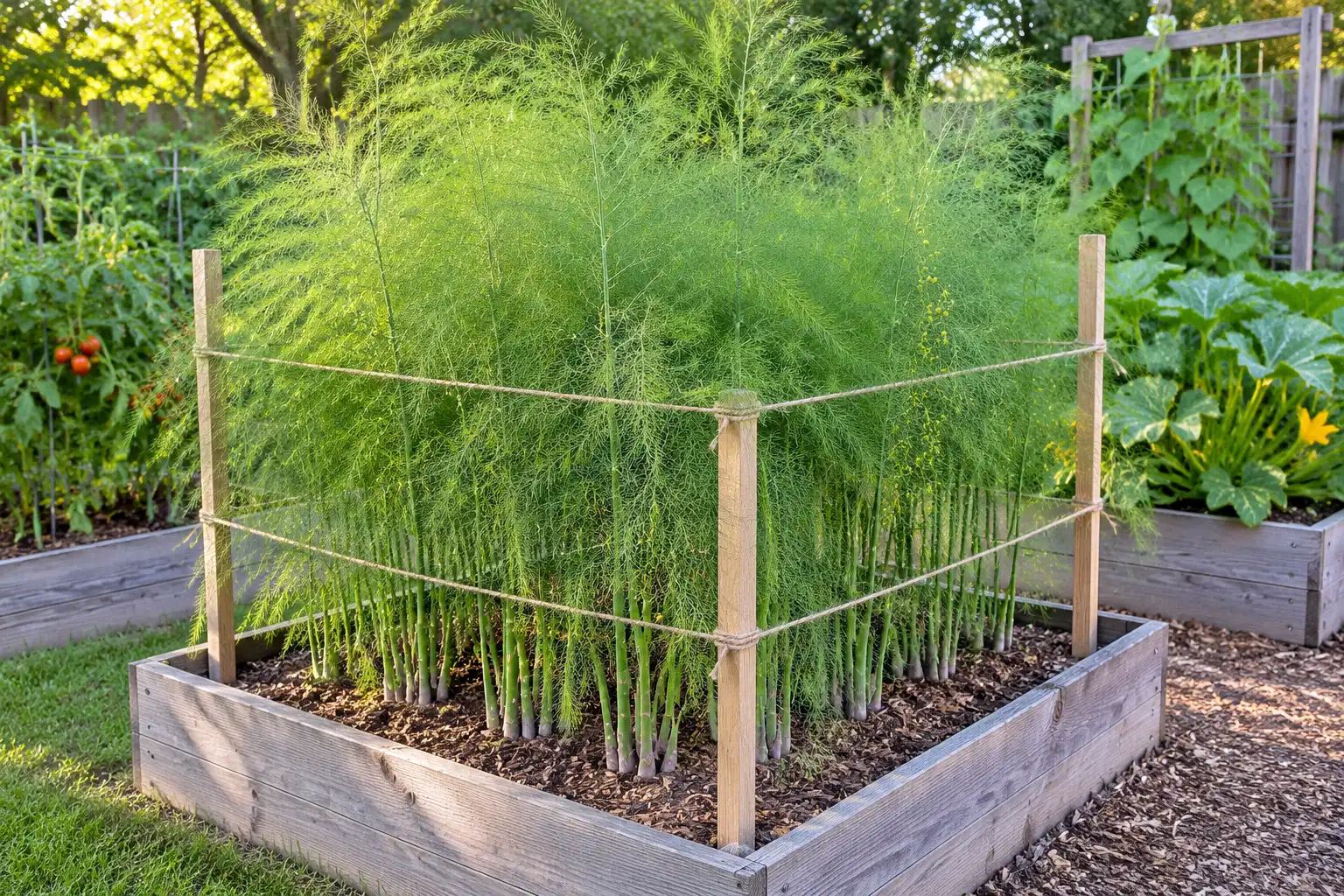
After the last harvest, let every spear grow into a fern. University of Minnesota Extension explains that ferns send energy to the crowns. Missouri likewise ties each spring’s yield to the previous year’s fern growth.
If ferns flop in wind, Virginia Tech suggests stakes and string. In a raised bed, a stake at each corner with two rounds of twine works.
Don’t cut ferns while they’re green, since Missouri Extension says early fall mowing reduces next spring’s harvest. Instead, wait for frost:
- Virginia Tech cuts them to 2-inch stubs once frost yellows them, before the red berries drop.
- University of Minnesota Extension cuts them in late fall or early spring, once they’re fully brown.
Cleanup has a second payoff. Missouri notes that asparagus beetles spend winter as adults in crop debris, so clearing old ferns removes their cover.
Finally, mulch. Virginia Tech adds 4 to 6 inches of compost or leaves after cutting back. In northern Missouri, growers also mulch crowns against cold injury and rake it aside in early April.
Common Problems in Raised Asparagus Beds
Several asparagus problems look alike. Your county extension office, local Master Gardener volunteers, or a plant diagnostic lab can confirm what you’re seeing. The table below describes common issues. It does not diagnose them.
| Problem | What it looks like | What the sources suggest |
|---|---|---|
| Weeds and grass | Weeds among spears, grass creeping in from the edges | Mulch 4 to 6 inches deep (Missouri). Pull weeds rather than hoe during harvest (Virginia Tech). Never till near crowns (Missouri, Utah State) |
| Asparagus beetles | About 1/4 inch, bluish black with creamy yellow spots edged in red (Missouri), or orange with spots (Utah State). Chewed spear tips, eggs on spears | Hand-pick in small beds (Missouri). Clear old ferns in fall |
| Thin, spindly spears | Pencil-thin spears early in the season | Causes listed include picking too hard or too soon (Virginia Tech) and water stress the summer before (Utah State) |
| Crown or root rot | Fern tips yellow, growing points die, spears small and skinny (Utah State) | Good drainage, the right pH, and no overharvesting (Missouri) |
| Volunteer seedlings | Red berries on female plants, then seedlings crowding the bed | All-male hybrids. Cut ferns before berries drop (Virginia Tech) |
One old trick to skip: salting the bed for weeds. Missouri Extension no longer recommends it, because salt damages soil structure and forms a crust that blocks water.
If you choose an insecticide for beetles, the product label sets how to mix it, when to apply it, and how long to wait before picking. Follow any pollinator directions on that label too.
FAQs on Growing Asparagus in a Raised Bed
Can asparagus grow in a 6-inch-deep raised bed?
Only if the native soil below is loose and drains well, so roots can keep going. Missouri and Minnesota extension guides plant crowns 4 to 10 inches deep, so a 6-inch frame leaves little loose mix under them.
Can I grow other vegetables in my asparagus bed?
It’s best to give asparagus its own bed. Digging annual crops each year risks damaging crowns, and Missouri Extension warns against tilling near asparagus because it harms crowns and promotes disease.
Can asparagus grow in a container instead of a raised bed?
It can, but a container holds far less soil than an open-bottom bed, and Utah State waters established asparagus 3 to 4 feet deep. If a pot is your only option, read up on asparagus in containers first.
Do I need all-male asparagus plants?
They aren’t required, but they help in a small bed. Missouri Extension notes male plants produce more spears, while female plants drop berries whose seedlings become volunteer weeds in the bed.
How long does an asparagus raised bed last?
A well-kept planting can produce for 10 to 20 years. Utah State expects 10 to 15 years of spears, while Iowa State puts a well-sited planting at 15 to 20, so build the frame to last too.
Can I plant asparagus crowns in the fall?
Spring is the standard for crowns. Iowa State calls early spring the best time, and Missouri Extension allows fall planting only for seed-grown transplants in southern Missouri, set out in September.
Before You Plant
Build an open-bottom bed 12 to 18 inches deep in full sun, and test the soil this season. Aim for a pH of 6.5 to 6.7, where the sources overlap. In early spring, plant nine 1-year-old all-male crowns per 4 by 4 bed. Then let the ferns stand until frost browns them, and hold off on a real harvest until year three. Virginia Tech’s yield research shows that patience pays back for years.