How to Grow Asparagus in Florida: What Works by Region
Asparagus is a perennial built for cold winters, and Florida rarely gives it one. That shapes every step of how to grow asparagus in Florida, from variety to harvest. Here’s what works in each part of the state.
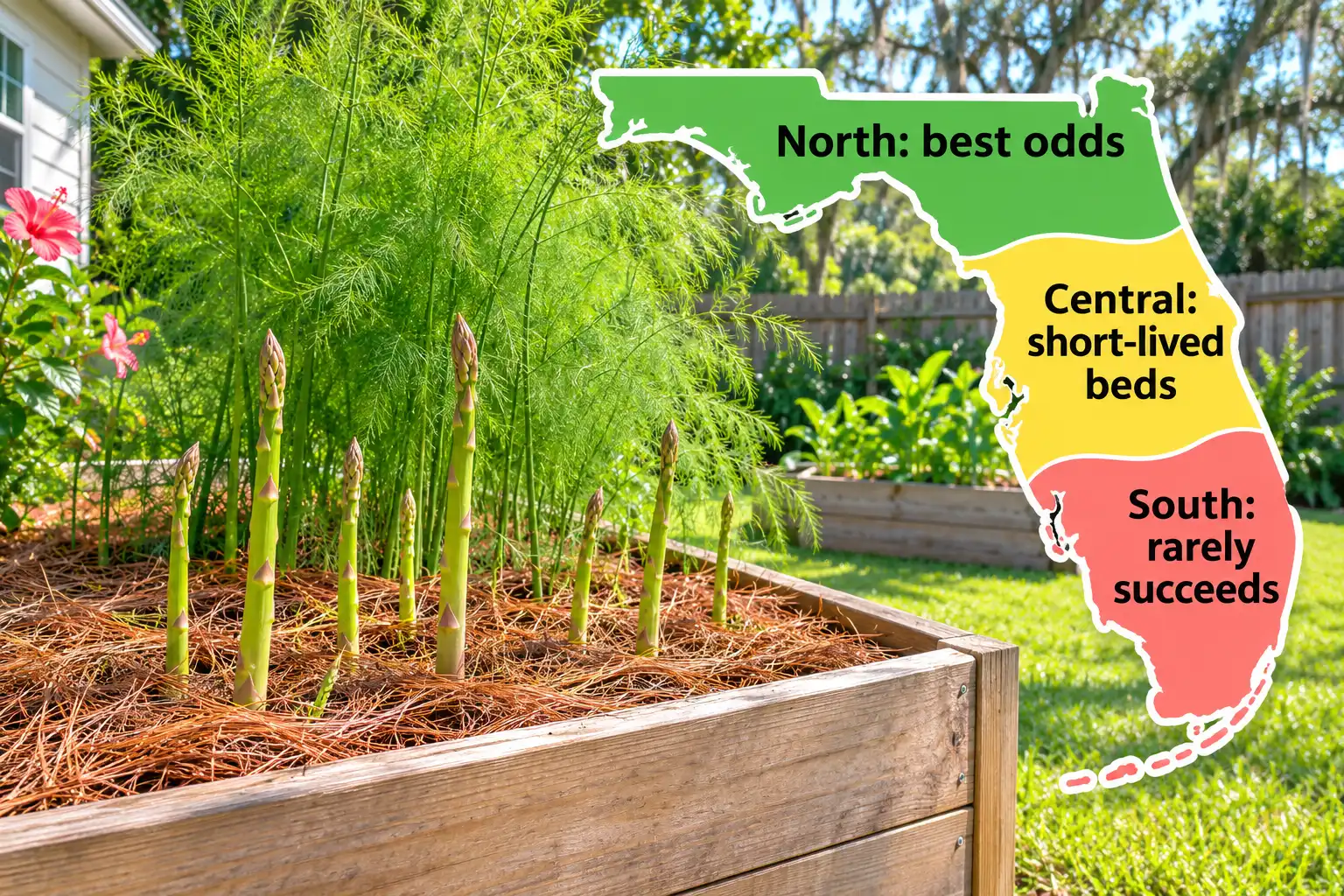
You can grow asparagus in Florida, but plan for a short-lived bed. Plant male hybrid crowns in spring in north or central Florida. UF/IFAS says beds there often give good spears for 4 to 5 years. South Florida rarely succeeds.
Can Asparagus Grow in Florida?
Yes, asparagus can grow in Florida, but it won’t last the way it does up north. UF/IFAS fact sheet HS546 says asparagus “is not well adapted to Florida.”
The problem is rest. Asparagus needs a dormant period to make good spears, and HS546 explains that cold or drought usually brings it on. Florida has little of either. So the plant keeps growing, and the spears come up weak and spindly.
That shortens the life of a bed. Under the best conditions, HS546 notes, an asparagus bed can produce for 30 years or more. In north and central Florida, though, beds often give good spears for only 4 to 5 years before they decline.
So will asparagus grow in Florida? Yes, as a short-term perennial. Most asparagus care basics still apply here. What changes is the variety, the rest period, and how long the bed lasts.
What to Expect in Each Part of Florida
Florida spans USDA hardiness zones 8 through 11, as UF/IFAS Extension in Pasco County notes. The odds for asparagus drop as you move south.
| Region | Winter rest | What to expect | Best approach |
|---|---|---|---|
| North Florida (Panhandle, Jacksonville, Gainesville) | Frost in most winters | Best odds; good spears for about 4 to 5 years (UF/IFAS) | Spring crowns; let frost brown the fern |
| Central Florida (Orlando, Tampa) | Little reliable cold | Possible; same 4 to 5 year window, thinner spears after warm winters | Spring crowns plus a planned rest period |
| South Florida (Fort Myers to Miami) | Almost none | Generally fails in the warm, wet southwest (UF/IFAS Charlotte County) | Treat it as an experiment |
In South Florida, UF/IFAS Extension in Charlotte County says edible asparagus generally doesn’t succeed. The climate is too warm and wet. If you still want to try, start small with asparagus in a container so a failed planting costs little.
Which Asparagus Varieties Do Best in Florida?
A modern hybrid topped both warm-climate trials below, but no recent trial names one best asparagus variety for Florida. These two small trials give the clearest clues.
| Trial | Location | Top variety | Mary Washington |
|---|---|---|---|
| UF/IFAS trial, reported in HS546 | North Florida | A California hybrid, 1,300 lb per acre | 212 lb per acre |
| Southern SARE producer trial, 28 months | Lyford, south Texas | Jersey Supreme, about 5,268 lb per acre per year (projected) | Third of five, ahead of UC 157 |
The trials disagree on Mary Washington. It trailed far behind in north Florida, yet it placed third in the south Texas trial. Both are single-site trials, so treat them as clues, not rankings.
Still, choose a male hybrid where you can. UGA Extension recommends male varieties for Georgia because they make thicker spears and set no seed. In Texas, Texas A&M AgriLife adds, male Jersey types outproduce the Washington types. Those include Jersey Giant, Jersey Knight, and Jersey Supreme.
Female plants also drop berries that sprout into crowded seedlings. In central Florida, UF/IFAS notes, those berries show up in July.
When to Plant Asparagus in Florida
Plant asparagus crowns in spring. UF/IFAS lists spring for setting crowns or sowing seed in Florida.
Other Southern sources narrow the window a little. Texas A&M AgriLife plants asparagus crowns in January or February across Texas. UGA Extension, by contrast, waits until Georgia soil reaches 60°F. In practice, a soil thermometer settles the day for your own yard.
Crowns or Seed?
Buy 1-year-old or 2-year-old crowns. Seed works, but it costs time a Florida bed doesn’t have.
In Florida, HS546 says asparagus seed takes about 2 to 6 weeks to germinate. In the UF trial, seed went into flats in January, and the seedlings reached the garden in May. That’s four months before a plant reaches the bed. Meanwhile, the bed itself may produce well for only 4 to 5 years.
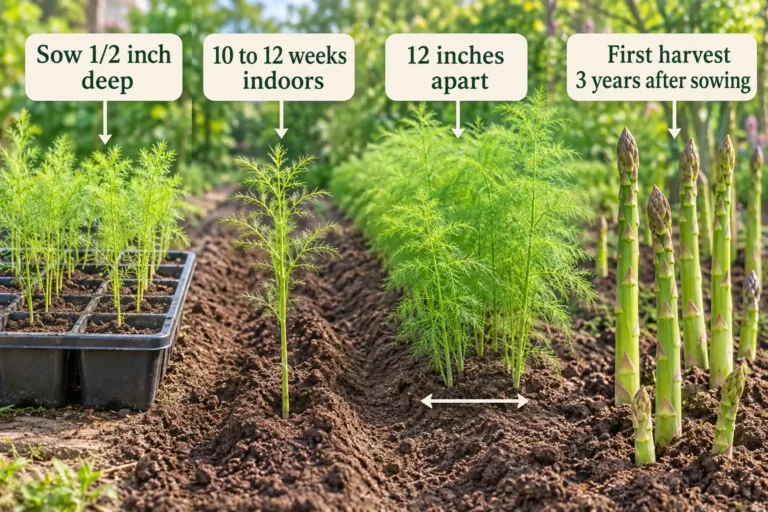
If you still want to try, the steps for starting asparagus from seed apply. HS546 sows asparagus seed 3/4 to 1 inch deep and about 4 inches apart.
How to Prepare an Asparagus Bed in Florida
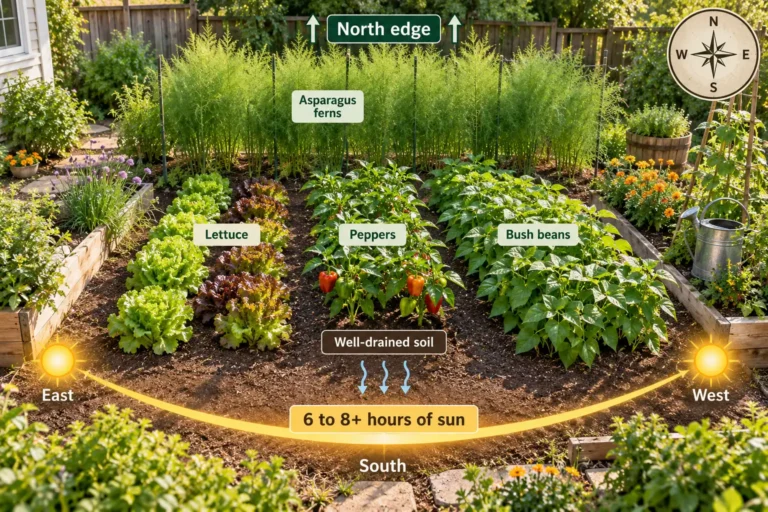
- Pick a sunny, well-drained spot. UGA Extension calls for 8 to 10 hours of sun for asparagus in Georgia. If your yard stays wet after summer storms, build a raised bed 8 to 10 inches high, as UGA suggests. Coastal gardens also get a break. HS546 notes established asparagus tolerates salty soil better than most other vegetables.
- Test the soil first. Send a sample to the UF/IFAS Extension Soil Testing Laboratory with its home garden test form. The standard test reports pH and nutrients, plus lime and fertilizer needs. Targets for asparagus differ. UGA suggests pH 6.5 to 7.0 in Georgia, while Texas A&M allows 6.5 to 7.5 in Texas. That matters here, since UF/IFAS puts Florida’s median soil pH at 6.1. Limestone and shell soils in South Florida and along the coast run alkaline instead. Near an older house or a busy road, ask your county extension office about a lead test too.
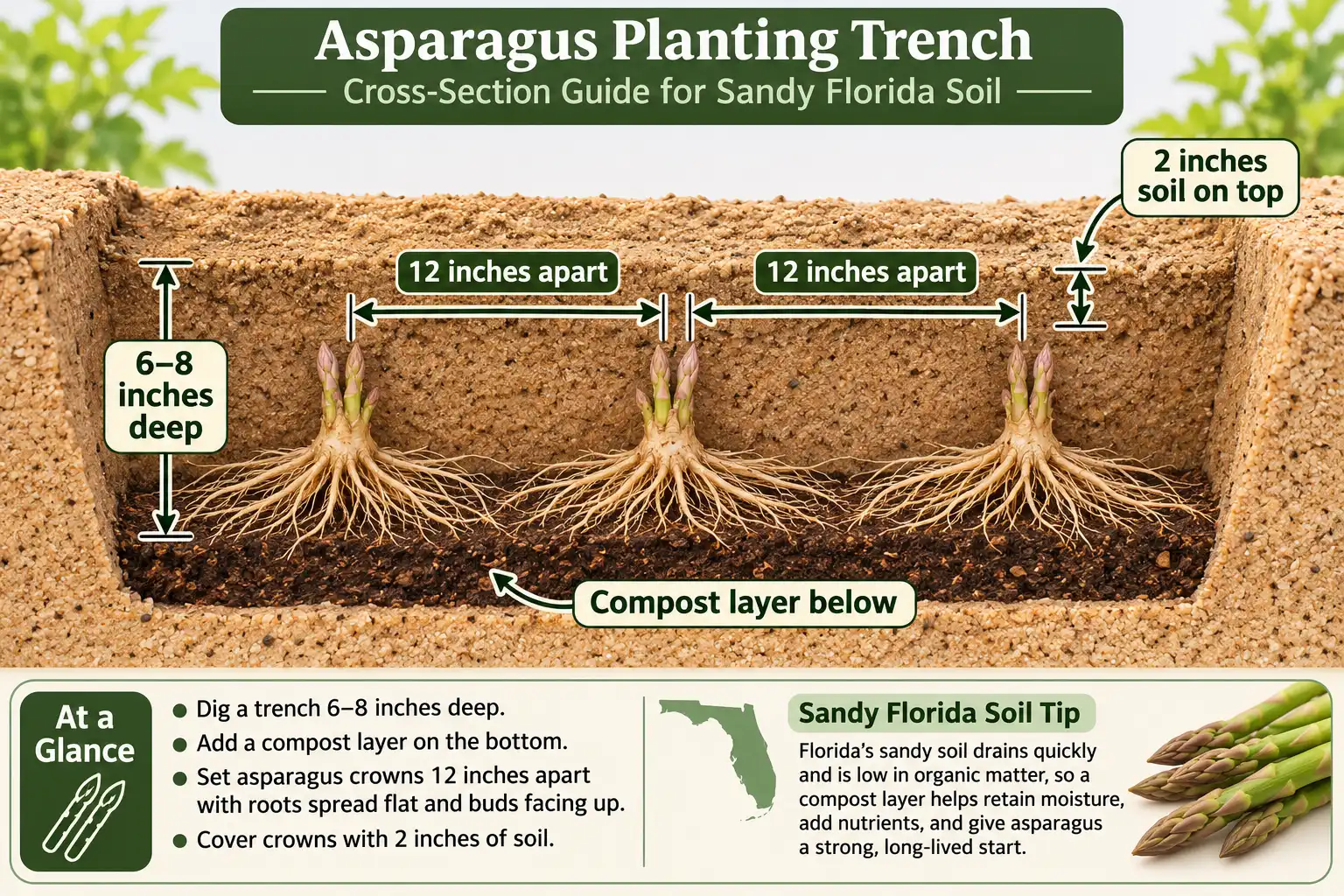
- Work in organic matter. Most Florida soil is sandy and holds little water or nutrients, per UF/IFAS Gardening Solutions. For that reason, HS546 notes, many Florida gardeners dig pits and fill them with compost. Use composted manure, not raw, since raw manure carries food safety risks. The National Organic Program also sets a rule for raw manure. It must go in at least 120 days before harvest for crops that touch the soil, like asparagus.
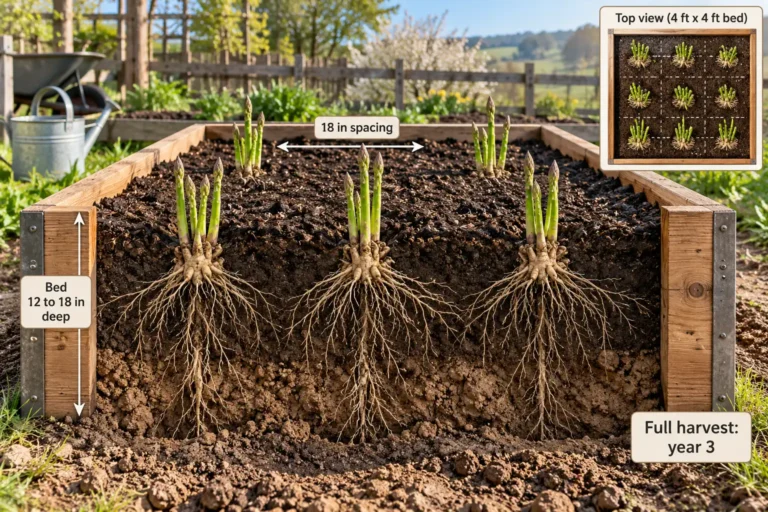
If you build a raised bed, fill it with a raised bed soil mix that drains well.
How to Plant Asparagus Crowns in Florida
- Call 811 before you dig. That way, the utility company marks buried lines before you open a long trench.
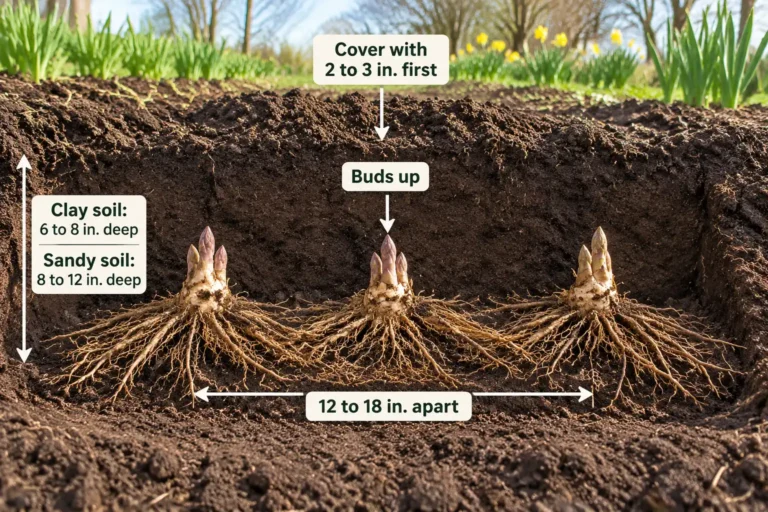
- Dig the trench. UGA Extension digs a trench 6 inches deep and 15 inches wide for asparagus in Georgia. HS546 sets asparagus crowns 6 to 8 inches deep in Florida, so dig to that depth.
- Space the crowns. HS546 places asparagus crowns 12 inches apart in Florida. Spread the roots flat with the buds facing up.
- Cover lightly and water. UGA covers asparagus crowns with about 2 inches of soil, then waters well. After that, add soil a little at a time as spears grow, until the trench is level.
The full process for setting crowns in a trench covers each step in more detail.
How Many Crowns to Buy
Use this math with the HS546 spacing of 12 inches between asparagus crowns:
Crowns per row = row length in inches ÷ 12
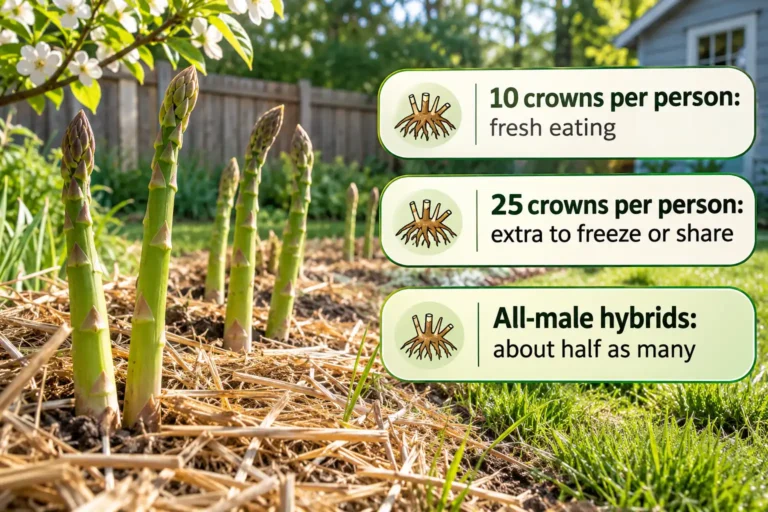
A 20-foot row is 240 inches, so it takes 20 crowns. Texas A&M AgriLife sizes that same 20-foot row as enough asparagus for a family of four in Texas. Florida yields may run lower, though, so consider a longer row.
Watering, Feeding, and Weeding
Water and feed asparagus from spring through fall, then leave it mostly alone in winter. That’s the schedule UF/IFAS Gardening Solutions gives Florida gardeners.
UGA Extension suggests about 1 inch of water a week for asparagus in Georgia when rain falls short. On a 4 by 8 foot raised bed, that’s about 20 gallons a week. The math: 32 square feet × 0.62 gallons per inch of water. Sandy Florida soil dries fast, so check it often in the dry spring months. A drip line puts that water at the roots and keeps the fern dry.
Next, feed by the soil test. The UF lab report gives the amount your bed needs. Without a test, UGA suggests 2 pounds of 10-10-10 per 100 feet of row for asparagus in Georgia. Apply it at planting and early in the season. For a 20-foot row, that’s about 6 ounces.
Weeds grow nearly year-round in Florida, so keep the bed mulched. UGA calls mulch the most effective control for weeds and moisture in asparagus. Any weed killer must list asparagus on its label. The label then sets every detail of its use.
How to Give Asparagus a Rest Period in Florida
You can’t make Florida colder. However, you can time when the fern dies back and when you cut it. That gives the crowns a break.
North Florida: Let Frost Do the Work
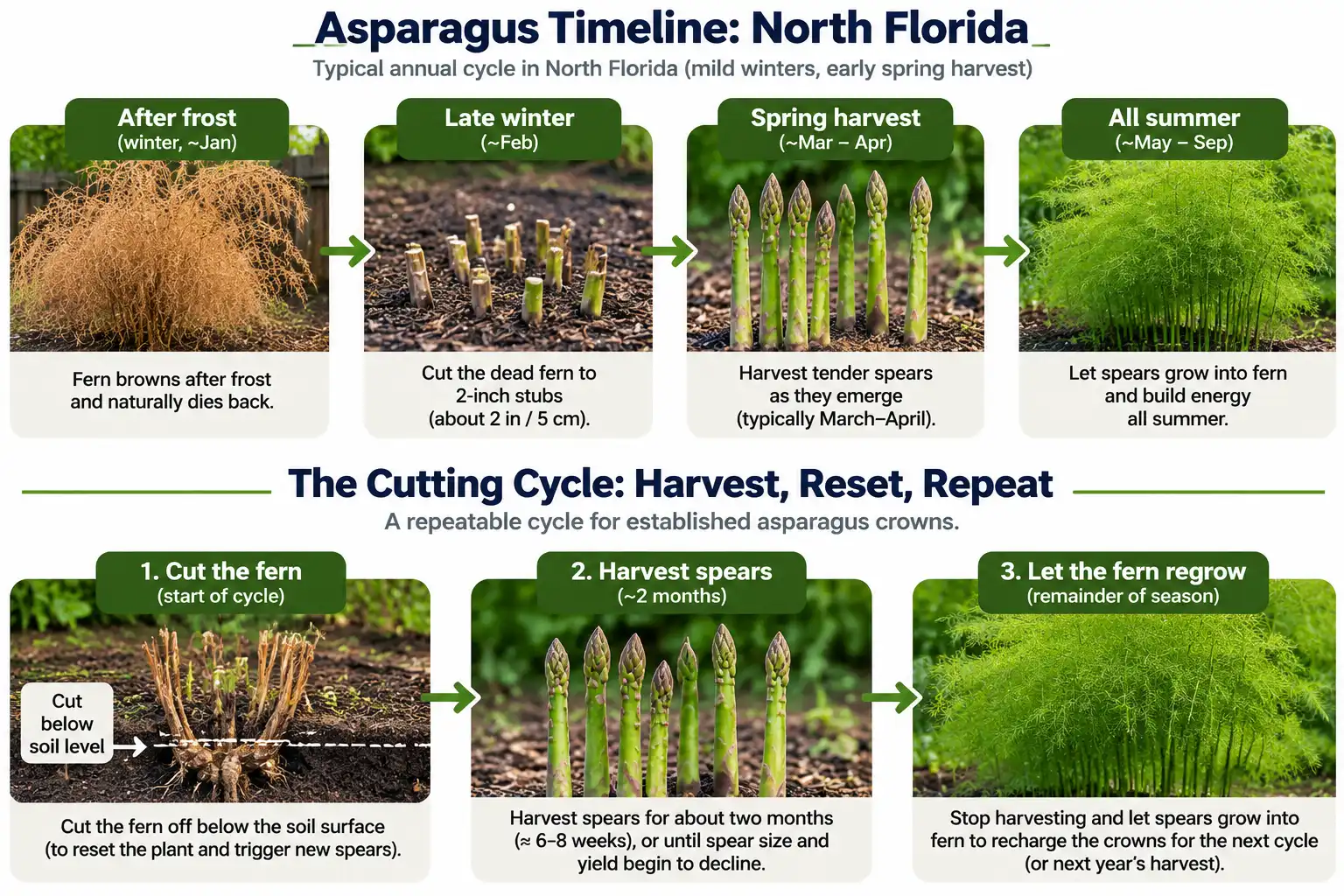
First, leave green fern standing. UF/IFAS Extension in Nassau County says the fern feeds next year’s spears, so cutting it early cuts next year’s crop. Wait for frost to brown it. Then cut it to 2-inch stubs in late winter, before new spears appear, as UGA Extension does in Georgia.
A mild winter may not brown the fern at all. Texas A&M AgriLife notes the fern can survive a freeze in southern Texas. In that case, it removes the fern in late November, once it yellows.
Easing off water may help too. UC IPM guidance for California asparagus fields stops irrigation as the fern starts to yellow in fall. The goal is to discourage new growth before dormancy. No Florida trial has tested this, though, and fall rain can keep the soil moist anyway.
Central and South Florida: Try a Cutting Cycle
With little frost, one grower in subtropical south Texas forced the rest by cutting instead. Southern SARE, a USDA program, funded his 28-month trial. He cut each planting’s fern below the soil surface every 10 months. He then harvested spears for two months and let the fern regrow. He also spread 2 inches of compost after each cut.
As a result, spears came in about 10 months of the year. Production peaked March through May, with a second peak September through November. January and August were the slowest months.
Still, it was one farm and a short trial. The report says the project didn’t run long enough to show how heat affects yield or plant life over time. So treat the cycle as a method to test, not a proven schedule.
When and How to Harvest Asparagus in Florida
Wait about two years after planting crowns before a full harvest. UF/IFAS Gardening Solutions says to wait at least 2 years after planting asparagus in Florida, and Texas A&M AgriLife agrees. UGA Extension, on the other hand, allows a light 3-week harvest of pencil-size spears in the second year in Georgia.
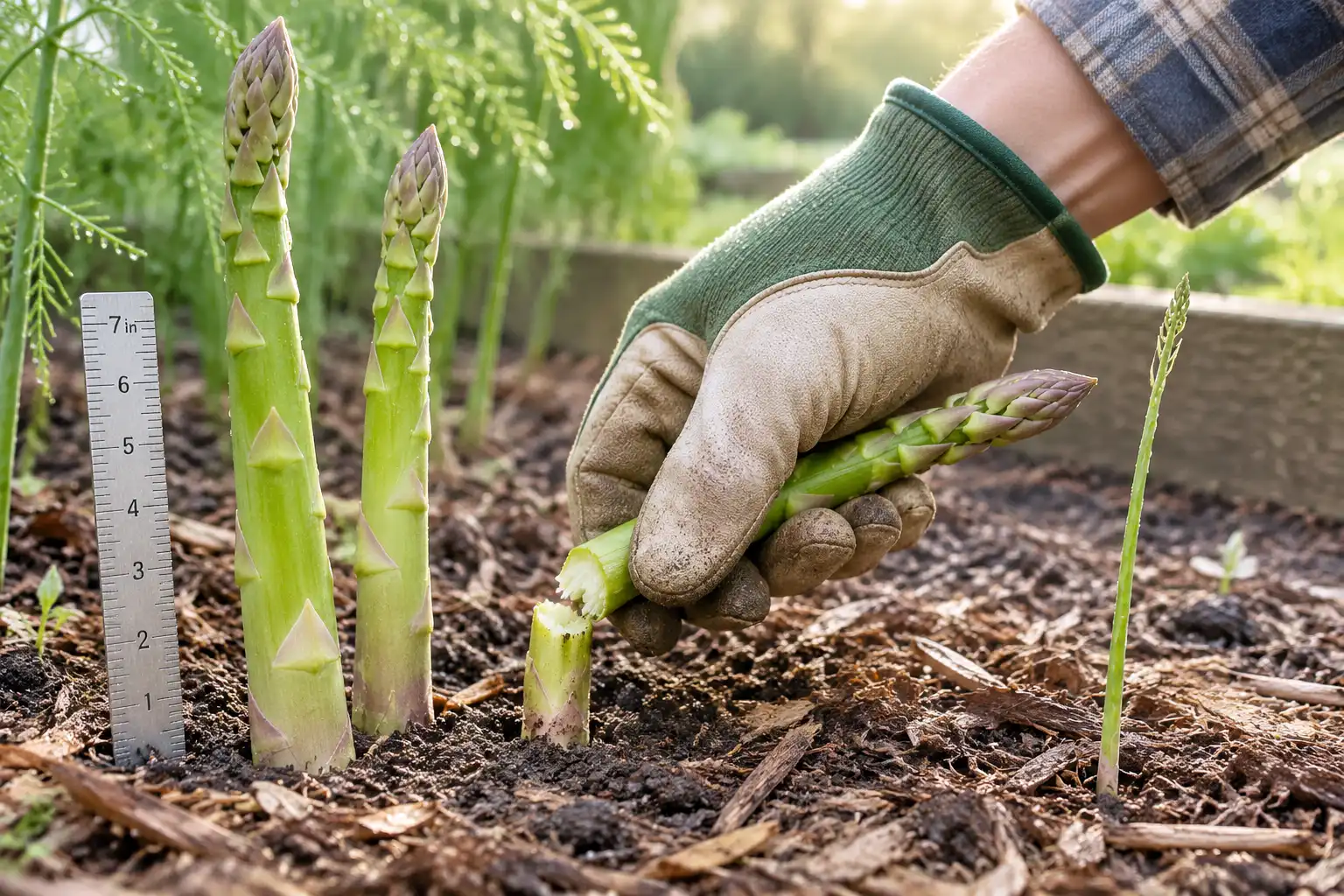
UF/IFAS Extension in Nassau County says established north Florida beds give spears for about 2 to 3 months in spring. Fall spears are possible too. The UF trial cut spears in late fall. The south Texas trial also saw a second peak from September through November.
These harvest marks come from Georgia and Texas guidance for asparagus:
- Cut or snap spears at 5 to 8 inches tall (UGA).
- Pick at least every other day, because spears turn fibrous fast (Texas A&M).
- Stop once most new spears are thinner than 3/8 inch (Texas A&M).
After that, let the fern grow. It refills the crown for next season.
How Much Asparagus to Expect
Plan conservatively. Published yields for warm climates vary widely, and the only Florida figure is the oldest and lowest.
| Source | Region | Yield from a 20-foot row |
|---|---|---|
| UF/IFAS trial, best hybrid | North Florida | About 3 lb over a 3 to 5 week fall cut |
| UF/IFAS trial, Mary Washington | North Florida | About 0.5 lb over the same cut |
| Texas A&M AgriLife estimate | Texas | 8 to 10 lb per season |
| Southern SARE trial, Jersey Supreme, year four | South Texas | About 12 lb per year |
With rows 5 feet apart, as Texas A&M spaces them, a 20-foot row takes about 100 square feet. The UF figures convert from per-acre yields. For example, 1,300 pounds ÷ 435.6 (hundreds of square feet in an acre) comes to about 3 pounds. The south Texas figure is 0.6 pound per running foot × 20 feet.
Common Asparagus Problems in Florida
Your county extension office or the UF/IFAS Plant Diagnostic Center can identify what’s affecting your plants. That matters, because several asparagus problems look alike.
| Problem | Common causes | What to check |
|---|---|---|
| Thin, spindly spears | No winter rest, young crowns, or a long cutting season | Rest period, plant age, harvest length |
| Bed fades after a few years | Florida’s typical 4 to 5 year bed life (UF/IFAS) | Start a new bed before the old one declines |
| Crowns rot | Wet soil; UGA lists crown rot and Fusarium crown rot | Drainage, a raised bed, soil pH |
| Chewed spears or fern | Asparagus beetles, which UGA lists in Georgia | Ask your extension office to confirm |
| Seedlings crowd the bed | Berries from female plants | Pull seedlings; choose male hybrids next time |
| Weeds overrun the bed | Year-round Florida weed growth | Mulch and hand weeding |
The south Texas trial reported no insect pressure during its run, though one farm can’t speak for Florida. Any insecticide or fungicide you use must list asparagus on its label. The label sets the rate, the timing, and the wait before harvest.
Don’t Confuse It With Asparagus Fern
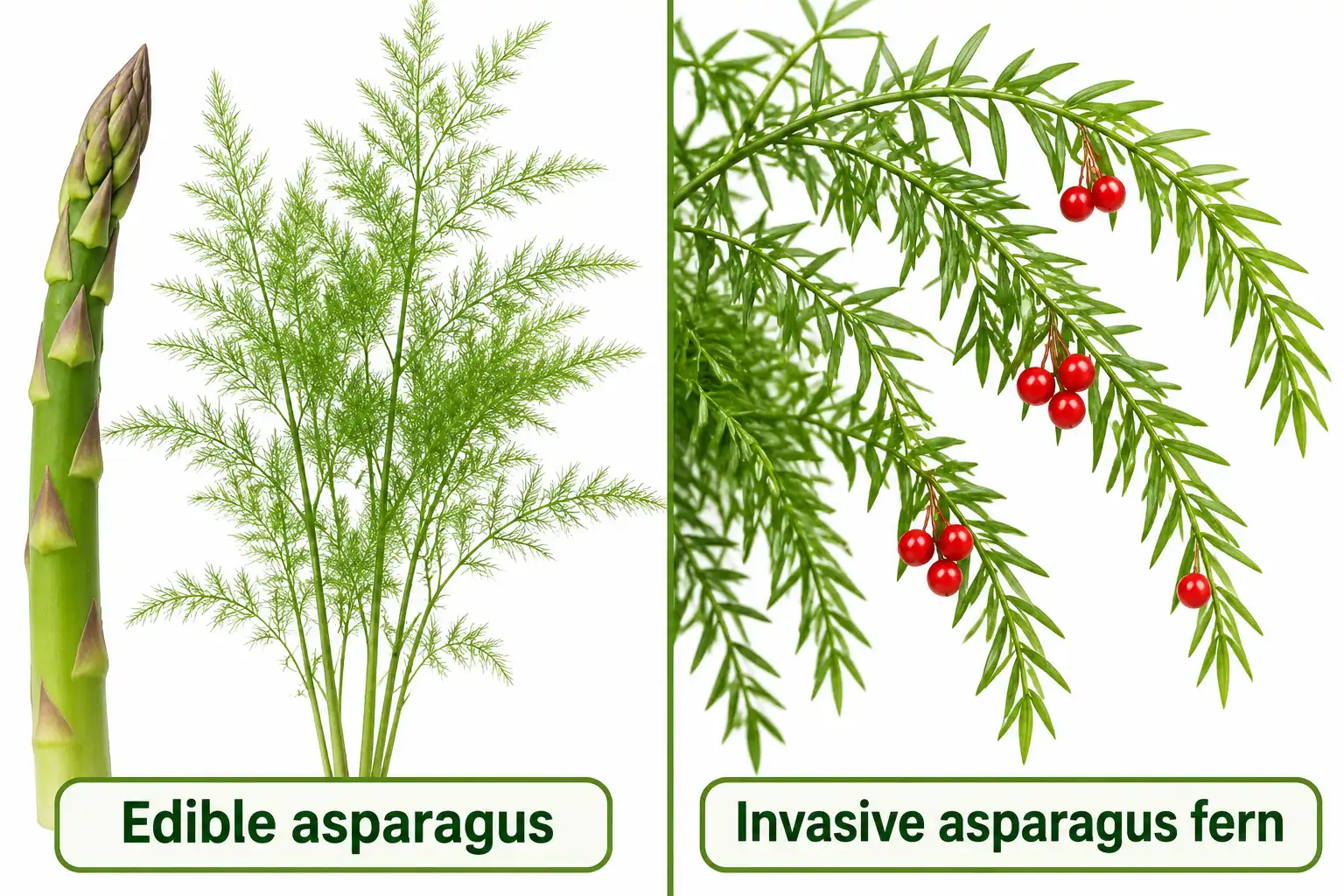
Ornamental asparagus fern is a different plant from edible asparagus (Asparagus officinalis). UF/IFAS Extension in Charlotte County notes that Sprenger’s asparagus fern (Asparagus aethiopicus) is a Category I invasive plant in Florida. Birds spread its seeds into natural areas. If you grow it at all, keep it in a container.
FAQs
Can I grow asparagus in South Florida?
It rarely succeeds because South Florida lacks the cold that lets asparagus rest. UF/IFAS Extension in Charlotte County says edible asparagus generally fails in the warm, wet climate of Southwest Florida.
Will asparagus come back every year in Florida?
Yes, for a few years, because asparagus is a perennial that regrows from its crown. UF/IFAS says north and central Florida beds often give good spears for 4 to 5 years, not decades.
Does asparagus need cold weather to grow?
It needs a yearly rest period more than it needs cold itself. UF/IFAS says cold or drought usually triggers that rest, and Florida asparagus without either makes weak, spindly spears.
Should I cut back asparagus ferns in Florida?
Not while they’re green, because the green fern feeds next year’s crop of spears. UGA Extension cuts the fern to 2-inch stubs in late winter in Georgia, once it browns.
How long until I can harvest asparagus in Florida?
Plan on about two years from crowns, since young plants need time to build roots. UF/IFAS says to wait at least 2 years, while UGA allows a light 3-week harvest in year two in Georgia.
Before You Plant
Start with a UF/IFAS soil test. Pick a well-drained spot with 8 to 10 hours of sun, UGA’s mark for asparagus. Then plant male hybrid crowns in spring, and hold off on a full harvest for about two years.
After that, plan for a 4 to 5 year bed, and start a new one before the old bed fades. North Florida gives the best odds. Farther south, treat asparagus as a small, low-cost experiment.