How to Plant Asparagus Crowns: Depth, Spacing, and Timing
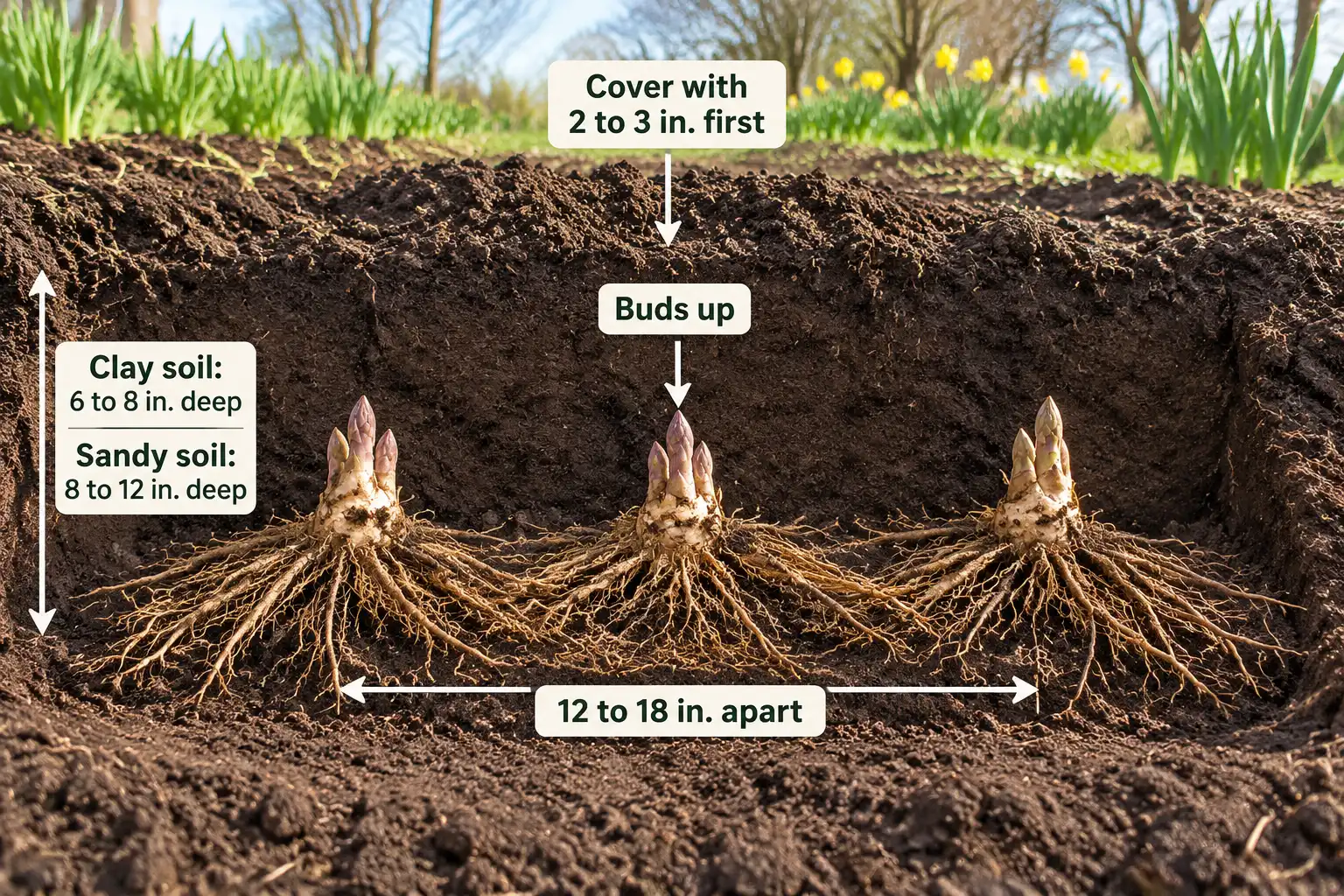
Iowa State Extension expects a well-sited asparagus bed to produce for 15 to 20 years, so planting day sets up everything after it. Knowing how to plant asparagus crowns comes down to timing, trench depth, spacing, and keeping dormant roots from drying out.
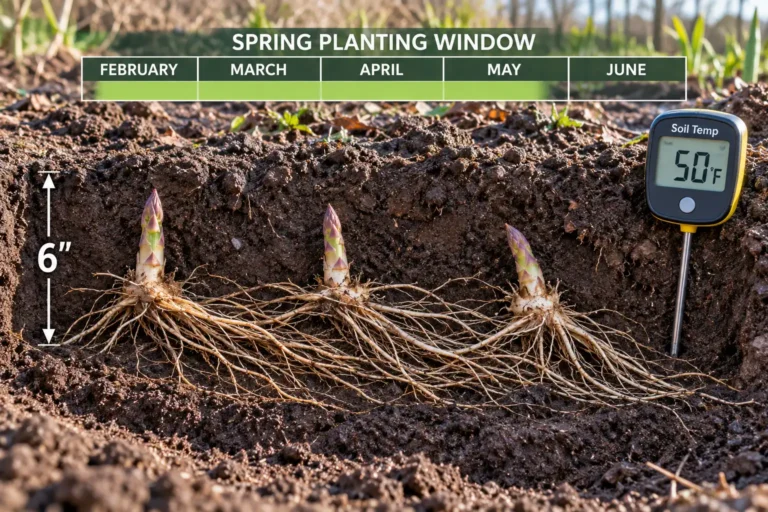
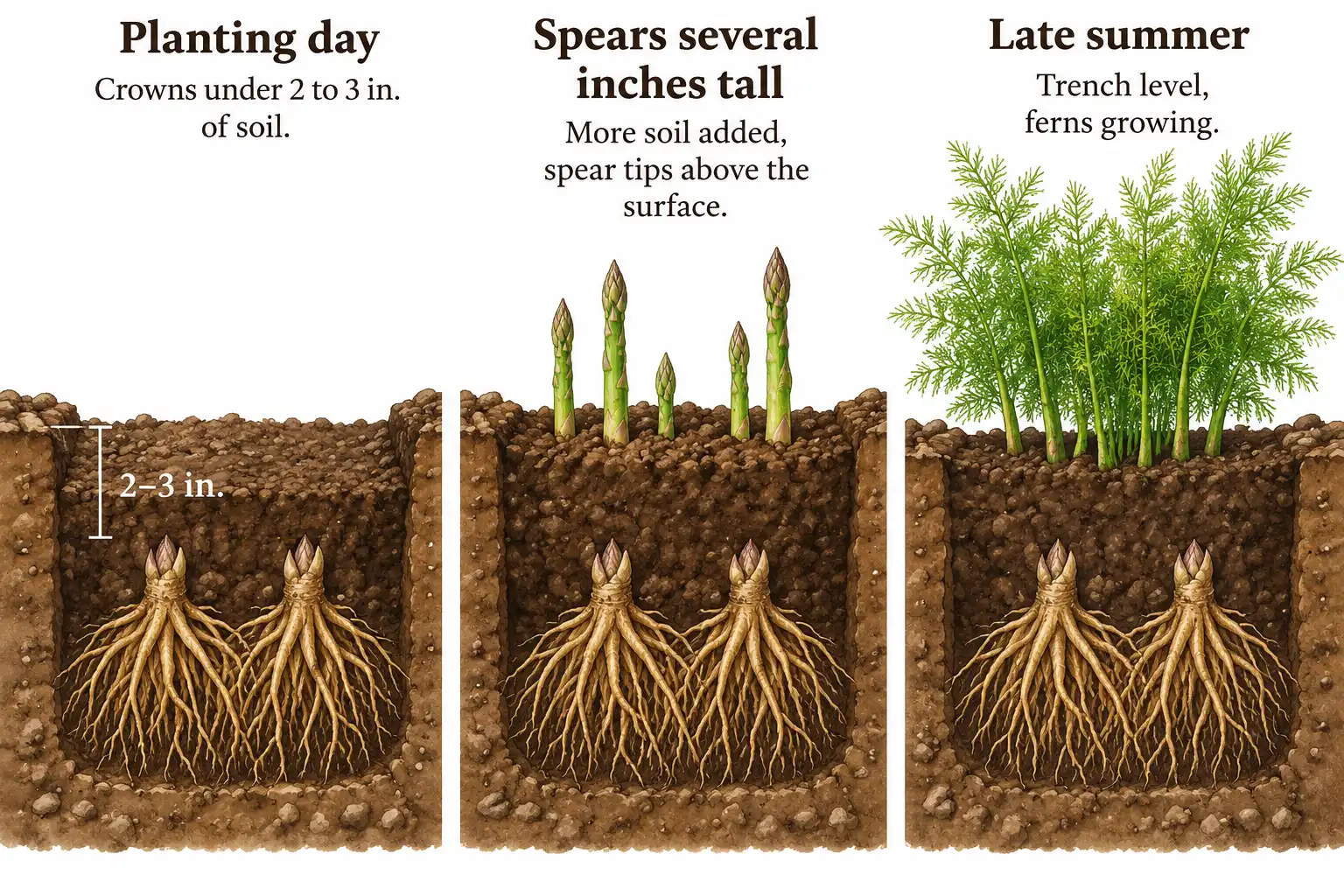
Plant asparagus crowns 3 to 4 weeks before last frost. Set them bud side up, 12 to 18 inches apart, in a trench 6 to 8 inches deep (deeper in sand). Cover with 2 to 3 inches of soil.
What Are Asparagus Crowns?
Asparagus crowns are dormant, one-year-old root systems, sold bare root with no soil around them. So a listing for “asparagus roots” or “bare root asparagus” means the same thing, and all three plant the same way. Oregon State Extension recommends one-year-old crowns and notes that seed-grown plants take an extra year to reach harvest.
Older isn’t better, though. Michigan State Extension reports that even two-year-old crowns don’t do as well as year-old crowns after the move. University of Minnesota Extension also recommends one-year-old crowns.
How to Pick Healthy Crowns
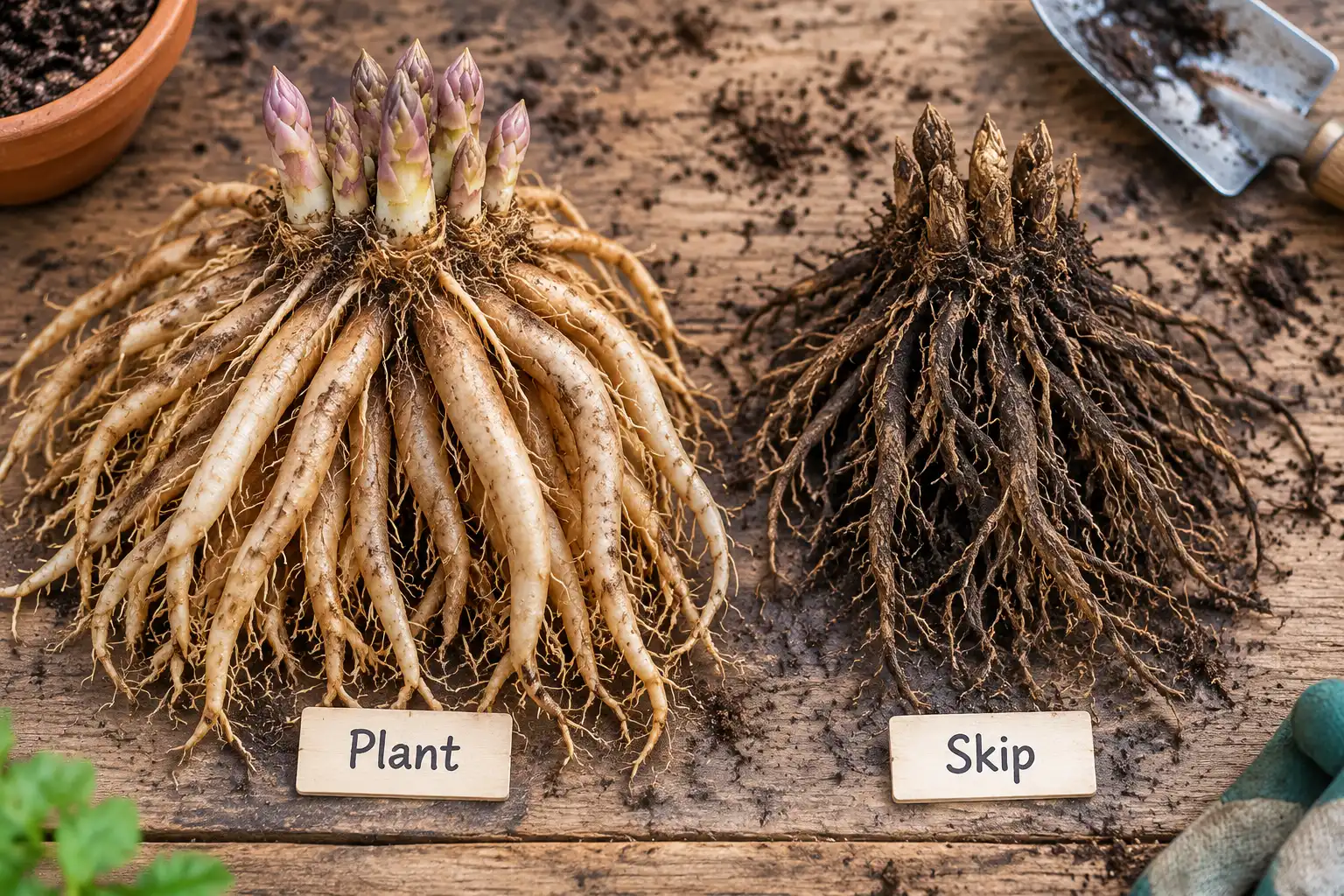
Colorado State Extension looks for crowns with 8 to 10 large roots and one or two healthy bud clusters. Oregon State Extension says to skip crowns that are dried out or show signs of rot.
In practice, pass on roots that feel brittle and hollow, or soft, dark, and moldy. If a shipment arrives that way, contact the seller before you plant.
All-Male or Standard Varieties?
All-male hybrids set no seed. University of Minnesota Extension notes that male plants also live longer and produce more spears. Michigan State Extension puts the hybrid yield advantage in Michigan at about 50 percent over the older Washington types. Jersey Giant, Jersey Knight, and Jersey Supreme are common all-male choices.
Cold winters can change the pick, however. University of Minnesota Extension warns that Jersey varieties can be damaged at -30°F without enough snow cover. It describes Millennium, from the University of Guelph, as vigorous and high-yielding. Mary Washington yields less but is very cold-hardy.
When to Plant Asparagus Crowns
Plant asparagus crowns in early spring, as soon as the soil is workable. Oregon State Extension sets that at about 3 to 4 weeks before your average last frost date. Regional guides agree on early spring, but their calendar dates differ widely.
| Region | Planting window for asparagus crowns | Source |
|---|---|---|
| Any region | 3 to 4 weeks before the average last frost | Oregon State Extension |
| Eastern North Carolina | February | NC State Extension |
| North Carolina Piedmont and mountains | Late winter, after hard freezes end and before growth starts | NC State Extension |
| Iowa | Early spring | Iowa State Extension |
| Minnesota | Early May to early June | University of Minnesota Extension |
Workable soil matters as much as the date. If a squeezed handful stays in a sticky ball, give the bed a few more dry days. Your county extension office can give you the average last frost date for your area. In zone 6b, a month-by-month zone 6b calendar shows what else goes in during the same weeks.
Prepare the Bed Before the Crowns Arrive
Like other long-lived perennial crops, asparagus needs a spot you won’t disturb for years. So check four things before you commit.
Sun comes first. Iowa State Extension wants asparagus in at least 6 hours of direct sun a day. Colorado State Extension asks for 8. Drainage is next. Michigan State Extension uses a simple test. If water stands on the spot for even an hour, it’s probably too wet for asparagus.
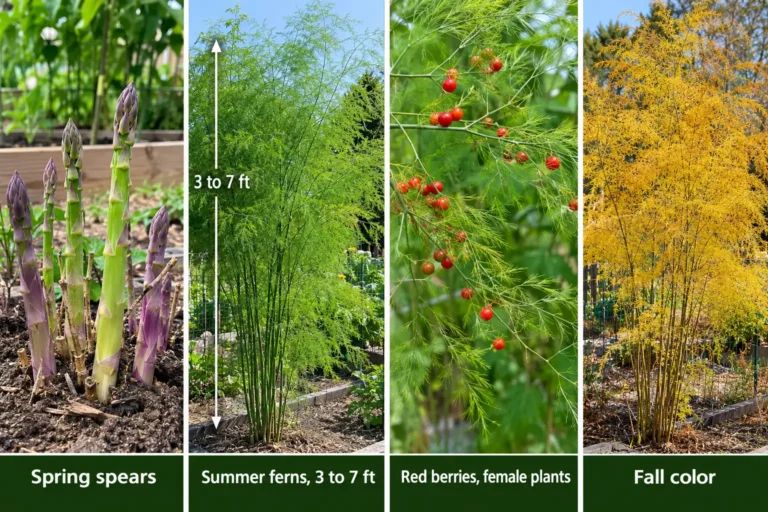
Then think about height. Oregon State Extension notes the ferns reach 5 to 6 feet. So a bed on the north edge of the garden won’t shade shorter crops. Finally, skip any spot where asparagus grew before. Michigan State Extension explains that Fusarium levels stay high in old beds. A new planting there yields less and doesn’t last as long.
These are the same sun and drainage checks for a new garden plot, with higher stakes.
Test the Soil and Set the pH
NC State Extension advises testing at least 6 months before planting and sampling 12 inches deep. pH targets differ by source. University of Minnesota Extension aims for 6.5 to 7.0. Oregon State Extension says about 6.5 to 7.5, and NC State says 6.0 to 6.7. Each writes for its own soils, so follow your lab’s recommendation.
Just avoid the acidic end. Michigan State University research shows lower pH favors the Fusarium fungi. Also, if the bed sits near an older house or a busy road, ask the lab to test for lead.
Clear Weeds and Loosen the Soil
NC State Extension recommends a site relatively free of perennial broadleaf weeds and nutgrass. Clear them now, because digging out perennial roots later disturbs the crowns. Then loosen the bed. Oregon State Extension suggests digging at least 12 inches deep and mixing in plenty of organic matter, such as compost.
If Your Soil Drains Poorly
Iowa State Extension suggests raised beds where soil drains poorly. Aim for at least the 12 inches of loose soil Oregon State calls for. Then fill it with a well-draining raised bed mix. A 4 by 8 foot bed fits one row of crowns down the center. At University of Minnesota’s 12-inch spacing, that’s 96 ÷ 12 = 8 crowns.
How to Plant Asparagus Crowns Step by Step
With the bed ready and the soil workable, follow these steps on planting day.
- Call 811 a few days ahead. Trenches can run a foot deep, so get buried utility lines marked first.
- Dig the trench. Match the depth to your soil type (next section). NC State Extension says to make it wide enough for the roots to spread fully.
- Add phosphorus only if your soil test calls for it. Michigan State Extension puts a little phosphate fertilizer in the trench before setting crowns. It also warns against any product with enough nitrogen or potassium to burn the crown.
- Set the crowns bud side up. Space them 12 to 18 inches apart with the roots lying flat. University of Minnesota Extension notes that fanning roots over a mound adds labor without a proven benefit.
- Cover them right away. University of Minnesota Extension warns against letting crowns dry out between the trench and the soil. Pull 2 to 3 inches of moist soil over them.
- Water immediately. A good soaking settles soil against the roots.
- Finish filling the trench gradually as spears grow, or all at once if you follow Iowa State’s method.
How Deep to Plant Asparagus Crowns
Plant asparagus crowns 6 to 8 inches deep in heavy clay and 8 to 12 inches deep in sandy soil. Measure from the soil surface down to the trench floor where the crowns sit. Three Midwest extension services give close, but not identical, figures.
| Soil type | Iowa State Extension | Univ. of Minnesota Extension | Michigan State Extension |
|---|---|---|---|
| Heavy or clay soil | 6 to 8 inches | 6 to 8 inches | About 6 inches |
| Light or sandy soil | 8 to 10 inches | 10 to 12 inches (very sandy) | 8 to 10 inches |
Oregon State and Colorado State both use a 6-inch trench, while NC State uses 8 inches. On loam that’s neither heavy nor sandy, about 8 inches is where most of these ranges meet.
The pattern also lines up with watering data. University of Minnesota Extension notes that an inch of water wets sandy soil about 10 inches deep. In heavy clay, it reaches only about 6.
How Far Apart to Plant Asparagus Crowns
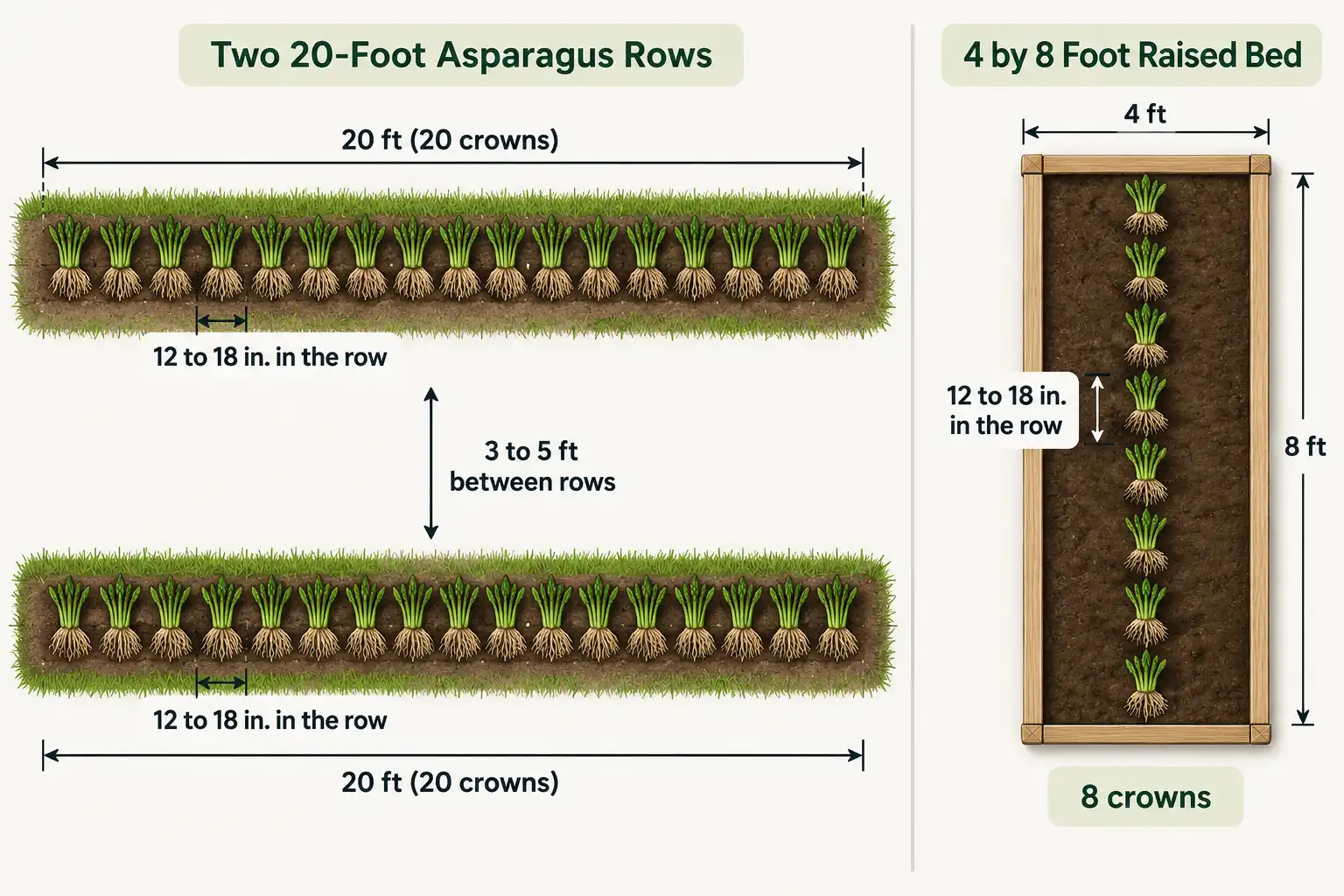
Space asparagus crowns 12 to 18 inches apart in the row, with rows 3 to 5 feet apart. University of Minnesota Extension sets crowns 12 inches apart, with rows at least 3 feet apart. Rows need that room because the plants spread as they age. Iowa State Extension uses 12 to 18 inches in rows 4 to 5 feet apart.
NC State Extension uses 12 inches in rows 5 feet apart. It adds that closer in-row spacing raises yield, but narrower rows may shorten the bed’s life.
To size your row, divide its length in inches by your in-row spacing:
- 20-foot row at 12 inches: 240 ÷ 12 = 20 crowns
- 20-foot row at 18 inches: 240 ÷ 18 = about 13 crowns
- 4 by 8 foot raised bed, one center row at 12 inches: 96 ÷ 12 = 8 crowns
How Many Crowns to Plant
NC State Extension suggests 10 crowns per family member for fresh eating, and at least 25 per person if you plan to preserve extra. For newer hybrids, it halves both numbers. So a family of four eating fresh spears from an all-male hybrid needs about 4 × 10 ÷ 2 = 20 crowns. That’s one 20-foot row at 12-inch spacing.
Should You Soak Asparagus Crowns Before Planting?
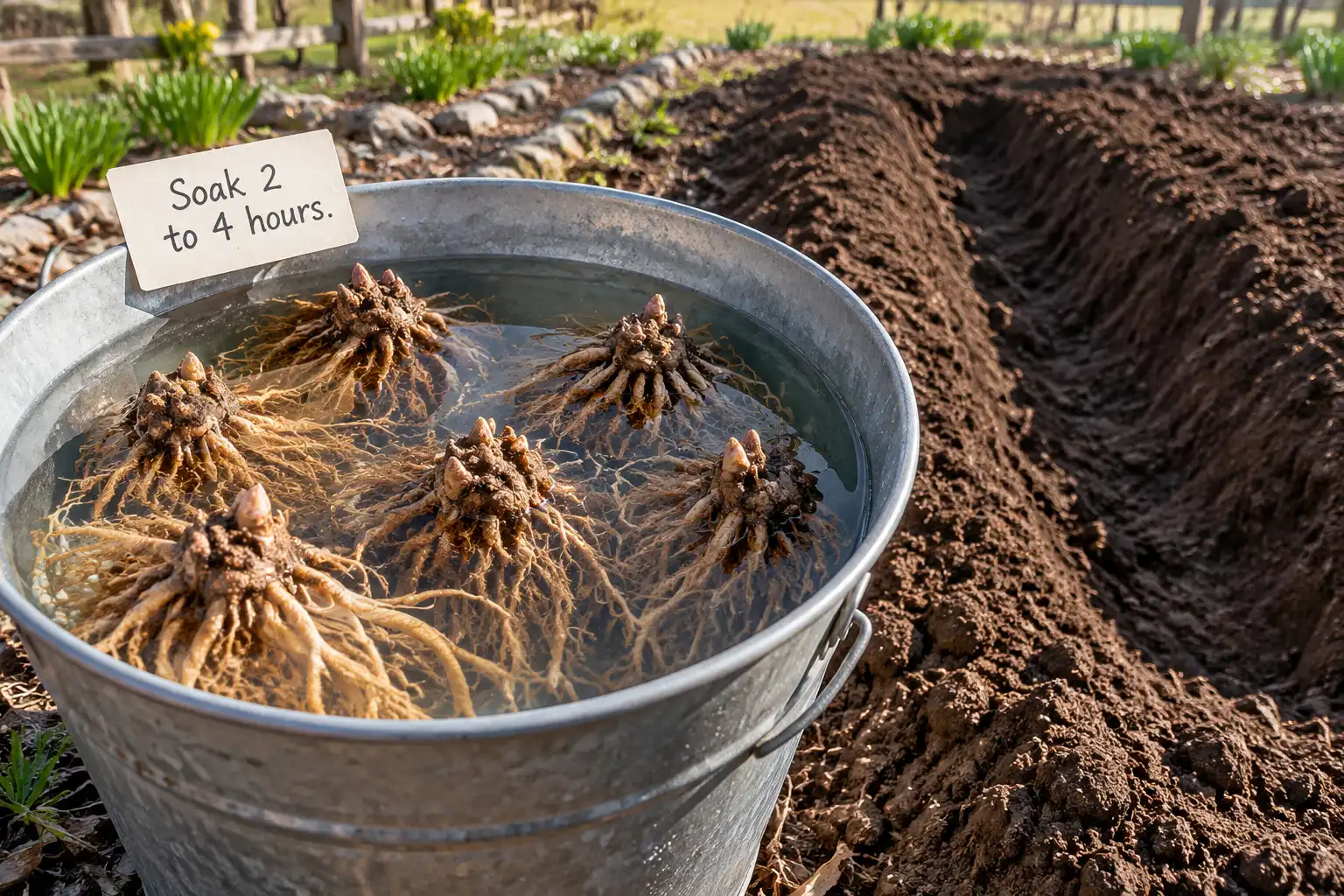
You don’t have to soak asparagus crowns, but a short soak helps crowns that arrive a little dry. Colorado State Extension suggests soaking crowns in warm water for 2 to 4 hours before planting. University of Minnesota Extension doesn’t call for soaking at all. Instead, it stresses keeping crowns from drying out before they’re covered.
Let the crowns’ condition decide:
- Firm, flexible roots in moist packing: plant them as they are, or give them a short soak.
- Roots slightly limp or dry to the touch: soak them 2 to 4 hours in warm water, per Colorado State.
- Brittle, hollow, mushy, or moldy roots: a soak won’t help. Oregon State Extension says to avoid dried-out or rotting crowns.
How Long to Soak Asparagus Crowns
Soak asparagus crowns for 2 to 4 hours, the window Colorado State Extension gives. Use lukewarm water, not hot. Carry them to the trench in the bucket so the roots stay wet until covered. None of the extension guides we checked call for an overnight soak, so stick to the window.
How to Store Asparagus Crowns Before Planting
Keep asparagus crowns cold, moist, and dormant until planting day. University of Minnesota Extension advises a delivery date close to planting day. Then refrigerate the crowns until they go in. If planting gets delayed, Oregon State Extension says to store crowns in a cool, moist place.
A few simple habits keep them in shape:
- Leave crowns in their original packing material and bag.
- Check them every few days. If the packing feels dry, mist it lightly. Aim for moist, not wet.
- Don’t let them freeze.
- Plant on the first day the soil is workable.
Neither source gives a maximum holding time. So treat storage as a short bridge to planting day, not a way to wait out the season.
Fill the Trench Gradually or All at Once?
Both methods have extension support, so pick the one that fits your schedule.
Gradual fill. University of Minnesota Extension covers crowns with 2 to 3 inches of soil at planting. Once the spears are sturdy and several inches tall, it backfills several more inches. Its tips for planting asparagus add one or two more backfills, so the trench is level by about August. Oregon State Extension also fills gradually and keeps the spear tips exposed.
Fill at planting. Iowa State Extension fills the trench completely right after planting. It says gradual filling isn’t necessary.
If you can check the bed every week or two, gradual filling follows most guides. If you can’t, Iowa State’s method saves trips. Either way, break up clods first, since University of Minnesota Extension warns that large dry clods can break young spears.
Expect thin spears within 2 to 3 weeks of planting, according to University of Minnesota Extension. Moisture, temperature, and soil cover all affect that timing.
First-Season Care
Water
University of Minnesota Extension calls for at least 1 inch of water a week on an asparagus patch, rain included. Colorado State Extension goes higher, at 1 to 2 inches a week for the first two years. One inch of water over 1 square foot is about 0.62 gallons. For your planting:
- 4 by 8 foot raised bed (32 square feet): 32 × 0.62 = about 20 gallons per inch
- 20-foot row with a 4-foot-wide strip (80 square feet): 80 × 0.62 = about 50 gallons per inch
So a 4 by 8 bed with no rain needs about 20 to 40 gallons a week in its first two years. A drip line run along the row puts that water right at the roots. University of Minnesota Extension adds that sandy soil usually needs more than one watering a week without rain.
Weeds and Ferns
Hand-pull weeds through the first season. If you hoe, University of Minnesota Extension says to stay shallower than 2 inches. Most of all, let every spear grow into a fern in the planting year. Those ferns build up the crown for next spring’s spears.
When You Can Start Harvesting
No source harvests in the planting year. After that, they split.
| Spring | Oregon State | NC State | Univ. of Minnesota | Iowa State |
|---|---|---|---|---|
| Planting year | None | None | None | None |
| 2nd spring | 1 to 2 weeks | Up to 2 weeks | None | None |
| 3rd spring | Until mid-June | 2 to 3 weeks | 2 weeks | Until early to mid-June |
| 4th spring on | Until mid-June | 6 to 8 weeks | Up to July 1 | Until early to mid-June |
University of Minnesota Extension starts that first light harvest only if the plants are healthy. It also notes that some growers wait another year. So if your first-year ferns were few and spindly, follow the slower schedule.
Common Asparagus Planting Mistakes
If crowns or young spears look soft, discolored, or rotted, several problems can look alike. Your county extension office, local Master Gardener volunteers, or a plant diagnostic lab can identify the cause.
- Planting in a wet spot. Standing water fails Michigan State’s one-hour test. Move the bed or build it up.
- Replanting an old asparagus bed. Fusarium is already established there, per Michigan State Extension.
- Letting crowns dry out. Keep them bagged, or in the soak bucket, until the soil goes over them.
- Burning crowns with fertilizer. High-nitrogen or high-potassium products in the trench can burn crowns, Michigan State Extension warns.
- Leaving soil acidic. Lower pH favors Fusarium. Test first, then follow the lab’s lime recommendation.
- Burying spear tips. Keep tips above the soil as you backfill, as Oregon State Extension does.
- Harvesting too soon. Spears picked in the planting year are ferns the crown never gets.
FAQs about Planting Asparagus Crowns
Which way up do asparagus crowns go?
Buds go up, with the roots spreading out flat around them. The buds are the small, pointed shoots at the crown’s center, and Oregon State Extension plants them facing up.
Can I soak asparagus crowns overnight?
An overnight soak isn’t needed for asparagus crowns. Colorado State Extension gives 2 to 4 hours in warm water, and University of Minnesota Extension doesn’t call for soaking at all.
How long can asparagus crowns stay in the refrigerator?
The extension guides we checked give no firm limit, so plant as soon as the soil is workable. University of Minnesota Extension suggests timing delivery close to planting day, which keeps storage time short.
Will two-year-old crowns give me a harvest sooner?
Not reliably, because Michigan State Extension reports even two-year-old crowns don’t do as well as year-old crowns after the move. University of Minnesota, Oregon State, and NC State Extension all recommend one-year-old crowns.
Can I pick a few spears the first spring?
No, leave every spear alone in the planting year. Oregon State Extension says not to harvest that first year and to let the plants grow ferns, which build the crown.
Can I plant asparagus crowns in a raised bed?
Yes, and Iowa State Extension suggests raised beds where soil drains poorly. A 4 by 8 foot bed with 12 inches of loose soil holds a row of 8 crowns at 12-inch spacing.
Putting This Into Practice
Start the soil test and weed clearing the season before your crowns arrive. Then schedule delivery for Oregon State’s window, 3 to 4 weeks before your last frost. Keep the crowns cold and moist until planting day. Set them at the depth your soil calls for, water them in, and leave the first year’s ferns standing.